
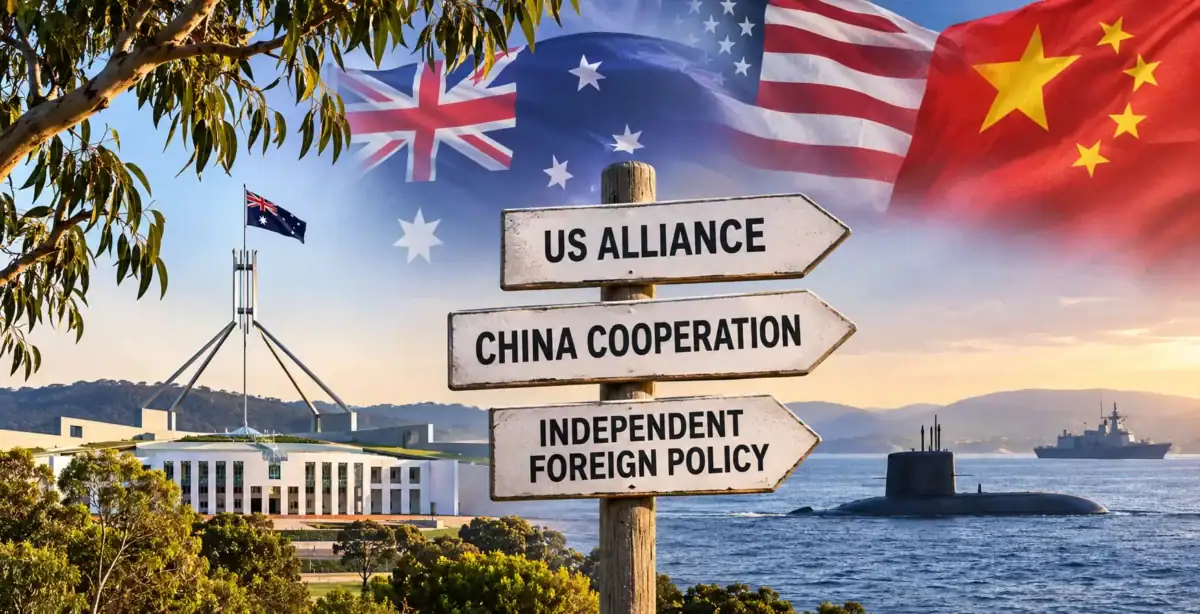
Australian foreign policy, Quad military exercises, AUKUS and China’s Belt and Road Initiative raise a choice about security, sovereignty and regional cooperation.
Quick answer
The November 2026 Quad summit announced a maritime patrol-aircraft exercise for 2027, alongside cooperation in technology, supply chains and regional resilience. This is not proof that Australia has committed to a war against China. It does, however, deepen the practical ties through which Canberra and Washington plan regional security.
Australia can maintain useful defence partnerships while asking harder questions about foreign access to Australian facilities, the cost and strategic purpose of AUKUS, and the diplomatic alternatives.
China’s Belt and Road Initiative offers lessons in infrastructure-led development, but any Australian participation would need transparent contracts, environmental safeguards and an independently defined national interest. [1][2]
A summit that deserves more than a reassuring headline
On 17 November 2026, Anthony Albanese met Donald Trump, Narendra Modi and Sanae Takaichi in Manila for the first Quad leaders’ summit since 2024. Their joint press release said the four countries intended to strengthen cooperation on maritime and transnational security, economic security, technology and disaster response. It announced that P-8 and P-3C maritime patrol aircraft would undertake the first exercise of this kind in a Quad setting in 2027. [1]
The Quad leaders announced plans for expanded military cooperation, including joint maritime surveillance exercises in 2027. Although these initiatives have been widely portrayed as measures to counter China’s growing influence, that framing deserves closer scrutiny.
China’s increasing economic and diplomatic influence does not, by itself, constitute a threat to regional peace. Equally important is examining the United States’ extensive overseas military presence, its history of military interventions and the consequences of drawing Australia further into US strategic competition with China.
For Australia, the central question should not be how closely we can align ourselves with Washington’s military objectives, but whether our decisions genuinely advance Australia’s sovereignty, regional stability and peaceful international cooperation.
Albanese publicly emphasised practical cooperation and rejected the suggestion that the initiative targeted China. Those are different descriptions of the same decision, and readers should be able to examine both rather than being asked to accept slogans about either confrontation or reassurance. [2][3]
Australia already possesses substantial military and civilian capabilities to monitor maritime activity, protect shipping, detect illegal fishing and safeguard its territorial waters. These are legitimate national responsibilities that do not inherently require participation in US-led military initiatives directed towards China.
Rather than automatically expanding military integration with Washington, Australia could invest in strengthening its independent surveillance, intelligence and maritime enforcement capabilities. Cooperation with neighbouring countries could continue where it serves mutually agreed purposes, without obliging Australia to participate in strategic confrontation.
The essential question is whether these arrangements protect Australian interests or progressively reduce our ability to make independent foreign policy and defence decisions.
What does Australia actually owe the United States?
The alliance is often discussed as though the United States must automatically defend Australia in every conflict, or as though Australia must join every American war. Neither reading accurately captures ANZUS. The treaty provides for consultation over threats and for each party to act to meet a common danger through its own constitutional processes. Decisions about Australian force commitments are still political and legal decisions made in Australia. [4]
The alliance also involves substantial intelligence, training, operational planning and equipment integration. Supporters argue that these relationships provide deterrence, advanced capabilities and access that would be difficult for Australia to reproduce alone. The other side of the calculation is dependence: the more deeply platforms, logistics and intelligence systems are integrated, the harder it may become to exercise independent judgement in a crisis.
US military access on Australian soil
Australia does not simply have a collection of ordinary, wholly US-owned military bases. The picture is more complicated and deserves accuracy. Defence has named three facilities jointly operated with the United States, including Pine Gap. US Marines also rotate through Darwin, while other force-posture arrangements provide for training, exercises, and aircraft cooperation at Australian facilities. Canberra says these activities operate by agreement and under Australian sovereignty. [5][6]
That formal position should not end parliamentary scrutiny. The essential questions are operational. Can Australian ministers know in advance what activities are conducted from Australian territory? Can they withhold consent? Would surveillance, communications or logistics from an Australian facility contribute to an overseas strike? Who would make that decision, and how would Parliament find out?
A parliamentary defence inquiry recorded that Marine Rotational Force–Darwin has operated since 2012. Defence has also described plans to expand northern Australian facilities and training areas. These are real, tangible commitments, not merely diplomatic symbolism. [6][7]
The lessons of American military intervention
Distrust of Washington need not rest on the claim that every American military action is identical. Historical examples are sufficient to justify rigorous scrutiny. The 2003 invasion of Iraq went ahead without a new Security Council authorisation expressly approving the use of force. In 2004, United Nations Secretary-General Kofi Annan publicly described the war as not in conformity with the UN Charter. The prolonged conflict showed how claims of security and liberation can lead to grave human costs and regional instability. [8]
Australia’s experience of joining US-led military operations makes the principle of independent assessment particularly important. An Australian government should demand a clear legal basis, demonstrated national interest, plausible objectives, an exit strategy and public accountability before committing personnel or providing facilities for military operations.
The United States keeps a far-reaching network of overseas military installations and access agreements. Comparisons of global base numbers differ because analysts count permanent installations, small sites, rotational access and host-country facilities differently. It is more accurate to examine the network’s reach and purpose than to treat a single disputed number as decisive proof of intent.
AUKUS has costs beyond the submarine price
AUKUS Pillar I is designed to provide Australia with conventionally armed, nuclear-powered submarines. The Australian Government estimates that the AUKUS nuclear-powered submarine program could cost up to $368 billion over several decades. This is not a one-off payment, but an enormous long-term financial commitment.
The money will cover much more than submarines. Australia will also need to train specialist workers, build and maintain shipyards, develop facilities to service nuclear-powered vessels and set up specialised facilities and train personnel to operate nuclear-powered submarines safely, prevent radiation accidents and manage radioactive waste. The program will also make Australia dependent on the United States and Britain for important technology, specialised equipment and ongoing technical support. [9][10]
Are AUKUS submarines really about defending Australia?
Australia is committing hundreds of billions of dollars to nuclear-powered submarines designed for long-distance operations. Yet their size makes them less suitable for shallow coastal waters, including parts of Australia’s northern maritime approaches.
This raises a fundamental question. Are these submarines primarily intended to defend Australia, or to project military power thousands of kilometres from our shores?
The Australian Government argues that long-range submarines will deter potential adversaries and protect vital shipping routes. However, it has not established that Australia faces an imminent invasion, nor publicly shown why nuclear-powered submarines are the most appropriate response to every identified threat.
Australians deserve a clear explanation of precisely what threats these submarines are intended to address, where they would operate and whether their deployment could draw Australia into a conflict involving the United States and China.
Defending Australia and participating in another country’s military confrontation are not necessarily the same thing.
The government argues that long-range submarines will strengthen deterrence and Australian defence capability. Yet unresolved public-interest questions remain: what happens if US shipyards cannot release the expected submarines; what alternative capabilities could the same skilled workforce provide; and how independent will Australia’s maintenance, software, weapons and mission planning become?
The choice is not between defence and no defence. It is between alternative defence strategies, each with resource costs and risks. A stronger national ability to protect sea approaches, cyber infrastructure and critical supply chains could be evaluated alongside long-range power projection rather than excluded from the debate.
China is not only a strategic competitor
China is indispensable to Australia’s economic life. According to the Department of Foreign Affairs and Trade, two-way goods and services trade with China totalled approximately $326 billion in 2025, about one-quarter of Australia’s total trade. It is Australia’s largest trading partner. This relationship supports employment and activity across resources, agriculture, education, tourism and services, even as concentration in any market creates vulnerability. [11]
China’s development record also deserves serious examination. A World Bank study estimated that close to 800 million people in China escaped extreme poverty over roughly four decades under the international poverty line then in use. Industrial investment, public infrastructure, expanding production and integration into international markets helped drive that transformation. This development achievement should not be dismissed because of differences in political systems. [12]
It is equally important not to confuse successful poverty reduction with evidence that every Chinese diplomatic or domestic policy serves the public good. China faces questions about civil liberties, transparency, environmental damage and maritime disputes. An independent Australian policy should apply consistent standards to Beijing and Washington alike, not excuse one power because of the other’s failures.
Could the Belt and Road Initiative offer a different model?
China launched the Belt and Road Initiative in 2013 to support cross-border transport, energy, ports and other connectivity projects. The initiative is not a single treaty or guaranteed pool of grants. Arrangements vary greatly by country, lender, ownership structure, project and financing terms.
The World Bank’s 2019 study found that transport corridors could increase trade and reduce transport barriers, but emphasised that the gains depend on project quality, transparency, open procurement, debt sustainability and safeguards against social and environmental harm. The estimates were modelled opportunities, not proven benefits from every completed project. [13]
Newer research also complicates easy narratives. The Lowy Institute’s 2026 Southeast Asia Aid Map found that China stayed an important infrastructure partner, while new project agreements had slowed. AidData has documented cases where debt pressures led Chinese lenders to provide rescue financing, including contracts with limited transparency. These findings do not show that every Belt and Road loan is a “debt trap”. They do show why public scrutiny and fair loan conditions matter. [14][15]
Australia does not need to enter an all-encompassing strategic alignment with China to cooperate on infrastructure, science or regional development. A project-by-project approach could support rail, clean energy, port logistics or shared projects with Pacific and Southeast Asian governments where benefits are credible, and security issues are manageable.
Why Australia has been wary of Belt and Road agreements
In 2021, the Commonwealth cancelled Victoria’s Belt and Road agreements with China under its foreign arrangements powers, citing consistency with Australian foreign policy. That history matters. Reconsidering the initiative would require a transparent policy change and a clear explanation of why particular proposals now pass Australia’s national-interest tests. [16]
Any proposed cooperation should publish ownership arrangements, commercial liabilities, procurement criteria, environmental assessments and dispute-resolution mechanisms. Infrastructure is valuable only when communities receive durable benefits and keep democratic control over essential assets.
The South China Sea and the limits of simple narratives
Several Southeast Asian governments have their own grievances with Beijing, independent of Washington. A tribunal set up under the UN Convention on the Law of the Sea issued a 2016 award in the Philippines–China arbitration, rejecting the legal basis for certain expansive Chinese maritime entitlements. China rejected the decision. The tribunal did not decide sovereignty over all disputed islands. [17]
Australia should support peaceful settlement and lawful navigation without treating ASEAN countries as passive pieces on an American or Chinese chessboard. The Quad itself has reaffirmed ASEAN centrality. The region’s governments have agency and often want economic relations with China alongside varied security partnerships. [1]
Avoiding military confrontation requires more than rejecting one side’s account. It requires practical crisis communications, negotiated maritime conduct, fisheries protection, diplomatic engagement and a refusal to make war appear inevitable.
Australia has a choice beyond following Washington or Beijing
The most useful question is not which superpower Australia should copy. It is what Australia can do itself, and with its neighbours, to protect people and reduce conflict. A genuinely independent policy could rest on the following commitments.
Make foreign military access accountable
Parliament should receive regular, meaningful reporting on the purposes and legal limits of foreign access arrangements, while protecting necessary operational secrets. Publicly articulated consent rules should explain how Australian facilities can and cannot support overseas hostilities.
Assess defence procurement against alternatives
Major programs should be independently tested against realistic strategic scenarios, delivery risks, sovereign sustainment, workforce capacity and alternative investments. The aim is national security, not automatic acceptance of any technology or alliance structure.
Treat regional development as security policy
Work with Pacific and Southeast Asian countries on ports, water, clean energy, climate adaptation, transport, health and education, offering transparent terms and genuine local decision-making. China, the United States and other partners can contribute where recipient countries choose, and proper safeguards exist.
Keep trade and diplomacy open
Protect economic relationships with China while diversifying suppliers, export markets and technical partnerships. Australia can cooperate on trade and climate even when governments disagree on territory, human rights, or military affairs. Diplomacy is not surrender; it is a way to manage differences before they become wars.
Use Australia’s economic capacity for Australian priorities
As the issuer of the Australian dollar under a floating exchange rate, the Commonwealth is not financially constrained in the same way as a household. That does not make submarines, public housing or hospitals costless. Engineers, shipyards, nurses, materials, imports and productive capacity are finite; poorly planned spending can intensify inflation or crowd out other activity. Defence choices therefore require an honest comparison of real resources and public benefits, not only a headline dollar figure.
Conclusion: independent security requires independent decisions
The Manila Quad announcement is not itself a declaration of conflict with China. But it is another step in a long process of integrating Australia into US-centred security planning. That integration can create capabilities and reassurance; it can also narrow choices in a crisis. Australians deserve to know which result their government is buying and which risks it is accepting.
China’s poverty reduction and infrastructure diplomacy offer worthwhile lessons, while Belt and Road financing and maritime disputes demand examination rather than romanticism. The United States is still an important partner, but partnership is not an obligation to endorse every American strategy. Australia’s responsibility is to judge each proposal by its legality, consequences, costs and contribution to a peaceful region.
A mature Australian foreign policy would be neither anti-American nor uncritically pro-Chinese. It would be answerable first to Australians, respectful of neighbouring countries and prepared to build peace through diplomacy as well as defence.
Frequently asked questions
Does the Quad require Australia to fight China?
No. The Quad is a diplomatic and practical cooperation grouping, not a mutual-defence treaty. The 2027 maritime surveillance exercise is an announced activity, not a commitment to enter a war. [1]
Are US bases in Australia American territory?
Not generally. Australian facilities host rotations and agreed activities, while Pine Gap is a joint facility. Sovereignty, access rights and operational decision-making are related but distinct questions. [5][6]
Would joining Belt and Road require ending ANZUS?
No automatic legal connection exists between an infrastructure cooperation arrangement and the ANZUS treaty. Whether projects conflict with security obligations or national-interest policies would need examination.
Does China’s poverty reduction prove its political model is superior?
It shows a major socioeconomic achievement, not a universal verdict on political systems. Governance, rights, distribution, environmental outcomes and long-term stability require separate evidence. [12]
Reader discussion
What safeguards would convince you that Australia could cooperate more deeply with Asian neighbours while keeping independent control over its defence decisions? Please share evidence, experiences or respectful disagreement in the comments below.
If this article has been useful, explore related analysis at Social Justice Australia and share it with others interested in peace, accountability and economic sovereignty. An optional donation helps support independent research and publishing. Click the Reader Feedback menu to send a testimonial or leave a comment below.
Sources
[1] White House. Quad Leaders’ Summit Joint Press Release. 17 November 2026. Source link
[2] ABC News. Donald Trump praises Anthony Albanese as Quad leaders unveil new defence and critical minerals deals. 18 November 2026. Source link
[3] The New Daily. Albanese expects no China blowback after Trump meeting. 18 November 2026. Source link
[4] Department of Foreign Affairs and Trade. United States of America country brief, ANZUS explanation. Accessed 18 November 2026. Source link
[5] Department of Defence. Securing Australia’s Sovereignty. 9 February 2023. Source link
[6] Parliament of Australia. Australian international defence cooperation and competition, Chapter 7. 2026. Source link
[7] Parliament of Australia. Progress on the transformation to an integrated focused force, Chapter 2. 2026. Source link
[8] United Nations. Noon briefing on the Secretary-General’s remarks concerning the Iraq war. 16 September 2004. Source link
[9] Australian Defence Ministers. Radio Interview, ABC Perth, AUKUS estimate. 11 September 2026. Source link
[10] Australian Defence Ministers. Building the workforce delivering Australia’s future nuclear-powered submarine capability. 12 November 2026. Source link
[11] Department of Foreign Affairs and Trade. China country brief. Trade figures for 2025, updated 2026. Source link
[12] World Bank. Lifting 800 Million People Out of Poverty. 1 April 2022. Source link
[13] World Bank. Managing the risks of the Belt and Road. 20 June 2019. Source link
[14] Lowy Institute. 2026 Southeast Asia Aid Map Report. October 2026. Source link
[15] AidData. Debt Distress on China’s Belt and Road. 30 May 2023. Source link
[16] Australian Minister for Foreign Affairs. Interview with Ben Fordham, Belt and Road agreements. 22 April 2021. Source link
[17] Permanent Court of Arbitration. The South China Sea Arbitration, case documents and award. 12 July 2016. Source link
#AustralianForeignPolicy #AustralianSovereignty #AUKUS #IndoPacific
Verified related coverage: End US Military Basing in Australia
Further reading: US Military Bases in Australia: The Cost to People and Planet