
Description
How US military bases in Australia support destructive wars, damage the environment and draw us closer to conflict with China.
The United States presents its worldwide military presence as a force for peace, freedom and international security. Australian governments repeat this message so consistently that the alliance is rarely subjected to serious public scrutiny.
Yet military power should be judged by its consequences, not its slogans.
US-led wars have contributed to millions of deaths, displaced entire populations and destroyed hospitals, water systems, electricity networks and livelihoods. Military operations have poisoned land and water, consumed immense quantities of fossil fuel and produced greenhouse emissions comparable with those of entire countries.
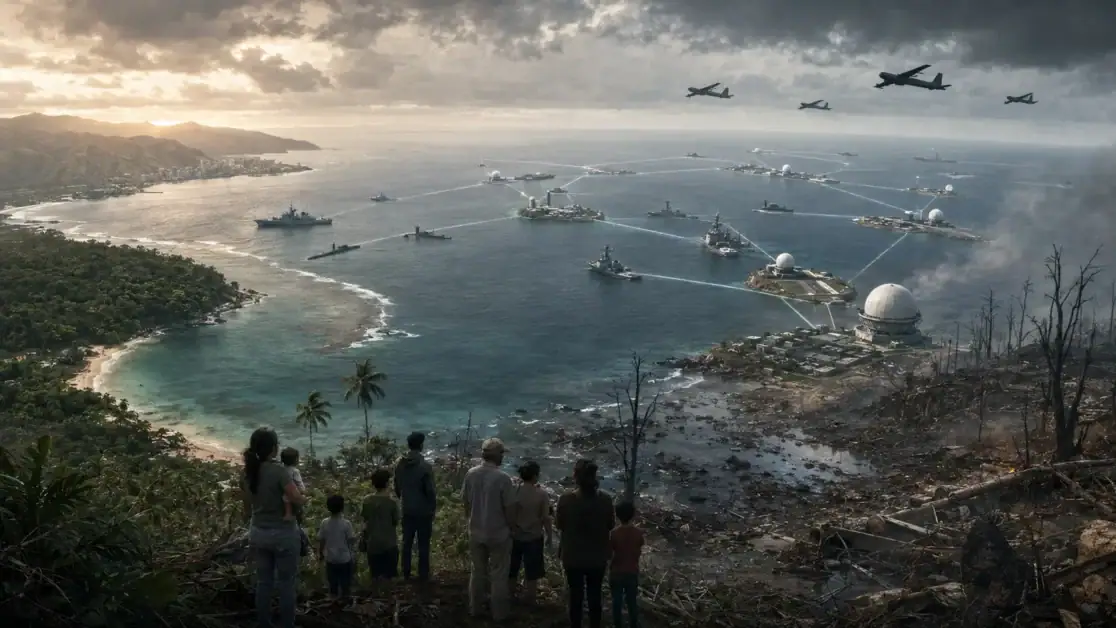
The United States also maintains a vast network of military facilities, forces and access agreements across the world. In the Indo-Pacific, these stretch through Japan, South Korea, Guam, the Philippines and Australia, forming an expanding military arc around China.
China’s military development and increasingly forceful conduct are commonly presented as the reason for this expansion. That explanation omits an essential part of the story: much of China’s military build-up has occurred in response to decades of American military power positioned close to its coastline.
This has created a dangerous cycle. Washington expands its regional forces to contain China. Beijing responds by strengthening its missiles, navy and air force. The Chinese response is then cited as proof that still more American bases, weapons and alliances are necessary.
Australia is becoming deeply embedded in this confrontation. Governments led by both major parties have supported US-led wars, provided intelligence through Pine Gap and expanded America’s military access to Australian territory.
The question Australians must ask is not whether China is perfect or whether the United States is always wrong. It is whether turning Australia into a major operating platform for the US military makes us safer—or places our sovereignty, environment and future at greater risk.
Criticising militarism is not anti-American
Criticism of US militarism is not hostility towards the American people or individual military personnel.
Many Americans have opposed their country’s wars. US veterans, journalists, academics, whistleblowers and peace organisations have exposed civilian casualties, torture, misleading intelligence, government secrecy and environmental contamination.
Nor is the United States responsible for every war or injustice in the world. Other governments, armed groups and terrorist organisations have committed terrible crimes.
The problem is a political and economic system that repeatedly treats military force as a normal instrument of foreign policy while weapons manufacturers, military contractors and strategically connected corporations benefit.
Every country has a legitimate right to defend its people. Defence becomes militarism when military power expands beyond genuine national protection and is used to dominate regions, overthrow governments, control resources or enforce a preferred international order.
The human cost of America’s post-9/11 wars
The human consequences of the “war on terror” are staggering.
Brown University’s independent Costs of War project estimates that more than 940,000 people were killed directly by violence in the major post-9/11 war zones of Afghanistan, Pakistan, Iraq, Syria and Yemen between 2001 and 2023. More than 432,000 were civilians.
Researchers estimate that a further 3.6 to 3.8 million people died indirectly, producing a combined toll of at least 4.5 to 4.7 million deaths.
Indirect deaths occur when war destroys the systems people need to survive. Hospitals lose electricity and medicine. Water and sewage systems fail. Food production collapses. Disease spreads, children become malnourished and families are driven from their homes.
These figures include deaths caused by numerous governments, militias, insurgents and terrorist organisations—not solely American forces. Nevertheless, the conflicts were initiated, shaped or intensified by US invasions, bombing, occupation, arms supplies and counterterrorism policies.
Brown University also estimates that at least 38 million people were displaced during the post-9/11 wars it studied. Many lost their homes, livelihoods, communities and family members.
The suffering did not end when American troops departed. Destroyed institutions, unexploded weapons, damaged ecosystems, political instability and untreated trauma can continue harming people for generations.
Iraq: a warning Australia ignored
The 2003 invasion of Iraq remains one of the clearest warnings against automatically following Washington into war.
The United States, Britain and Australia invaded Iraq on the central claim that Saddam Hussein possessed weapons of mass destruction. The predicted stockpiles were not found.
Britain’s official Iraq Inquiry later concluded that peaceful options had not been exhausted and military action was not a last resort. The invasion proceeded without a new United Nations Security Council resolution explicitly authorising force.
Saddam Hussein headed a brutal dictatorship. Recognising that fact does not justify an invasion based on claims that proved wrong or erase the consequences.
The war dismantled Iraqi institutions, intensified sectarian conflict and contributed to the conditions from which Islamic State emerged. Civilians endured years of bombing, terrorism, displacement, unemployment and failing essential services.
Australia’s participation was presented as serving our national interest. It also demonstrated how maintaining favour in Washington can influence Australian decisions.
Australia has never held a comprehensive, independent inquiry comparable with Britain’s Iraq Inquiry. A democracy that refuses to examine a disastrous war leaves itself vulnerable to repeating the same mistakes.
Vietnam’s poisonous legacy
The damage caused by American warfare did not begin after September 2001.
During the Vietnam War, the US military sprayed more than 19 million gallons of herbicides and defoliants across rural areas of Vietnam, Laos and Cambodia. These chemicals were intended to destroy vegetation and food sources.
The US Department of Veterans Affairs acknowledges the enormous scale of the spraying and recognises numerous diseases associated with Agent Orange exposure. US Veterans Affairs research
Forests, farmland and ecosystems were damaged. Vietnamese communities and American, Australian and allied veterans suffered long-lasting health consequences.
Australia contributed troops to the Vietnam War in support of the United States. The conflict demonstrated how alliance loyalty, ideological fear and exaggerated threat assessments could draw Australia into a destructive intervention far from any direct attack on our country.
Nuclear testing in the Pacific
Between 1946 and 1958, the United States conducted 67 atmospheric nuclear tests in the Marshall Islands.
The US Department of Energy acknowledges that radioactive fallout contaminated the environment with caesium-137, strontium-90, plutonium and other radioactive materials. Some remain hazardous for generations. US Department of Energy report
For Marshallese communities, nuclear testing was not an abstract exercise in deterrence. People were displaced from ancestral lands, exposed to radiation and left with contaminated food sources and continuing uncertainty about their environment.
This history illustrates a recurring injustice. Powerful nations frequently locate their most dangerous military activities on the lands of Indigenous, colonised or politically marginalised peoples.
The military’s enormous carbon footprint
Military aircraft, warships, armoured vehicles and international supply networks require immense quantities of fossil fuel.
The US Department of Defense reported 51 million tonnes of carbon-dioxide-equivalent emissions in 2021 from its Scope 1 and Scope 2 activities. Jet fuel accounted for half of the total.
That figure excluded much of the military supply chain, including emissions generated while manufacturing weapons, vehicles, aircraft and other equipment. US Department of Defense emissions plan
Brown University researcher Neta Crawford estimated that the US military produced approximately 1.2 billion tonnes of greenhouse emissions between 2001 and 2017, including more than 400 million tonnes associated with war-related fuel consumption. Pentagon Fuel Use and Climate Change
Scientists for Global Responsibility and the Conflict and Environment Observatory estimate that the world’s militaries may be responsible for approximately 5.5 per cent of global greenhouse emissions. This remains an estimate because military reporting is incomplete and frequently excludes supply chains and wartime destruction. Military emissions study
Even these figures do not capture the full climate cost of war. Destroyed cities must be reconstructed with carbon-intensive cement and steel. Forests and fuel facilities burn. Agricultural land is damaged. Supply chains are disrupted and damaged electricity systems may become dependent on dirtier fuels.
Governments cannot credibly declare a climate emergency while treating military emissions as secret or secondary.
Toxic contamination around military facilities
Military pollution is not confined to battlefields.
Bases store enormous quantities of fuel, explosives, solvents and firefighting chemicals. Accidents, leaks and decades of unsafe disposal can contaminate groundwater and surrounding communities.
At the US Navy’s Red Hill facility in Hawai‘i, fuel leaks during 2021 contaminated drinking water serving approximately 93,000 military personnel and civilians. A US Government Accountability Office investigation found that Navy personnel accidentally caused two leaks. US Government Accountability Office
Australia has its own warning.
The Department of Defence acknowledges that PFAS contamination originating from RAAF Base Tindal is a significant issue for the Katherine community. Monitoring and remediation continue. Australian Defence Department
This contamination cannot simply be attributed to the current American presence. It resulted from historical Defence use of firefighting foams. Nevertheless, it demonstrates the environmental risks associated with military activity.
Expanding fuel storage, aircraft operations, weapons facilities and training ranges requires strict independent environmental oversight. Military necessity must never become an excuse for weaker environmental standards.
America’s expanding military network around China
Public discussion in Australia usually begins with the claim that China is expanding militarily and the United States is merely responding.
The historical and geographical picture is more complicated.
For decades, the United States has maintained major forces and facilities in Japan, South Korea and Guam. It operates warships and surveillance aircraft near China and provides extensive military support to Taiwan.
US access in the Philippines has expanded, giving American forces use of strategically located sites close to Taiwan and the South China Sea. Australia is providing access for US bombers, Marines, submarines, surveillance aircraft and military supplies.
Together, these positions form an arc along what military strategists call the first and second island chains. The first runs broadly through Japan, Taiwan and the Philippines. The second extends towards Guam and the wider western Pacific.
American military analysts discuss these chains as a way to restrict China’s naval access to the Pacific and position forces for a possible war. A RAND Corporation study explains that Chinese military planning has focused heavily on preventing US forces from operating within the first island chain. RAND Corporation
Research from Harvard’s Belfer Center has also warned that an American strategy based on attacking Chinese mainland bases could create pressure for China to strike first during a crisis. Harvard Belfer Center
From Beijing’s perspective, American bases, intelligence facilities, naval patrols, bomber deployments, alliances and missile systems represent a long-standing threat close to Chinese territory.
This does not prove that every Chinese military decision is defensive or justified. China has its own strategic ambitions, unresolved territorial disputes and responsibility for its conduct towards neighbouring countries.
But China’s military expansion did not occur in a vacuum. It has been substantially shaped by the presence of a much older and more extensive American military system around its coastline.
The dangerous security dilemma
The confrontation between the United States and China is an example of what international-relations scholars call a security dilemma.
One country takes military action it describes as defensive. The other sees that action as threatening and responds. Each response increases the insecurity of the other.
The cycle operates like this:
- The United States expands bases, surveillance, alliances and weapons deployments near China.
- China develops missiles, warships and defensive systems intended to keep American forces at a distance.
- Washington portrays China’s response as evidence of aggressive expansion.
- The United States then builds more bases and deploys additional forces.
- China responds again, producing an escalating regional arms race.
Both sides claim to be deterring war while preparing more intensively to fight one.
Australia’s growing military integration with the United States does not simply protect us from an already existing Chinese threat. It also makes Australia part of the system generating that threat.
Facilities for American bombers, submarines, intelligence gathering, fuel and weapons communicate to China that Australian territory would support US operations during a conflict. China consequently has an incentive to include Australian facilities in its military planning.
The policy presented as making Australia safer could therefore make us a more likely target.
Australia as America’s southern military platform
The Australian Government says that US forces operate here at Australia’s invitation and that Australian sovereignty remains intact.
Most facilities used by American forces remain legally Australian bases rather than sovereign American territory. Pine Gap is officially a joint Australian–American facility. US Marines rotate through Darwin rather than being described as permanently stationed there.
Those distinctions are legally important—but they do not resolve the practical question.
Defence Minister Richard Marles acknowledged in 2024 that American force posture in Australia involved “every domain; land, sea, air, cyber and space.” He confirmed that a US logistics base had been established at Bandiana and that America’s presence was being deepened. AUSMIN press conference
Current agreements and projects include:
- US Marine rotations through Darwin
- American bomber, fighter and surveillance-aircraft rotations
- visits by US nuclear-powered submarines
- the planned Submarine Rotational Force–West
- pre-positioned American fuel, munitions and military stores
- expanded runways and aircraft parking areas
- explosive-ordnance storage
- fuel facilities at Darwin and RAAF Base Tindal
- expanded training areas and weapons ranges
- increased land, maritime, cyber and space cooperation.
The Defence Department confirms that works at Tindal include bulk fuel storage and infrastructure supporting American aircraft. Northern Territory range upgrades are valued at $747 million. Defence infrastructure projects
In December 2025, Marles referred openly to the “growing American footprint in Australia” and announced further infrastructure supporting increased rotations of US fighters, bombers and surveillance aircraft, along with pre-positioned Osprey aircraft. AUSMIN 2025
Saying that America has simply constructed sovereign US bases in Australia would be legally imprecise. But claiming that Australia hosts no meaningful American basing presence is equally misleading.
Whatever terminology governments use, Australia is being developed as a platform from which US forces can train, store supplies, gather intelligence, maintain equipment and conduct regional operations.
Pine Gap and democratic accountability
Pine Gap near Alice Springs is one of the most important US–Australian intelligence facilities in the world.
Its publicly acknowledged functions include satellite intelligence, communications interception, missile-launch detection and support for arms-control verification. These capabilities can provide Australia with valuable intelligence and early warning.
Much of Pine Gap’s operation, however, remains classified.
Research by the Nautilus Institute describes extensive integration between Australian personnel and US agencies, including the National Security Agency, Central Intelligence Agency and National Reconnaissance Office. Researchers have linked Pine Gap-derived intelligence to American military operations and drone targeting.
The Australian Government maintains that activities at joint facilities occur with Australia’s “full knowledge and concurrence.” The public cannot independently test that assurance because the operational details remain secret.
If intelligence collected in Australia contributes to targeting or military action overseas, Australians deserve to know what approval process exists, what legal standards apply and whether our government can refuse a particular use.
Secrecy may sometimes be necessary to protect intelligence methods. It must not eliminate democratic accountability.
Does the alliance make Australia safer?
Supporters of the alliance raise legitimate considerations.
American intelligence and military capability may deter some forms of attack. Joint training can improve Australian skills. US forces can assist with disaster relief, maritime rescue and regional emergencies. Pine Gap can provide early warning of missile launches.
These benefits must be weighed against the risks.
Hosting facilities that support US bombers, submarines, intelligence and regional operations may turn Australia into a target during a major war. Deep integration can also make it extremely difficult for Australia to remain outside a conflict initiated by Washington.
The ANZUS Treaty does not require Australia to participate automatically in every American war. It says each country will respond to a common danger “in accordance with its constitutional processes.” ANZUS Treaty
An alliance should provide consultation and cooperation—not surrender Australia’s right to reach an independent decision.
Support is not literally unconditional—but it is too automatic
Australia has not supported every American policy. Describing the alliance as literally unconditional would be historically inaccurate.
The deeper problem is that Australian governments appear unwilling to establish clear public limits.
The alliance is routinely described as “unbreakable,” while those who question it are portrayed as irresponsible or sympathetic to an enemy. Major military agreements are presented as accomplished decisions rather than choices requiring public consent.
Australia followed the United States into Vietnam, Afghanistan and Iraq. It hosts intelligence and military infrastructure central to American regional strategy. AUKUS further integrates our defence forces, industries and technology with those of the United States and Britain.
The danger is not merely that Australia might consciously choose to join another American war. Intelligence dependence, shared facilities, pre-positioned equipment, weapons compatibility and operational planning may make non-participation practically impossible.
That is not an equal alliance. It is strategic dependency.
Australia can afford a more peaceful strategy
Military expansion is presented as financially unavoidable while public housing, healthcare, environmental restoration and poverty reduction are treated as costs Australia cannot afford.
That argument misunderstands Australia’s monetary system.
The Australian Government issues the Australian dollar. It cannot run out of its own currency in the way a household, business or state government can. Its genuine constraints are available workers, skills, technology, energy, materials and ecological capacity—and the inflation that may occur when total spending exceeds those productive limits.
This does not mean governments can spend without consequences. It means the real question is how Australia uses its available resources.
Engineers designing weapons cannot simultaneously design renewable infrastructure. Skilled tradespeople constructing military facilities are unavailable to build housing and hospitals. Steel, concrete, energy and land committed to militarisation cannot be used elsewhere at the same time.
Australia has the financial capacity to provide genuine national defence while investing in diplomacy, climate protection, public housing, healthcare, foreign aid and regional development.
What is missing is not money. It is a political commitment to place human and environmental security ahead of military expansion.
What an independent Australian policy should require
Australia does not need to become isolated or hostile towards the United States. It needs a more equal, transparent and peaceful relationship.
Reform should include:
- Parliamentary approval before overseas wars, except when immediate action is required to defend Australia from attack.
- An independent inquiry into Australia’s participation in the Iraq War, including the intelligence used and the decision-making process.
- A public review of Pine Gap, the Force Posture Agreement and AUKUS, releasing as much information as genuine security permits.
- A binding requirement that Australian territory cannot support an overseas attack without explicit Australian authorisation.
- A prohibition on foreign nuclear weapons entering or being stored in Australia.
- Independent environmental assessments covering foreign fuel, weapons, aircraft, submarine and training activities.
- Full reporting of military greenhouse emissions, including supply chains and major exercises.
- Polluter-pays requirements ensuring military partners fund contamination prevention, monitoring and remediation.
- Greater investment in diplomacy, peacebuilding, climate cooperation and Pacific development.
- A regional policy aimed at reducing both US and Chinese military escalation, including confidence-building measures, arms-control negotiations and crisis-communication arrangements.
- A genuinely defensive Australian force, designed to protect Australia rather than operate as part of another country’s global military system.
Security must mean more than preparing for war
Real security means more than bombers, missiles and submarines.
A secure society ensures that people have housing, healthcare, education, meaningful employment, clean water and a liveable environment. A secure region resolves disputes through diplomacy and international law rather than an escalating competition in weapons.
Chinese military pressure should not be examined separately from the American military system positioned around China. Nor should Beijing’s actions be used automatically to justify every new US base, submarine arrangement or weapons facility in Australia.
Washington’s strategy of containment encourages China to strengthen its military. China’s response gives Washington justification for further expansion. Australia is helping perpetuate this dangerous cycle.
The United States is separated from China by the Pacific Ocean. Australia is part of China’s region. China is a major trading partner and will remain a powerful country regardless of whether Australians approve of its political system.
Our long-term security therefore depends on peaceful coexistence, regional cooperation and an independent foreign policy—not on helping one great power prepare for war against another.
Australia can remain friendly with the American people while refusing automatic participation in American wars. It can cooperate on genuine defence while protecting its sovereignty. It can provide for national security without allowing military activity to escape democratic and environmental accountability.
The choice Australians face is increasingly clear:
Do we want an independent country working to prevent war—or an operating platform for a foreign military preparing to fight one?
If you found this article insightful, explore more about political reform and Australia’s monetary sovereignty on Social Justice Australia.
Share this article with your community to help drive the conversation towards a more just and equal society.
Click the Reader Feedback menu and tell us how our content has inspired you. Submit your testimonial and help shape the conversation today.
Additionally, leave a comment about this article below.
Support Independent Analysis
Social Justice Australia receives no funding from corporations, political parties or lobbyists. Reader support helps keep every article independent, evidence-based and freely available.
Support Social Justice Australia with a one-time or monthly contribution.
Thank you for helping sustain independent, ad-free and reader-funded public-interest analysis.