
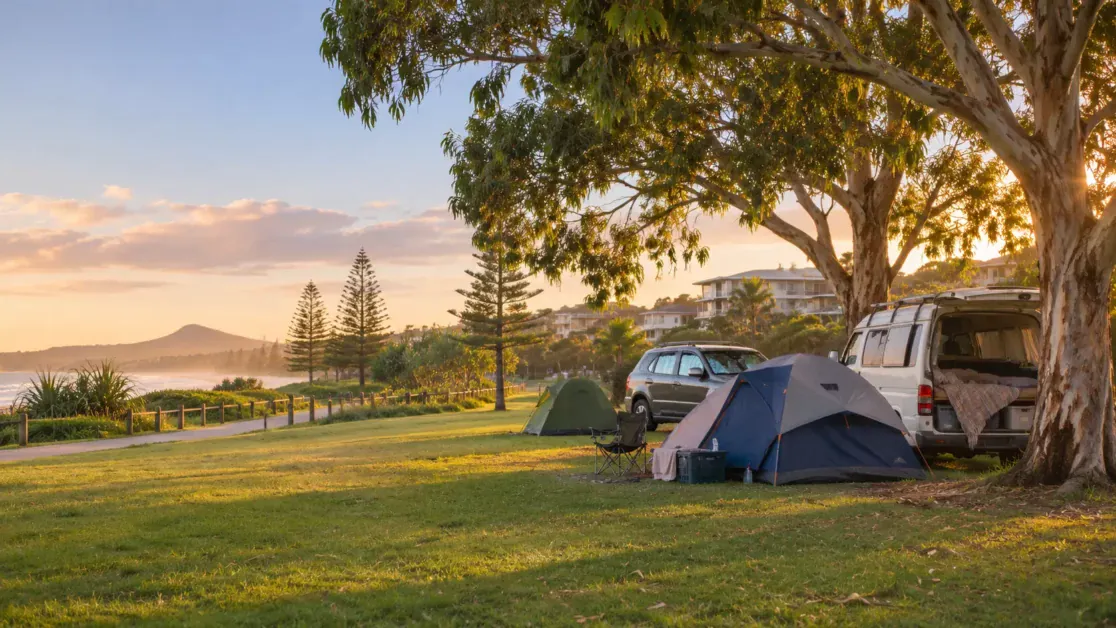
When tents become part of the landscape
Drive through parts of the Sunshine Coast and the housing crisis is no longer an abstract debate. Tents in parks and people living in vehicles are visible reminders that some Australians lack a secure place to sleep. We cannot know the circumstances of people we pass from a car window. But we can ask why a region known for beaches, tourism and growing prosperity has people relying on public spaces for shelter.
A tent is not a home. A car is not a substitute for a secure tenancy. For people experiencing homelessness, everyday activities—resting safely, taking medication, washing clothes, maintaining work and staying connected with family—can become extraordinarily difficult. There are also legitimate concerns about the safety and accessibility of shared public spaces. Public policy must address both, without treating the loss of housing as wrongdoing.
This article examines what the evidence tells us, what governments have promised, and the questions citizens can ask to determine whether those promises are producing permanent homes.
How serious is Sunshine Coast homelessness?
The 2021 Census estimated 1,205 people experiencing homelessness in the Sunshine Coast local government area, compared with 785 in 2016—an increase of 54 per cent. These are the most recent comparable Census figures for the local government area, not a count of everyone sleeping in parks today. [1]
The distinction matters. The Australian Bureau of Statistics defines homelessness more broadly than rough sleeping. It includes some people in severely crowded dwellings, supported accommodation and other insecure living arrangements. Conversely, a point-in-time count may miss people moving between vehicles, temporary stays and other locations. The number of visible tents cannot reliably tell us how many people in the region are homeless. [2]
In August 2025, ABC reporting documented concerns about people living in Nambour parks, including the experiences of a woman sleeping rough and the competing concerns of nearby residents. It showed why this is both a housing and community wellbeing issue, not merely a matter of enforcing park rules. [3]
Why are people losing secure housing?
There is no single pathway into homelessness. Some people are displaced when rent rises, or a tenancy ends. Others face family and domestic violence, relationship breakdown, unemployment, illness, financial hardship or a shortage of accessible accommodation. Those experiences differ, but they become much harder to resolve when affordable alternatives are scarce.
National figures from the Australian Institute of Health and Welfare show the scale of these pressures. In 2024–25, family and domestic violence and housing crisis were among the leading main reasons people approached specialist homelessness services. The number reporting housing affordability stress as their main reason had risen markedly over the previous decade. These are national service-use statistics; they do not identify the reason for homelessness of any particular person living in a Sunshine Coast park. [4]
The region’s council also reports that essential workers in healthcare, retail, hospitality and education face substantial housing stress and that many cannot afford to buy locally. If people who keep hospitals, shops and schools running struggle to secure housing, the problem extends well beyond those already sleeping rough. [5]
Queensland’s rental market remains constrained. The Real Estate Institute of Queensland reported in October 2026 that 48 of 50 monitored regions had vacancy rates between zero and 2.5 per cent in the September quarter. It also recorded renewed tightening in some Sunshine Coast submarkets. A tight market leaves households with fewer options when they need to move. [6]
What are governments doing—and what is still missing?
Sunshine Coast Council
Sunshine Coast Council adopted its Housing and Homelessness Action Plan in July 2023. Its priorities include facilitating diverse housing, supporting community-led responses and advocating for more accommodation. A 2025 progress update is available, and the council has identified eleven development-ready residential properties for a Marcoola affordable housing project. Identifying sites and publishing plans are useful, but readers should also ask how many homes have been completed, whether they are affordable to people in greatest need, and when residents can move in. [5]
Queensland Government
Queensland’s Nambour Homelessness Response includes expanded outreach support, a planned 20-place crisis and transitional accommodation project, and eight new social homes in partnership with Coast2Bay Housing Group. The department described these measures as initiatives to be delivered—not proof that all beds and homes were occupied by the publication date of this article. [7]
A particularly revealing debate concerns people sleeping in cars. In November 2026, Sunshine Coast News reported that Sunshine Coast and Noosa councils backed a proposal to use suitable vacant state land for supported overnight parking. The Queensland Government declined to pursue the model, saying it would continue to focus on housing supply and existing homelessness services. Safe parking could reduce immediate risks for people already in vehicles, but it cannot replace secure housing. [8]
The same report recorded the department’s statement that 277 social and affordable homes were underway in the Sunshine Coast region and that nearly $15.9 million had been committed to five organisations providing fourteen specialist homelessness services during 2025–26. Those figures describe a project pipeline and service funding, not the number of residents who have moved into permanent housing. [8]
Statewide, Queensland’s OpenHome dashboard recorded 24,454 active households on the social housing register as at 31 August 2026, and 7,018 social and affordable homes under construction or contract. The latter category includes homes not yet under construction. These statewide figures demonstrate activity and continuing demand; they should not be confused with a Sunshine Coast waiting-list figure. [9]
Australian Government
The Commonwealth has announced a goal of 55,000 social and affordable homes by mid-2029 through several programs, including the Housing Australia Future Fund and Social Housing Accelerator. Its May 2026 national housing plan also covers rental security, the private market and expansion of social and affordable housing. These national measures deserve scrutiny for the number of homes actually delivered in places such as the Sunshine Coast, not just their announced totals. [10]
Why temporary accommodation cannot be the whole answer
Emergency accommodation, outreach teams and temporary safe parking can protect people from immediate harm. They are necessary parts of a humane response. But they cannot resolve homelessness if people have nowhere affordable to go when temporary arrangements end.
A lasting response needs enough homes people can actually afford, including publicly owned and community-managed housing; accessible properties for people with disability; and supportive housing for residents who need ongoing assistance. Early intervention matters too: rental support, help to resolve tenancy problems and prompt responses to domestic violence can prevent a housing crisis from becoming homelessness.
A transparent local housing program should report not only approvals and announcements, but completions, occupancy, waiting times, affordability, accessibility and whether people remain housed. Those are outcomes residents can understand and compare over time.
Could Australia build more public housing?
Australia’s Commonwealth Government issues the Australian dollar. That gives it fiscal capacity different from a household or a state government that does not issue its own currency. The meaningful question is not simply whether the Commonwealth can “find the money”; it is how public spending can mobilise available land, skilled labour, building materials and infrastructure without worsening inflationary pressure or displacing other essential construction.
This does not mean construction is instant or unlimited. Planning rules, water and transport connections, workforce shortages and climate resilience are real constraints. But those constraints call for coordinated long-term investment, training, land-use planning and transparent delivery targets—not an assumption that persistent homelessness must be accepted.
Local and state governments also have important roles in development approvals, land, housing management, emergency accommodation and support services. Cooperation across all three levels of government is essential because responsibility is shared even when budgets and powers differ.
What would a credible local housing response look like?
First, publish a clear Sunshine Coast account of need: the number of people sleeping rough, households seeking social housing, projected demand, available emergency places and the limitations of each measure. This should protect individual privacy while allowing the community to see whether conditions improve.
Second, publish a delivery timetable. Residents should be able to distinguish housing that is promised, contracted, under construction, completed and occupied. Separating social housing from broader “affordable” housing would also help people understand who is eligible for each project.
Third, increase permanent housing pathways alongside immediate support. That includes purpose-built social housing, community housing partnerships, the use of suitable publicly owned land and supported accommodation for people who require additional care.
Fourth, involve residents who have experienced homelessness in designing responses. Their knowledge can identify barriers that are easy to miss, such as storage, transport, identification documents, access to health care, and staying connected to employment.
Finally, maintain parks as safe, shared spaces while treating homeless residents with dignity. Moving people from one park to another without an alternative place to live does not demonstrate that homelessness has been reduced.
What can citizens do right now?
A useful first step is to request specific information rather than accept broad claims from any level of government.
- Ask your Queensland MP: How many new social homes have been completed and occupied in the Sunshine Coast area during the past twelve months? How many are scheduled for the next twelve months? What is being done for people currently sleeping in cars or tents?
- Examine the evidence: Read the Sunshine Coast Council housing action plan and 2025 progress report, and compare promises with the Queensland OpenHome dashboard. Ask council and the department for locally disaggregated numbers if they are not publicly available.
- Participate constructively: Watch for relevant parliamentary inquiries and local consultation opportunities. Share factual observations or lived experiences without photographing or identifying vulnerable people without permission. You can also ask elected representatives to explain their response in writing.
For a practical guide and example letter, visit Social Justice Australia’s Take Action page: https://socialjusticeaustralia.com.au/take-action/.
The question our community should keep asking
Encouraging examples of cooperation exist between government, housing providers, and local organisations. Yet plans, pipelines and temporary support are not the same as a safe, permanent home. The most revealing measure is whether fewer people are forced to rely on tents, cars and insecure arrangements over time.
The Sunshine Coast should not be judged by how quickly tents disappear from public view, but by whether the people who lived in them have somewhere secure and affordable to go.
What housing change would make the greatest difference in your community—and what evidence would convince you that the government is delivering on its promises? Share your experience, evidence or respectful disagreement in the comments.
If you found this article useful, share it with your community, explore further analysis at https://socialjusticeaustralia.com.au/ and visit our Take Action page. You can also use Reader Feedback to report constructive steps you have taken and responses received. Donations to support independent public-interest analysis are welcome but entirely optional.
#SunshineCoast #HousingCrisis #Homelessness #SocialHousing
Frequently asked questions
How many people are homeless on the Sunshine Coast?
The 2021 Census estimated 1,205 people experiencing homelessness in the Sunshine Coast local government area. It is not a live count and includes more than people sleeping rough. [1, 2]
Does homelessness mean sleeping in a tent?
Not necessarily. Australia’s statistical definition also includes certain overcrowded and insecure accommodation situations, so visible tents show only one part of homelessness. [2]
Who is responsible for social housing in Queensland?
The state government leads social housing and homelessness services. Councils influence planning and local responses, while the Commonwealth helps finance housing and shapes national policy. [5, 7, 10]
What should someone do if they need emergency accommodation?
In Queensland, call the Homeless Hotline on 1800 474 753 for information and referrals. Availability is not guaranteed; contact the service for current options. [11]
Can safe parking solve homelessness?
Supported parking may offer short-term safety and access to services for people living in vehicles. It does not replace permanent affordable housing. [8]
Authoritative sources and further reading
- Sunshine Coast Council — Responding to homelessness (2021 Census local figure) — https://www.sunshinecoast.qld.gov.au/living-and-community/community-support/homelessness
- Australian Bureau of Statistics — Estimating Homelessness: Census 2021 (2023) — https://www.abs.gov.au/statistics/people/housing/estimating-homelessness-census/2021
- ABC News — Plea to make parks safe again in Nambour (22 August 2025) — https://www.abc.net.au/news/2025-08-22/calls-for-action-on-homeless-in-nambour-sunshine-coast/105675322
- AIHW — Specialist homelessness services annual report 2024–25 — https://www.aihw.gov.au/reports/homelessness-services/specialist-homelessness-services-annual-report/contents/clients-services-and-outcomes
- Sunshine Coast Council — Housing and Homelessness Action Plan and 2025 update — https://www.sunshinecoast.qld.gov.au/council/planning-and-projects/council-plans/sunshine-coast-housing-and-homelessness-action-plan-2023
- REIQ — Healthy vacancy rates kept at bay (October 2026) — https://www.reiq.com/resources/media-releases/healthy-vacancy-rates-kept-at-bay-says-reiq
- Queensland Department of Housing — Nambour Homelessness Response (updated 30 June 2026) — https://www.housing.qld.gov.au/initiatives/nambour-homelessness-response
- Sunshine Coast News — Councils lose safe parking bid for homeless (20 November 2026) — https://www.sunshinecoastnews.com.au/2026/11/20/councils-lose-safe-parking-bid-for-homeless/
- Queensland Department of Housing — OpenHome dashboard (updated 30 September 2026) — https://www.hpw.qld.gov.au/news-publications/housing-dashboard
- Australian Treasury — Homes for Australia: A National Plan (28 May 2026) — https://treasury.gov.au/publication/p2026-773858
- Queensland Government — Homeless Hotline — https://www.qld.gov.au/housing/emergency-temporary-housing/homeless-persons-information-qld
Discover more from
Subscribe to get the latest posts sent to your email.