
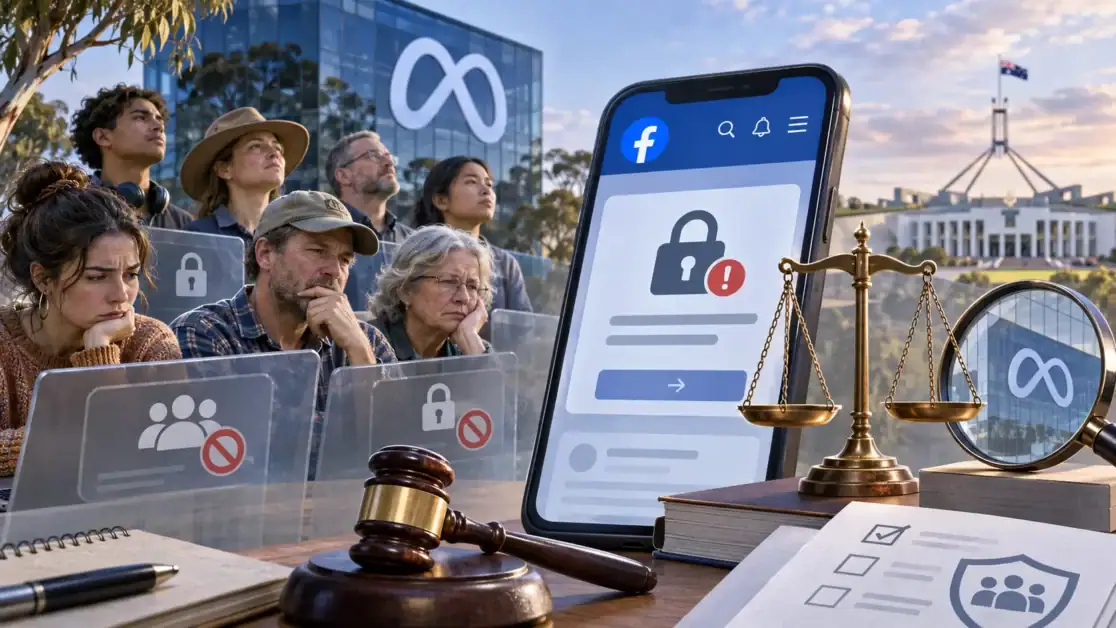
A Facebook account can represent years of work. It may contain family photographs, conversations with friends, a small business’s customer contacts or a community’s discussion of local and national issues. Losing access can mean losing all of these connections at once.
Imagine being told that your account has breached community standards, without being shown the offending material or told what behaviour triggered the decision. You appeal, but the platform rejects your request. Where can you go next?
Facebook accountability is no longer simply a question of a private company’s policies. It concerns Australians’ ability to challenge consequential decisions made by digital platforms. On 25 November 2026, Parliament passed new online safety legislation that offers an opportunity to address part of this problem. Whether it delivers meaningful remedies for wrongly excluded users will depend on its implementation.
Quick Answer
Meta sets and enforces Facebook’s rules. Its Oversight Board reviews selected decisions, but ordinary users cannot rely on it as a general account-reinstatement tribunal. Australian regulators offer limited assistance: small businesses can seek dispute support, and privacy law provides certain information-access rights. Neither is a comprehensive remedy for wrongful bans. Parliament’s newly passed Digital Duty of Care legislation includes a power to establish external complaint resolution, but the new arrangements are not yet operational. Effective Facebook accountability requires specific reasons for serious penalties, proportionate enforcement, accessible human review and independent dispute resolution that protects both users’ safety and legitimate expression.
When an account disappears, the consequences are real
In July 2025, ABC News reported the experience of Australian beautician Madison Archer. Meta had suspended her Instagram business account over an alleged breach involving child exploitation material. Other linked personal accounts were also affected.
Her initial appeal failed. It was only after the ABC raised the case with Meta that access was restored. The company acknowledged its mistake to Archer. According to the ABC, she had built her audience over nine years, and her business account had approximately 11,000 followers.
That case illustrates why an appeal system needs to do more than confirm the original decision. People should not need a journalist to intervene before an error can be corrected.
The damage is not confined to income. A volunteer running a neighbourhood support group can lose the ability to organise assistance. A person living alone may lose an important source of companionship. Independent writers can lose access to readers who have chosen to follow their work.
An account is not the same as a person’s network of relationships. Yet when a platform controls the means of reaching those relationships, the two become closely connected.
Why Facebook closes accounts
Facebook needs rules. Online threats, fraud, impersonation, harassment and exploitative material can cause serious harm. A platform must be able to act rapidly when someone faces an immediate danger.
The problem lies in how the rules are interpreted and enforced, especially when a penalty affects an entire account rather than a single post.
Automation, repeated posting and unclear rules
Software can help moderation teams assess enormous quantities of material and identify patterns of activity. But software cannot always establish the meaning or intent of a particular action. A person sharing a legitimate article across many groups may resemble someone distributing unwanted advertising. A compromised account may behave differently from its usual owner.
Repeated posting may therefore be investigated as possible spam or misuse, but the number of groups alone cannot establish why a particular account was removed. The appropriate response depends on the behaviour, the context and the applicable rules.
When a notice provides only a broad policy category, users may be unable to tell whether the issue was a post, a security concern, a pattern of sharing or an identity check. Without that distinction, they cannot make an informed appeal or adjust their conduct.
The challenge is to preserve effective enforcement without making ordinary people bear the consequences of an avoidable error. Platforms can explain the substance of a decision without revealing technical detection methods that criminals could exploit.
What Meta’s Oversight Board discovered
On 4 June 2026, the Oversight Board published its first pilot decision examining a permanent account ban. Meta had referred an Instagram case involving severe threats directed at a journalist. The Board upheld the ban, finding that the threats justified the sanction.
Importantly, it also identified broader problems with Meta’s account enforcement, including the difficulty of understanding when a violation triggers immediate exclusion rather than progressive penalties. It received accounts from users describing unsuccessful appeals, inaccessible information and damaging losses of personal or commercial connections.
The Board recommended greater clarity about the rules, meaningful reasons for account removal, transparency about the involvement of government requests and automated systems, and fair review arrangements.
These findings matter because they separate the legitimacy of a particular ban from the fairness of the wider system. A justified removal and an inadequate appeals system can exist at the same time.
Can political criticism lead to a ban?
Political expression can be affected by moderation, whether through removal of material, account restrictions or loss of access to an audience. But identifying the reason for a specific decision requires evidence. A complaint by an individual, a government request, a platform’s automated detection and an independent moderation decision are different mechanisms.
The Board’s call for disclosure of government involvement is particularly important. Legitimate requests to address unlawful threats must be distinguished from pressure to suppress lawful criticism. Appropriate safeguards should include independent scrutiny, public reporting and protection of sensitive personal information.
Our earlier discussion of Facebook censorship in Australia raised questions about corporate influence over political debate. The focus here is how Australians can obtain a fair decision regardless of their political views.
Australia’s accountability gap
In June 2025, the Australian Competition and Consumer Commission (ACCC) concluded its five-year inquiry into digital platform services. It reiterated its recommendation for a specialist external dispute resolution body. The ACCC specifically identified the problem of businesses losing their customer networks when accounts are deactivated. In its consumer survey, 82 per cent of respondents supported a specialised independent body to escalate unresolved platform complaints.
A separate Telecommunications Industry Ombudsman (TIO) report, published in June 2026 and prepared by the Consumer Policy Research Centre, estimated the annual cost of unresolved digital service problems at $497 million. The research also reported that 67 per cent of people who made complaints were dissatisfied with the outcome.
These findings cover digital services generally, including online shopping and social media. They should not be read as estimates of wrongful Facebook bans. They nevertheless show the wider demand for workable complaint resolution.
The TIO deals with telecommunications complaints, but it has called for a broader remit covering digital platforms. The Queensland Small Business Commissioner explains that it cannot currently resolve such platform disputes and that even eligible business complaints referred to Meta cannot compel reinstatement.
This leaves a significant gap between the importance of these services and the remedies available to those who use them.
What the new Digital Duty of Care changes
Australia’s Online Safety Amendment (Digital Duty of Care) Bill 2026 passed Parliament on 25 November 2026. This is a significant development for the accountability debate.
The framework requires online services to address serious online harms and introduces stronger enforcement powers, including penalties for duty breaches and a right to seek damages where a breach causes loss or damage. The government also announced a power to make rules establishing an external dispute resolution pathway.
The department’s explanation states that the new duty will commence 12 months after Royal Assent. As at 28 November 2026, it is not an operational account-recovery service.
The external complaints pathway is particularly relevant to people locked out of Facebook. Its value will depend on the eventual rules: which disputes it can hear, whether ordinary individuals and community groups qualify, what information it can obtain, how promptly it acts and whether it can secure effective remedies.
There is an important distinction between compelling companies to reduce online harm and protecting users against unjustified enforcement. Both deserve attention. A safety duty should not become an incentive to remove lawful material indiscriminately simply to minimise a platform’s regulatory risk.
Our earlier article on social media regulation and journalism examined the relationship between platform power and media accountability. The latest legislation brings a more immediate question: what practical protections will an individual receive when the platform makes a mistake?
What Australia can learn from Europe
The European Union’s Digital Services Act offers a useful comparison. Article 17 requires clear reasons for specified restrictions imposed because content is unlawful or contrary to platform terms, including account suspension or termination. For covered decisions, the explanation includes relevant grounds and information about the use of automated means, subject to the legislation’s exceptions.
Article 20 provides a free internal complaint mechanism for covered decisions, available for at least six months. Article 21 provides access to certified out-of-court dispute settlement. Those bodies do not issue binding settlements under that article, but they create an additional route beyond the platform’s own review.
Australia need not copy every European rule. The useful principle is that a meaningful explanation and an opportunity to challenge a decision should be enforceable protections, not merely optional company practices.
What meaningful Facebook accountability would look like
A credible system should contain the following safeguards.
1. Mandatory warnings before account suspension
Facebook should have to issue a clear warning before suspending an account for ordinary or correctable breaches of its rules.
The warning should name the specific conduct, the community standard breached and what the account holder must do to comply. Users should then be given a reasonable opportunity to correct their behaviour.
Suspension should generally occur only when a user continues the prohibited conduct after receiving a meaningful warning. Exceptions should be limited to serious violations requiring immediate intervention to protect others or prevent harm.
It is fundamentally unfair to punish someone without explaining what they have done wrong or giving them an opportunity to correct their behaviour.
Account suspension should be a last resort, not the first response to a correctable breach.
2. Accessible review independent of the first decision
For major restrictions, users should have access to trained reviewers who can examine context and correct mistakes. An external dispute body should be able to investigate unresolved cases, require relevant information and provide appropriate remedies. Its independence should be protected from both government direction in individual cases and corporate influence.
3. Meaningful remedies and continuity
An effective system should be able to restore wrongly removed accounts, correct inaccurate enforcement records and, where lawful and safe, enable access to personal archives. Clear timeframes matter because long suspensions can damage a business or scatter a community, even when a later appeal succeeds.
Transparency reports should also show account-level restrictions, appeal outcomes, correction rates and the role of automation, using consistent definitions. This would help independent researchers assess performance rather than rely on anecdotes alone.
Funding fair oversight is a public investment
Australia’s dollar sovereignty matters for the practical delivery of these protections. The Commonwealth can authorise Australian-dollar funding to establish an independent complaints service, train investigators and develop secure systems for handling evidence.
The constraint is the availability of skilled people, technology and institutional capacity, alongside competing demands on the economy. A well-designed industry levy could also allocate costs to the companies generating the workload and help sustain the scheme. Access for individuals should not depend on their ability to pay for premium support or lengthy litigation.
What can Australians do if Facebook closes an account?
Options are limited, but the following steps can help.
First, keep any notices, account identifiers, appeal responses and relevant dates. Use the official review option presented by the platform if it is available. Avoid paying people who promise guaranteed recovery; the ABC case demonstrates how vulnerable locked-out users can become to recovery scams.
Second, eligible small businesses can contact the Australian Small Business and Family Enterprise Ombudsman (ASBFEO) after attempting to resolve the problem with Meta. Its Meta dispute form enables the office to raise eligible complaints with the company. It cannot guarantee or order account restoration.
Third, Australian privacy law may allow individuals to request access to personal information held about them, including relevant records if they constitute personal information and no exception applies. The OAIC’s access guidance explains the right. If a genuine privacy complaint remains unresolved after raising it with the organisation, the OAIC complaint process may be available, generally after allowing 30 days for a response. It is not an appeal against every moderation decision.
Keep independent copies of original articles, photographs and other important material. Where people voluntarily subscribe to a newsletter, maintain that direct connection securely and respect their privacy. Diversifying communication channels helps reduce dependence on any single service.
What can citizens do?
Ask your federal representative how the new external dispute resolution rules will cover account suspensions, individual users and community organisations, and whether effective remedies will be available. The Take Action page provides a route to finding your representative.
Follow the Digital Duty of Care implementation and read the eventual complaint rules. When relevant consultations open, consider contributing documented experiences and practical proposals.
Discuss verified cases with community organisations and consumer groups, without publishing account credentials, private correspondence or other sensitive details.
Frequently asked questions
Can Facebook permanently disable an account without a warning?
Meta’s enforcement system allows immediate disablement for certain exceptionally serious violations. The Oversight Board has identified problems with the rules’ clarity. Its findings highlight why warnings and proportionate penalties matter.
Can I appeal a permanent ban to the Oversight Board?
Not through its ordinary content-appeal process if you have no active account on the relevant service. Its June 2026 account case was a special Meta referral, not a general appeals service. Consult the Board’s eligibility guidance for current information.
Does freedom of expression guarantee access to Facebook?
The Australian Constitution’s implied freedom of political communication does not create a general right to use a particular private platform; it limits governmental power rather than creating an unrestricted personal right. Legislation can nevertheless require fair platform procedures.
Will the new Australian law restore previously closed accounts?
Not automatically. The new duty has not started, and the coverage, procedures, and remedies of the external complaints pathway still need to be developed.
Conclusion: Who holds Facebook accountable?
At present, Meta retains considerable control over account enforcement, with some oversight by regulators, courts and the Oversight Board. Australia’s new legislation creates a chance to strengthen independent scrutiny, but a workable remedy for wrongly excluded users is not yet in place.
A society can protect people from threats and abuse while ensuring that lawful participation is not lost through opaque or mistaken decisions. The test of accountability is whether ordinary people can understand a decision, challenge it fairly and obtain a remedy when it is wrong.
What protections do you think Australians should have when a social media platform closes an account, and what experiences or evidence have shaped your view?
Share your thoughts in the comments or through Reader Feedback. Explore related analysis at Social Justice Australia. If you value independent public-interest journalism, an optional donation helps sustain this work.
Sources
- ABC News — Meta falsely accuses Instagram user of breaking child exploitation rules (17 July 2025)
- Oversight Board — Account Ban for Targeting Public Figures (4 June 2026)
- ACCC — Regulatory reform in digital platform markets (23 June 2025)
- Telecommunications Industry Ombudsman / CPRC — Someone To Turn To (22 June 2026)
- Queensland Small Business Commissioner — Meta shutdowns: The Risks of Relying on One Platform (2026)
- Minister for Communications — Australia’s Digital Duty of Care becomes law (25 November 2026)
- Department of Infrastructure — Digital Duty of Care (November 2026)
- European Union — Regulation (EU) 2022/2065, Digital Services Act, Articles 17, 20 and 21 (19 October 2022)
- ASBFEO — Dispute support
- OAIC — Access your personal information
- OAIC — Before you lodge a privacy complaint with us
- Oversight Board — Frequently asked questions
- ASBFEO — Meta dispute form
- Social Justice Australia — Why Facebook Censorship in Australia Protects the Status Quo
- Social Justice Australia — Social Media Regulation: Its Impact on Journalism
- Social Justice Australia — Take Action
- Social Justice Australia — Reader Feedback
- Social Justice Australia — Support Social Justice Australia
- Social Justice Australia — Home
- Australian Human Rights Commission — Protest rights in Australia: an explainer (2025)
Suggested related internal links
Social Justice Australia — Why Facebook Censorship in Australia Protects the Status Quo
Social Justice Australia — Social Media Regulation: Its Impact on Journalism
Social Justice Australia — Take Action
Social Justice Australia — Reader Feedback
Social Justice Australia — Support Social Justice Australia
Discover more from
Subscribe to get the latest posts sent to your email.