
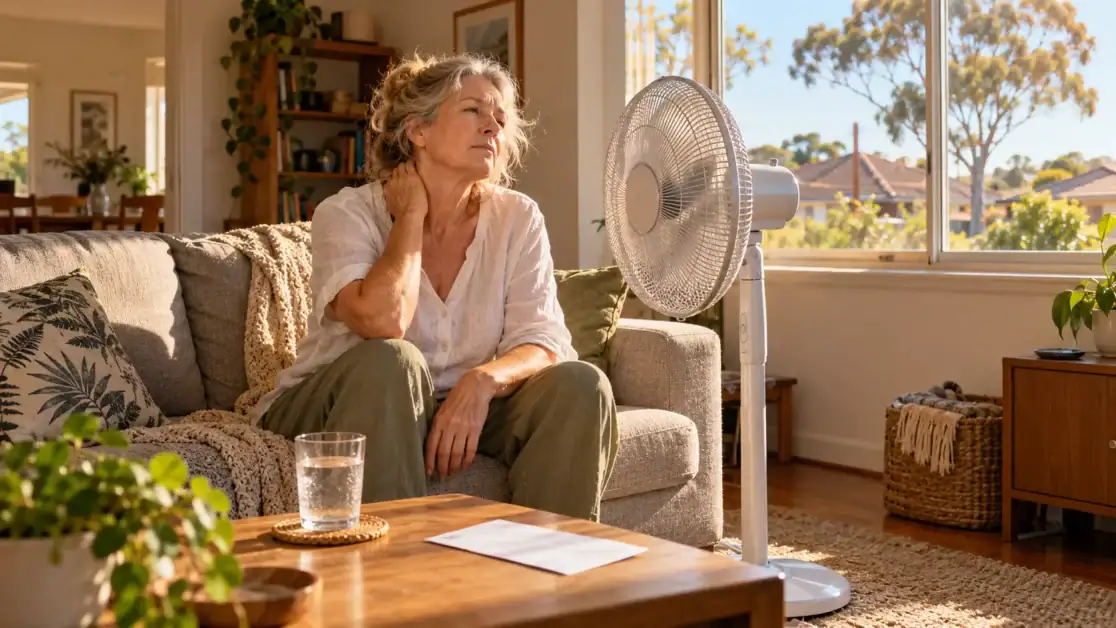
Rental heat exposes a basic gap in housing affordability. A tenant may manage the weekly rent yet struggle to pay for a home that stays cool enough to live in. The person paying the electricity bill often has little control over the roof, windows or fixed cooling equipment.
Who should pay to fix that problem? The answer involves property owners, tenants, and governments, but their responsibilities differ. As Australia approaches another summer, cooling rules and public upgrade programs show both what can change and where protection remains incomplete.
Quick Answer
Renters with their own electricity account pay to run cooling, while landlords control most permanent improvements to the property. What landlords must install depends on local law; Queensland, for example, does not require air conditioning or ceiling fans. Victoria’s new cooling standard starts phasing in from March 2027. A fairer approach would make owners responsible for basic housing quality, combine efficient cooling with suitable building improvements, and provide targeted public support. Tenants also need affordable energy and protection against displacement. Announced funding and installed equipment are useful steps, but neither alone proves that homes are cooler or households better off. [3, 5]
What rental heat research tells us
Better Renting’s 2026 report, Boiling Point, monitored 50 NSW rental homes through the 2025–26 summer. The highest recorded indoor temperature was 40.6°C. Participants also described disrupted sleep and limiting air-conditioner use because of electricity costs. [1]
These findings deserve attention, but they are not a national estimate. Better Renting is a tenant advocacy organisation, and participants were volunteers rather than a random population sample. The study documents serious problems in the participating homes; it cannot tell us what proportion of all Australian rentals experience the same conditions.
The health concern is well established. Health Direct identifies older people, babies and people with some existing health conditions as particularly vulnerable to hot weather. Heat can cause serious illness. A home’s cooling arrangements therefore matter for more than comfort or convenience. [2]
SJA’s earlier article on renting in Australia examines the wider affordability problem. Rental heat adds a separate question: what does a tenant’s rent actually buy in protection from summer conditions?
Who pays now and who controls the home
For a renter paying their own power bill, cooling has an immediate household cost. Permanent improvements raise a different question: who can authorise the work and who keeps the improvement when the tenant leaves? In Queensland, for example, tenants seeking to install air conditioning themselves must follow the process for requesting fixtures and structural changes. [3]
This creates what economists call a split incentive. An owner pays for an improvement, but the tenant may receive much of the benefit through lower electricity use. A tenant may be willing to improve the home but reluctant to spend savings on a property they do not own. That is why clear standards and carefully designed assistance matter.
Social Justice Australia’s position is that basic protection from excessive heat should be part of providing a habitable rental home. Permanent improvements should generally be the owner’s responsibility. Public assistance should be judged by what it achieves for residents, particularly those on low incomes, rather than simply by the value of equipment purchased.
Cooling rights depend on where you rent
The following comparison covers three jurisdictions with important differences. It is not a complete guide to every state and territory. Rules are checked as at 25 September 2026; individual properties may have exemptions or other circumstances that affect their obligations.
Queensland does not require cooling equipment
Queensland’s Residential Tenancies Authority states that rental homes do not have to include air conditioning or ceiling fans. Equipment supplied at the start of a tenancy must work, and general maintenance and repair rules apply. [3]
Queensland requires minimum housing standards, including weatherproofing, structural soundness, and other basic facilities. Those protections should not be confused with a requirement to install cooling. A home can meet the listed minimum standards without having an air conditioner. [4]
Victoria has a future cooling requirement
Victoria has made regulations introducing new energy-efficiency standards. The cooling requirement begins phasing in on 1 March 2027, so it is not yet a universal right to a newly installed air conditioner. [7]
For properties without fixed cooling, the requirement is triggered by a new rental agreement or conversion to a month-to-month agreement. It requires suitable fixed cooling in the main living area. From 1 July 2030, the cooling standard applies regardless of when the agreement started, subject to exemptions. Existing systems have separate replacement rules when they fail beyond repair. [5, 6]
The focus on the main living area matters. Meeting that requirement does not necessarily mean every bedroom will be cool. Residents should check the detailed rules before assuming that a landlord must cool the entire home.
The ACT requires ceiling insulation
In the ACT, rental homes with no ceiling insulation, or insulation rated below R2, generally need an upgrade to at least R5. Homes with existing insulation of R2 or more meet this standard. R-values describe resistance to heat passing through insulation; a higher value means greater resistance. [8, 9]
For continuously tenanted properties whose first agreement predates 1 April 2023, the compliance deadline is 30 November 2026. Other deadlines depend on when the tenancy began and whether an exemption applies. Landlords pay for required upgrades and must disclose compliance or exemption. This is an insulation standard, not a guarantee of a particular indoor temperature. [8, 9]
A cooler building reduces the work cooling must do
An air conditioner is only part of the answer. The Australian Government’s Your Home guidance on passive cooling explains how shading, insulation and appropriate ventilation can reduce heat entering a building or help heat escape. “Passive cooling” means using the building’s design to reduce the need for powered cooling. [10]
The right combination depends on the climate and the building. Ventilation helps when outside conditions offer relief; opening windows is less useful when outside air is hotter. Insulation should form part of a whole-home assessment that also considers shading and ways to release unwanted heat.
Your Home identifies reverse-cycle air conditioners as highly efficient heating and cooling systems and stresses correct sizing. An undersized appliance can struggle, while an oversized one can waste money and energy. [11]
For policy, the lesson is practical: fund an assessment and suitable work, rather than assume the same appliance will solve every home’s problem. A shaded ground-floor unit and an exposed top-floor flat may need different improvements.
Public funding is expanding, but results need checking
The Commonwealth’s Social Housing Energy Performance Initiative supports improvements with state and territory governments. The department’s September 2026 update describes a $1.1 billion program, including $800 million from the Commonwealth, expected to reach more than 100,000 social housing properties by mid-2031. Upgrades can include insulation, shading, efficient appliances and solar. These are program commitments and targets, not a claim that all work is complete. [12]
On 15 September 2026, the Australian Government announced $97.1 million for another 8,000 Queensland social housing properties, with installations to start during 2026. The announcement also reported that more than 15,000 Queensland properties had already received upgrades through the program. These are government-reported delivery figures. [13]
An upgrade count does not establish the size of a household’s bill savings or the temperature of its bedroom. Evaluation should measure summer indoor conditions, electricity use and tenant experience before and after work, allowing for changes in weather and energy prices.
Private renters do not automatically receive assistance through this social housing program. Social housing residents should contact their provider about whether their property is included; properties are selected by the states and territories. [12]
How to stop improvements becoming another rent burden
Who receives an invoice is not necessarily the same as who ultimately bears the cost. An owner may seek a higher rent after improvements. The outcome will depend on the local market, tenancy rules and the design of any subsidy. It would be misleading to promise either that every upgrade raises rents or that no tenant will face extra costs.
Consider a purely illustrative example. If an upgrade saves a household $10 a week on electricity but rent rises by $20 a week, the household is $10 worse off overall. Those figures are not a forecast. They show why a program should assess rent and energy costs together.
We recommend that governments build tenant protections into any new assistance scheme:
- Require participating owners to meet clear conditions on rent increases and continued rental availability for an agreed period. Those conditions would need enforceable legal terms.
- Prioritise homes with the greatest heat exposure and residents with the least ability to pay. Provide fair options where an owner faces genuine financial hardship or a building has difficult physical constraints.
- Publish completed work, inspection results and measured benefits. Use qualified installers, appropriate safety checks and a clear complaints process.
- Fund tenancy advice and enforcement so residents can raise problems without having to manage a complex dispute alone.
These are proposed safeguards, not a description of a universal scheme already operating. They should be tested against evidence, including whether they affect rental availability or encourage owners to avoid participation.
Australia can fund upgrades but must plan the work
Australia’s monetary sovereignty is important for a national upgrade program. The Commonwealth issues the Australian dollar through its monetary institutions; the Reserve Bank issues the currency and is wholly Commonwealth-owned. Australia has a floating exchange rate, and its government debt is denominated in its own currency. State and territory governments, households and businesses do not have that same currency-issuing capacity. [14, 15]
That gives the Commonwealth policy capacity that cannot be understood simply by comparing its budget with a household’s. It does not remove parliamentary spending authorisation, existing borrowing arrangements or the risk of inflation. Under current arrangements, the government finances deficits through market borrowing. [16]
The practical constraint is also the work itself. A larger program needs electricians, trained insulation installers, equipment and effective oversight. Expanding spending faster than those resources become available can push up prices. [17] A sensible program would train workers, phase contracts and prioritise the homes where improvements are most urgent.
Grants and public spending are fiscal policy, decided through government budgets. Monetary policy, conducted by the Reserve Bank, includes setting the cash-rate target. Changing interest rates does not, by itself, insulate the economy. Housing standards, funding and delivery need their own decisions. [14]
Keeping homes cool should be part of housing policy
The evidence supports treating rental heat as both a housing-quality issue and an energy-cost issue. Existing protections differ, new requirements take time to reach tenants, and public funding still needs to demonstrate its results.
Our judgement is that owners should provide essential dwelling quality, while governments enforce standards and help those most exposed to heat and financial hardship. Tenants need affordable power to use the equipment provided. The test of reform should be whether residents can live safely and comfortably without being priced out of their home.
Frequently Asked Questions
Must my landlord install air conditioning?
There is no single answer across Australia. Queensland does not require installation. Victoria’s new cooling requirements phase in from March 2027, with conditions and exemptions. Check your local tenancy authority and the rules applying to your agreement. [3, 5, 6]
Can insulation replace an air conditioner?
Insulation can reduce heat transfer, but it does not actively refrigerate a room. Whether a home also needs powered cooling depends on its design, climate and occupants. Shading and suitable ventilation matter too. [10, 11]
Does an energy upgrade guarantee a lower bill?
No. A more efficient home or appliance can need less energy for the same comfort, but bills also depend on prices, weather and use. A previously under-cooled household might use the improvement to achieve safer comfort rather than reduce spending. [11]
Can social housing tenants apply for the national program
The federal program does not require residents to apply. States and territories select properties. Ask your housing provider whether work is planned for your home. [12]
What should Queensland tenants do about supplied cooling
Check supplied equipment at the start of a tenancy and record problems in the entry condition report. Report faults to the property manager or owner. Keep fans and accessible filters clean, and seek tenancy advice if repairs remain unresolved. [3, 4]
Support Social Justice Australia
If you believe in what we are trying to achieve, please consider donating to Social Justice Australia. Your support helps us continue producing independent public-interest analysis. We appreciate every contribution, large or small. Donate to support our work.
Explore our Housing and Cost of Living coverage, share this article with others who may find it useful, and join the discussion at Social Justice Australia. You can also ask your state representatives how rental standards and upgrade programs will protect tenants in your area.
#RentalHousing #EnergyEfficiency #ClimateJustice #SocialJusticeAustralia
Authoritative Sources
Sources checked on 25 September 2026. Undated pages are identified below rather than assigned an assumed publication date.
- Better Renting. Boiling Point: NSW renters pushed to the limit by unsafe indoor heat. 2026; monitoring 18 December 2025–1 March 2026.
- Health direct Australia. Hot weather risks and staying cool. Reviewed December 2024.
- Queensland Residential Tenancies Authority. Air conditioning and ceiling fans. Undated; accessed 25 September 2026.
- Queensland Residential Tenancies Authority. Minimum housing standards. Undated; accessed 25 September 2026.
- Consumer Affairs Victoria. Minimum energy efficiency standards: Cooling standard. Updated 4 June 2026.
- Consumer Affairs Victoria. New minimum energy efficiency standards. Updated 17 August 2026.
- Victorian Government. Residential Tenancies Amendment (Minimum Energy Efficiency Standards) Regulations 2025, S.R. No. 63/2025. Made 1 July 2025; see regulation 17.
- ACT Government. Minimum housing standard for ceiling insulation in rental properties. Undated; accessed 25 September 2026.
- ACT Government. Residential Tenancies Regulation 1998. Republication R16, effective 23 February 2026; part 3.
- Australian Government, Your Home. Passive cooling. Updated 2020.
- Australian Government, Your Home. Heating and cooling. Undated; accessed 25 September 2026.
- Department of Climate Change, Energy, the Environment and Water. Social housing energy performance. Updated 8 September 2026.
- Australian Government, Assistant Minister for Climate Change and Energy. Joint media release: Bill relief on the way for thousands of Queensland households. 15 September 2026.
- Reserve Bank of Australia. About Our Role | Questions & Answers. Undated; accessed 25 September 2026.
- Reserve Bank of Australia. The Road to Australian Dollar Funding. Bulletin, March 2020.
- Reserve Bank of Australia. The Exchange Rate and the Reserve Bank’s Role in the Foreign Exchange Market. Undated; accessed 25 September 2026.
- Reserve Bank of Australia. Causes of Inflation. Undated; accessed 25 September 2026.