
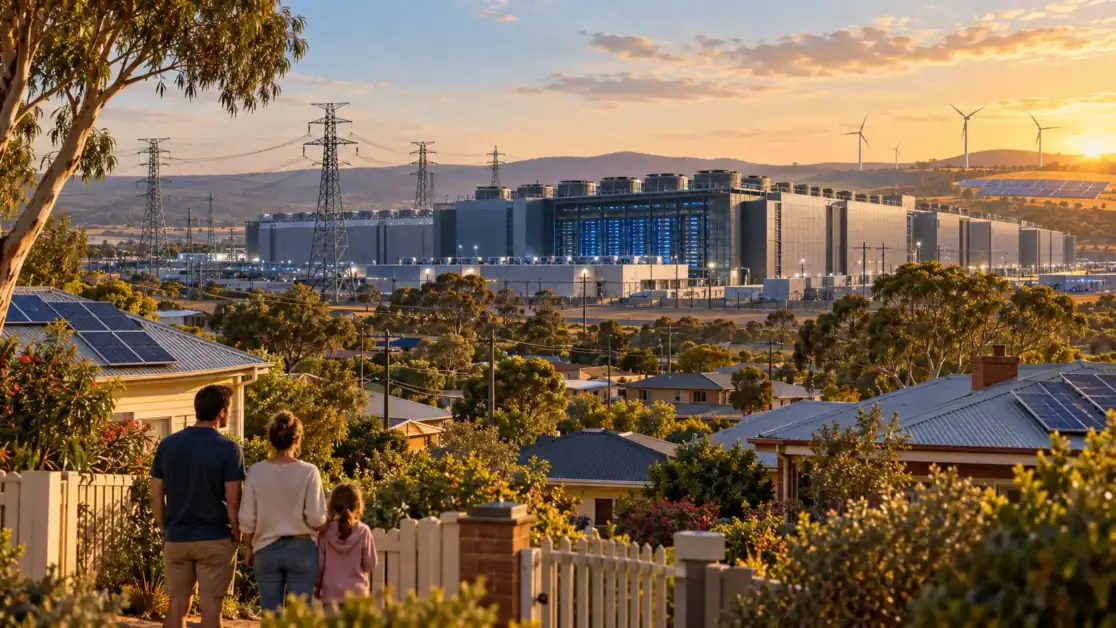
Australia can benefit from AI data centres, but governments must ensure their power and water needs don’t leave households paying more.
Why the AI data centre boom matters to households
Australia’s AI data centre boom brings promises of jobs and better services. When a company announces a huge investment, the headline sounds promising.
Yet, a family trying to pay its power bill may ask a simpler question: will this make life better or more expensive for us?
That is a fair question. A large investment can bring benefits while also straining shared services. Governments should explain both before approving a project or offering public support.
This article follows three costs: the power a centre uses, the networks that carry it, and the water needed for cooling. It then asks what Australia should expect in return.
Our earlier articles examine Australian AI leadership and corporate influence in politics. Here, the focus is on the costs reaching households and the safeguards needed to protect them.
Quick Answer
Companies pay to build and run data centres, but the wider costs depend on each project’s power supply, network and water agreements. Households could face higher bills if extra demand outpaces supply or shared infrastructure costs are passed on to existing customers. That outcome is not inevitable. Additional electricity supply, storage and fair charges can reduce the risk. Government policy statements call for such safeguards, but the rules and conditions for each project still need scrutiny. The central test is whether Australians gain useful services and lasting benefits without being left to cover costs that properly belong to the developer.
What a data centre actually does
A data centre is a building full of computers that store and process information. Those computers support services such as online banking, health records and government systems. Some also run artificial intelligence, or AI, which can produce text, analyse data and perform other tasks. Not every data centre is devoted to AI. [1, 4]
The computers need power. They also produce heat, which must be removed so the equipment can keep working.
This creates a practical issue. A company can build its own computer rooms, but it still relies on resources used by the rest of the community.
How a data centre can affect your power bill
More demand can push up electricity prices
Electricity retailers buy power and sell it to households and businesses. The price paid in the large electricity market is called the wholesale price. It is only one part of your final bill.
If a large new customer starts using power before enough extra supply is available, wholesale prices can rise. Energy Consumers Australia identifies this as one way data centres could affect other customers. [2]
Think of a town with a busy bus service. A large new workplace opens, and many more passengers need the bus. Unless capacity expands, the same service comes under more pressure. Electricity is more complex, but the basic question is similar: does supply grow in time to meet demand?
New poles and wires also cost money
A large centre may need a new connection or upgrades to the electricity network. That network includes the wires and equipment that carry power to users.
Paying for a connection does not automatically settle every wider network cost. The rules for sharing those costs matter. Energy Consumers Australia warns that different connection arrangements can affect what existing customers end up paying. [2]
So governments need to ask two questions: has the company paid a fair share of the network work, and is enough extra electricity available to meet its demand?
What the electricity modelling means
Baringa examined how data centre growth could affect electricity prices by 2035. It prepared the study for the Clean Energy Finance Corporation in December 2025. [3]
Without extra renewable generation to meet the additional demand, its modelling estimated wholesale prices could be 26 per cent higher in New South Wales (NSW) and 23 per cent higher in Victoria than in its starting forecast.
That starting forecast already included some data centre growth. The study tested what could happen if demand grew further.
When it included extra renewable generation and battery storage, the estimated price impact was much smaller: around 3 per cent in NSW and 2 per cent in Victoria. [3, printed pages 19–24 and Appendix 1]
These figures compare possible futures for 2035. They do not compare 2035 prices with today’s prices. Nor do they mean household bills would rise by the same percentages.
The central point is that expanding electricity supply alongside data centres could substantially reduce their effect on prices. The results depend on the study’s assumptions; they are not a promise about what will happen.
Why water use also matters
Cooling methods differ, so water needs vary between facilities. Useful questions include how much water a particular centre needs, where it will come from, and what happens during a drought.
Sydney Water says data centres can need large volumes of water in concentrated locations, with a high need for reliable supply. It plans to prioritise recycled water. Its stated principles include protecting existing customers from higher costs and added supply risk. [1]
Those are useful commitments. Residents should be able to see how they will be implemented.
For example, if a project needs a new recycled-water pipeline, who pays to build and maintain it? Will it also serve homes or other businesses? What happens if the centre uses much less water than expected?
Recycled water can reduce pressure on drinking-water supplies. It still needs treatment and pipes. Describing a project as sustainable does not answer who pays for that work.
What governments have promised so far
In March 2026, the federal government published expectations for new and expanded data centres. These call for extra clean energy or storage, a fair share of network and water costs, efficient resource use, and benefits for Australian workers and communities. [4]
The document guides which proposals the Commonwealth prioritises. It works alongside existing laws. It is not proof that every centre already has legally enforceable conditions covering every possible cost.
Victoria’s Sustainable Data Centre Action Plan, published on a government page updated on 22 September 2026, calls for new renewable power and storage and payment for the network work caused by a project. It says some detailed energy compliance rules still need finalisation. The plan also identifies existing protections requiring large new users to fund project-related water infrastructure. [5]
Some protections already exist; other details are still being developed. The next question is which rules apply to a particular project and how authorities enforce them. A community needs to know who checks compliance, what is measured and what happens when a promise is broken.
What should Australians get in return?
Data centres provide useful services. Australia has good reasons to support research, reliable digital systems and skilled work. The federal expectations recognise those benefits. [4]
But the amount spent on a building does not tell us how much the public gains.
Before offering help, governments should show how many jobs will continue after construction ends. They should explain any training commitments and whether local researchers or businesses gain useful access to computing services.
Public support also needs clear terms. If a company receives a grant, cheaper finance or publicly funded infrastructure, Australians should know what it must deliver in return.
This does not mean a company must fund every shared asset. A new pipeline or power upgrade may serve the wider community for decades. A public contribution can make sense when the public benefit is clear. The decision should be explained openly.
How Australia’s monetary sovereignty fits in
The federal government is different from a household
Australia has its own currency, the Australian dollar, and a floating exchange rate. This means its value can move against other currencies. [7]
Australia’s public monetary system can create Australian dollars. For example, the Reserve Bank created money in banks’ settlement accounts when it bought government bonds. Households and businesses cannot issue the national currency. Neither can state or territory governments or councils. [8]
This difference is often called monetary sovereignty. It means the Commonwealth’s ability to act should not be judged as though it were a family with a fixed pot of savings.
But current rules still matter. The Australian Office of Financial Management issues government debt and manages cash, so the Commonwealth can make its payments. Parliament must authorise spending. The Reserve Bank bought existing bonds from the market, rather than lending directly to the government. [8, 9]
Fiscal policy means government decisions about spending and taxes. Monetary policy means central-bank decisions, such as setting interest rates, that influence borrowing, spending and inflation. These tools have different responsibilities. [8]
Real resources set limits
The ability to create dollars does not create an endless supply of things to buy.
Suppose the government funds a new power project. It still needs workers, land, equipment and time. If the same workers and equipment are already needed elsewhere, rushing more projects into construction can push up costs.
Australia can issue dollars. It cannot issue more water in a drought or train an electrician overnight. Imported equipment also depends on overseas supply and exchange rates.
That is why real resources and inflation matter. Inflation is a broad rise in prices. The Reserve Bank explains that it can occur when demand exceeds the economy’s ability to supply goods and services. Spending needs to expand useful capacity while managing that risk. [6]
Public investment should serve public needs
In my view, monetary sovereignty strengthens the case for judging public investment on what it achieves. Governments can consider building power supply, recycling water or training workers instead of assuming private investors must lead every project.
It does not follow that every data centre deserves a subsidy. Nor does it remove the case for charging companies for the resources and services they use.
Taxes and charges also affect fairness, demand and who gains from public assets. Requiring a developer to pay a fair share can protect the public interest even when the Commonwealth has the capacity to support investment.
The question should be: what can Australia build, with the resources available, that improves people’s lives?
Five practical safeguards
These are proposed reforms, not a claim that the same rules already apply everywhere.
- Show who pays. Publish a clear account of the company’s costs, shared costs and any government support. Explain what households could be asked to pay.
- Bring new supply online in time. Set clear dates for the extra power, storage and network work. Explain what happens if the data centre is ready first.
- Protect water supplies. Publish water needs, drought plans and charges. Show how existing users will be protected.
- Make public support earn a return. Set measurable promises for jobs, training and community benefits. Include ways to recover assistance if those promises are not met.
- Let residents check the results. Publish progress reports and offer a clear complaints process. Assess the combined effect of nearby projects, rather than treating each one as though it were alone.
Questions to ask about a local project
You do not need to be an energy expert to ask useful questions. Start with these:
- Where will the extra power and water come from?
- Which costs will the company pay, and which will others share?
- What public assistance has been offered?
- Which promises are legally binding?
- Who checks the results, and can residents read the reports?
Ask the council or relevant state planning authority for the project documents. A company’s promotional material can explain its plans, but approval conditions and service agreements show what it must do.
A fair deal from the AI data centre boom
Companies pay their own building and operating costs. The effect on the rest of us depends on the extra supply they bring, the agreements they sign, and the rules governments enforce.
The evidence shows a risk of higher costs when demand grows without enough supporting supply. It also shows that extra generation and storage can reduce that risk. The impact of any one development remains a question, depending on its plans and agreements.
Australia can gain from new technology while protecting affordable power and secure water. Open information, fair charges and firm public safeguards would help make that possible.
Frequently Asked Questions
Will data centres definitely make my power bill higher?
Not necessarily. The outcome depends on supply, network costs and the terms of each project. The Baringa modelling describes a possible effect of further data centre growth, not a forecast of your household bill. [2, 3]
What is the difference between wholesale prices and my bill?
Wholesale prices are what electricity costs in the large market before it is sold to homes and businesses. Your bill also includes network costs and other charges. A percentage change in wholesale prices does not translate directly into the same percentage change in your bill. [2]
Can data centres use recycled water?
Yes, where suitable supplies and infrastructure are available. Sydney Water prioritises recycled water, but each project still needs an assessment of its water needs and local supply. Recycled water also has treatment and delivery costs. [1]
Does renewable power solve the whole problem?
No. A data centre still needs reliable power day and night, network access, and suitable cooling. Water use and other local effects need separate assessment. [4]
Why should companies pay if Australia can create dollars?
Because money does not remove resource limits or decide what is fair. Companies should bear appropriate costs, and any public contribution should bring a clear public benefit.
What would a fair deal look like in your community?
What benefits and safeguards would matter most to you if a large data centre were proposed near your community?
Share your experiences, evidence and views in the comments. Respectful disagreement is welcome. Please offer another interpretation or flag information you think needs correcting.
Support independent public interest analysis
If you believe in what we are trying to achieve, your support can help Social Justice Australia continue producing independent public-interest analysis. We appreciate every contribution, large or small.
Read our related articles, share this piece with people who may find it useful, and join the discussion. You can also ask your representatives how local projects will protect the public interest.
Support Social Justice Australia
Authoritative Sources
Sources checked on 24 September 2026. The Baringa results are conditional modelling, not measured household bill increases.
Sydney Water. Data centres. No publication date shown.
Energy Consumers Australia. How data centres are reshaping Australia’s energy landscape. 15 October 2025.
Baringa for the Clean Energy Finance Corporation. Getting the balance right: Data centre growth and the energy transition. December 2025.
Department of Industry, Science and Resources. Expectations of data centres and AI infrastructure developers. 23 March 2026.
Victorian Department of Jobs, Skills, Industry and Regions. The Sustainable Data Centre Action Plan. 2026; download page updated 22 September 2026.
Reserve Bank of Australia. Causes of Inflation. No publication date shown.
Reserve Bank of Australia — Christopher Kent. Australia’s External Position and the Evolution of the FX Markets. 29 April 2025.
Reserve Bank of Australia. Review of the Bond Purchase Program. 21 September 2022.
Australian Office of Financial Management. Operations. No publication date shown.