
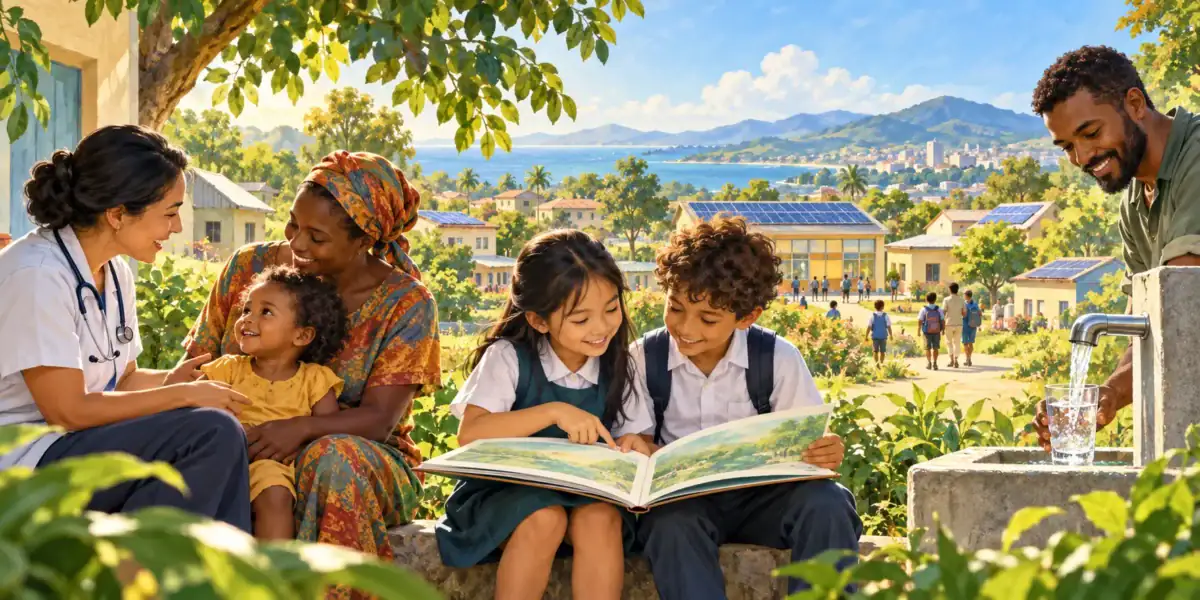
Positive changes in the world offer reasons for hope. Explore real gains in health, education and living standards, and lessons for Australia.
More children are surviving their early years. More adults can read and write. Billions of people have gained safer water and sanitation. These positive changes deserve a place in our understanding of the present—and our expectations for the future.
For Australians wondering what kind of world their children will inherit, evidence of progress matters. It shows that people can improve living conditions on an enormous scale. The useful question is: what have we achieved, and what can those achievements teach us about the next step?
Quick Answer
Progress gives us reasons for hope because major improvements in people’s lives have already happened. International evidence records fewer child deaths, wider literacy, a large long-term reduction in extreme poverty, and expanded access to essential services. These achievements also offer practical lessons: develop useful knowledge, build reliable services, reach excluded communities and sustain action over time. Progress is uneven and can stall, so past gains do not guarantee future success. But they provide evidence that change is possible. For Australia, the opportunity is to learn from effective action and judge new efforts by the difference they make to people’s lives.
Positive changes in the world are human achievements
A statistic about survival, literacy or safe water describes something deeply personal. It can mean a child reaching school age, an adult reading an important document, or a family having safe drinking water at home.
Looking closely at improvement also changes the questions we ask. Alongside “What is going wrong?”, we can ask “Where has life improved, how was that achieved, and who could benefit next?” That is a useful starting point for reform.
The following examples use international sources available on 6 October 2026. Each identifies the period measured: a report published this year often describes earlier years because collecting reliable global data takes time.
More children are living to see their fifth birthday
Annual deaths among children under five have more than halved since 2000, according to United Nations estimates published in March 2026. That is an extraordinary improvement in human wellbeing. [1]
Vaccination offers a particularly clear example of what sustained effort can achieve. A WHO-led modelling study led by the World Health Organization (WHO) estimated that vaccines against 14 diseases saved about 154 million lives between 1974 and 2024, including around 101 million infants. These are modelled estimates comparing vaccination with a scenario without those vaccines. [2]
Behind that achievement are scientific research and the work needed to put it into practice: producing vaccines, transporting them, maintaining services and reaching families. A medical discovery becomes more valuable when people can benefit from it.
An estimated 4.9 million children under five still died in 2024, and progress has slowed. That remaining need makes the lesson more valuable: effective prevention and care deserve sustained attention, especially where access is weakest. [1]
Extreme poverty has fallen on a huge scale
The World Bank’s June 2025 assessment estimated that roughly 1.5 billion fewer people lived in extreme poverty in 2022 than in 1990. Estimates change as data improve, but the scale of that historical reduction strongly argues against the idea that severe deprivation is unchangeable. [3]
The Bank’s September 2026 update estimates that about 824 million people, or 10.1% of humanity, lived in extreme poverty in 2024. The measure uses US$3 per person a day, adjusted for differences in purchasing power between countries and expressed in 2021 prices. It is a very low threshold, not a measure of a comfortable life. [4]
The practical lesson is to set ambitious goals while being clear about what a measure tells us. Leaving extreme poverty is a meaningful gain. Secure housing, adequate food, healthcare and a decent income remain worthwhile goals beyond that first step.
These global figures establish an improvement; they do not, by themselves, settle debates about the contribution of particular economic policies. Understanding what worked in a particular country requires closer examination.
Reading and writing have reached more people
The United Nations Educational, Scientific and Cultural Organization (UNESCO) reports that global adult literacy rose from 81% in 2000 to 88% in 2024. Youth literacy rose from 87% to 93% over the same period. [5]
The 2026 education monitoring report records a broader ability to use skills that matter throughout life. Reading can help people understand instructions, compare information and participate in public discussion. Writing helps people communicate their own needs and ideas.
Literacy statistics do not measure every aspect of education quality. They do show that a basic capability has become more widely shared. The lesson is to keep widening access while asking what learners can actually do with the education they receive.
Billions have gained safer water and sanitation
Between 2000 and 2024, 2.2 billion people gained access to safely managed drinking water and 2.8 billion gained safely managed sanitation, according to a joint WHO–UNICEF report from WHO and the United Nations Children’s Fund (UNICEF). [6]
“Safely managed” drinking water means water from an improved source that is available at home when needed and free from contamination. The definition matters: a water source somewhere nearby is not the same as a dependable, safe supply.
This is progress built into daily life. Pipes, treatment systems and sanitation can be easy to overlook once they work. Their value becomes clearer when we consider the difference between having an essential service and having to manage without it.
The practical lesson is that ordinary infrastructure deserves serious attention. Building it, maintaining it and checking service quality are all part of making an improvement last. Access remains unequal, so extending reliable services is still unfinished.
Electricity is opening opportunities in more communities
Global rural access to electricity rose from 73% in 2010 to 85% in 2024, according to the 2026 Energy Progress Report. Electricity enables lighting, refrigeration, communication, and work. [7]
The report identifies planning, capable institutions and targeted help with costs as features of countries making good progress. It also notes that 655 million people still lacked electricity in 2024. A connection alone does not guarantee reliability or affordability.
For Australia, the lesson is relevant to any essential service: measure whether people can use it in practice. Coverage, quality and cost belong in the same conversation.
The ozone layer shows environmental action can work
The recovery of the ozone layer offers a concrete example of successful international cooperation. The World Meteorological Organization’s September 2026 ozone bulletin describes long-term recovery associated with restrictions on ozone-depleting chemicals under the Montreal Protocol. [8]
The United Nations-backed 2022 scientific assessment projected a return to 1980 ozone levels around 2040 for most of the world, if current policies remain in place. Recovery over Antarctica is expected to take longer. These are conditional projections; annual ozone-hole measurements also fluctuate with weather. [9]
The useful lesson is the process: identify a danger through science, agree on rules, act on them and keep monitoring the results. The achievement shows that countries can cooperate to change the course of an environmental problem. Other environmental challenges require their own solutions, but successful cooperation gives us experience to learn from.
Give achievements a fair share of our attention
Daily reporting helps us understand urgent events and hold powerful people accountable. Long-term progress supplies another part of the picture. Improvements that unfold over decades rarely arrive as a single dramatic event.
Evidence suggests negative wording can attract attention. A 2023 study published in Nature Human Behaviour examined online headline experiments at Upworthy. For a headline of average length, each additional negative word increased the click-through rate by about 2.3% relative to the comparison rate. That finding concerns one online publisher; it cannot explain every newsroom or every reader. [10]
SJA’s Why Mainstream Media in Australia Fails Citizens explores ownership and accountability. This article adds a different perspective: the achievements that deserve to sit alongside coverage of problems. Readers can also explore How the Media Shapes Our Thinking for practical help with framing and presentation.
Human Progress’s Trends website helped inspire this inquiry. Human Progress identifies itself as a Cato Institute project. Its collection is a starting point for discovery; the figures here have been checked against the responsible international organisations and research sources. [11, 12]
Social Justice Australia’s editorial view is that evidence of achievement deserves more attention because it helps us imagine and examine workable improvements. Understanding an achievement gives readers something concrete to examine, discuss and potentially build on.
What Australia can learn from progress
The examples above suggest a practical approach to public policy. Start with an outcome that matters to people. Learn from places that have improved it. Build the capacity to deliver, and publish results that communities can understand.
1. Choose outcomes, not just announcements. For housing, ask how many suitable homes are completed and occupied, and whether residents gain security.
2. Plan for the people who deliver a service. Buildings and equipment need skilled workers, maintenance and effective management.
3. Ask who is still missing out. A rising average can conceal communities receiving little benefit.
4. Learn from success without copying blindly. A useful approach elsewhere may need to change to suit Australian conditions.
Match public investment with the capacity to deliver
Australia also needs an accurate discussion of its capacity to invest. The Commonwealth issues the Australian dollar through Australia’s monetary institutions; states, territories, households and businesses use it. Australia has a floating exchange rate, and the Commonwealth issues debt primarily in Australian dollars. [13, 14, 15]
That gives the Commonwealth a different position from a household, but it does not make resources unlimited. Workers, skills, materials, technology, infrastructure and environmental limits matter. Spending beyond the economy’s capacity to supply goods and services can add inflationary pressure.
The practical task is to plan funding and delivery together. SJA’s Australia’s Monetary Sovereignty: How Government Money Really Works explores the monetary system in more detail. Here, the central question is what resources an improvement needs and how to organise them effectively.
Conclusion: hope with something to build on
The evidence gives us solid reasons for hope. Human beings have reduced child deaths, expanded literacy and essential services, and cooperated to protect the ozone layer. Those are substantial achievements in people’s lives.
Past success cannot promise future success. It can give us knowledge, examples and a more useful starting point than the assumption that improvement is impossible.
Social Justice Australia’s view is that recognising progress should be part of the work of seeking justice. We can value what people have achieved, learn how it happened and help extend its benefits. A better future is a practical possibility worth working towards.
Frequently Asked Questions
How can I tell whether a progress claim is reliable?
Look for the original source, the years compared and a clear definition of the measure. Check whether the figure is an observed outcome, a modelled estimate or a forecast. The same checks apply to alarming claims.
Does a global improvement mean everyone is better off?
No. Global figures combine different experiences. Check regional and local evidence, including whether disadvantaged communities share in a gain. Australian living conditions also need Australian measures.
Can a lower percentage still mean more people are affected?
Yes. Population growth can mean a falling percentage represents a rising number of people. Check both the proportion and the headcount before drawing a conclusion.
Does recognising progress weaken the case for reform?
It need not. Evidence that a problem has been reduced can help identify useful approaches and set more ambitious goals. It also allows communities to ask why effective services are not reaching everyone.
What can I do with this information?
Bring a well-sourced example into a discussion, examine an outcome reported by a local service, or ask representatives what they have learned from a successful program. Constructive participation can start with a clear question and a willingness to consider the evidence.
Join the discussion
Which improvements offer the most useful lessons for your community, and what would it take to build on them?
Share your experiences, evidence and views. Respectful disagreement, alternative interpretations and corrections are welcome in the discussion or through Reader Feedback.
Support independent public-interest analysis
If you believe in what we are trying to achieve, your support can help Social Justice Australia continue producing independent public-interest analysis. Every contribution, large or small, is appreciated. You can support Social Justice Australia.
Explore the related SJA articles linked above, share this article and join the discussion. Consider where your interests and experience could contribute to constructive democratic, social or economic reform.
Authoritative Sources
The sources below informed the evidence and definitions in this article. Data years are stated in the text. Undated webpages were checked on 6 October 2026.
- UNICEF and the United Nations Inter-agency Group for Child Mortality Estimation. Progress in reducing child deaths slows as 4.9 million children under five die in 2024. 18 March 2026.
- World Health Organization. Global immunization efforts have saved at least 154 million lives over the past 50 years. 24 April 2024.
- World Bank. June 2025 Update to Global Poverty Lines. 5 June 2025.
- Laura Moreno Herrera and colleagues, World Bank. September 2026 Global Poverty Update from the World Bank: One in ten worldwide live in extreme poverty. 22 September 2026; table-label correction noted October 2026.
- UNESCO, Global Education Monitoring Report. Monitoring education in the SDGs. 2026 edition; accessed 6 October 2026.
- World Health Organization and UNICEF. Progress on household drinking-water, sanitation and hygiene 2000–2024: Special focus on inequalities. 26 August 2025.
- International Energy Agency, International Renewable Energy Agency, United Nations Statistics Division, World Bank and World Health Organization. Tracking SDG 7: The Energy Progress Report 2026 — Executive Summary. 2026.
- World Meteorological Organization. WMO bulletin shows successes and challenges in ozone layer recovery. 16 September 2026.
- United Nations Environment Programme. Ozone layer recovery is on track, helping avoid global warming by 0.5°C. 9 January 2023.
- Claire E. Robertson and colleagues, Nature Human Behaviour. Negativity drives online news consumption. 16 March 2023.
- Human Progress. Trends. Undated; accessed 6 October 2026.
- Human Progress. About. Undated; accessed 6 October 2026.
- Reserve Bank of Australia. What is Money?. Undated; accessed 6 October 2026.
- Australian Office of Financial Management. Australian Government Securities. Undated; accessed 6 October 2026.
- Reserve Bank of Australia. Drivers of the Australian Dollar Exchange Rate. Undated; accessed 6 October 2026.