
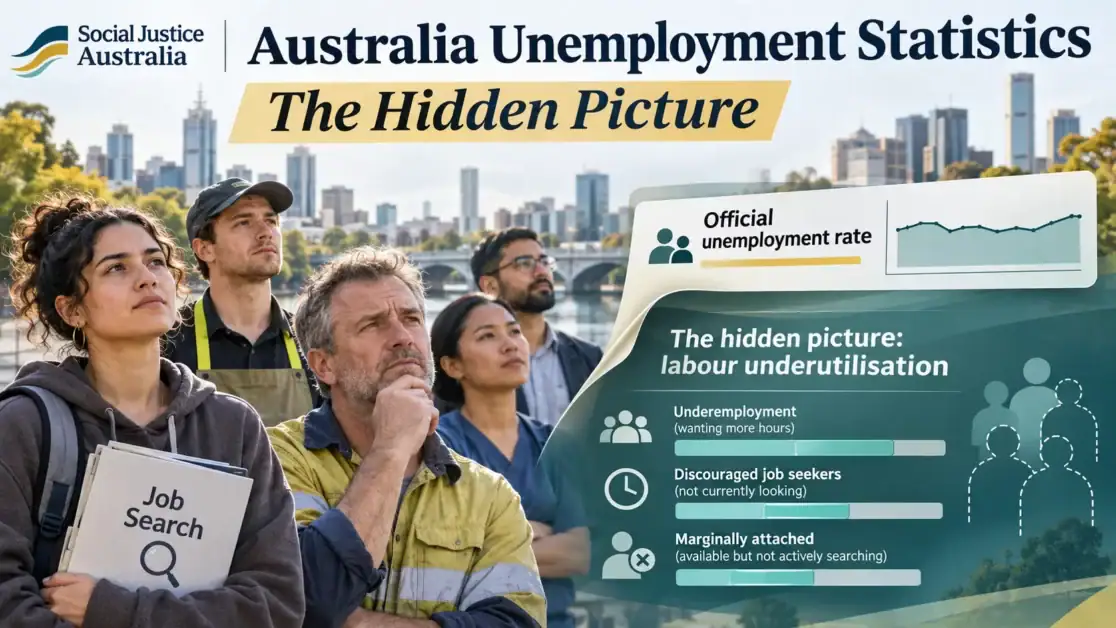
An Australian can be counted as employed after working just one hour in a survey week. That is a defensible statistical convention, but it does not tell us whether the person can pay the rent, obtain enough shifts or find secure employment. ABS figures released on 19 November 2026: Unemployment: 4.9%; Underemployment: 6.2%; and Combined labour underutilisation: 11.1%
If we use the headline unemployment rate as the whole story, we overlook people who want more hours and people who want work but aren’t classified as unemployed.
The question is not whether the Australian Bureau of Statistics (ABS) is inventing its numbers. It is whether the numbers most often repeated in politics and the media are sufficient to explain the labour market Australians actually experience. They are not.
Quick Answer
Australia’s headline unemployment rate counts people without work who meet defined job-search and availability tests. It excludes people already doing some work, including those desperate for more hours, and many people outside the labour force who still want jobs. In September 2026, ABS unemployment was 4.7%, but combined unemployment and underemployment reached 11.0%. The international LU4 measure goes further by adding the potential labour force and using a broader denominator. It is a better primary measure of unmet demand for work, though it still cannot establish whether wages are adequate or jobs are secure. A genuinely useful public report would publish LU4 alongside earnings, hours and job-quality indicators.
Australian Unemployment Statistics: What do they really say?
In September 2026, the ABS estimated 732,000 unemployed Australians and a seasonally adjusted unemployment rate of 4.7%. Its underemployment rate was 6.3%. Combined, its established labour-force underutilisation rate was 11.0%. The ABS also estimated 14.78 million employed people and an employment-to-population ratio of 63.6%. These figures relate to the same September Labour Force Survey reference period. Source: ABS Labour Force, September 2026. Source: ABS September 2026
A 4.7% unemployment rate answers a precise question: what share of the labour force meets the unemployment definition? It does not mean that 95.3% of Australians have adequate jobs. That conclusion confuses a narrow labour-market classification with an assessment of income and wellbeing.
Roy Morgan published a different picture on 17 November 2026 for October: estimated unemployment of 11.3%, underemployment of 9.7%, and a combined 21.0%, representing approximately 3.31 million people. Its survey asks different questions, includes people aged 14 and over rather than the ABS population aged 15 and over, and defines unemployment and underemployment differently. These are not competing measures of the same population using the same method. Roy Morgan also uses “real unemployment” as its own label, not an official international standard. Source: Roy Morgan October 2026
The large gap between estimates warrants scrutiny, not the assumption that one organisation must be dishonest. Good reporting should identify survey coverage, definitions, reference dates and sources before placing two percentages side by side.
Why one hour of work makes someone employed
Under the ABS Labour Force Survey definition, a person is employed if they worked at least one hour for pay, profit or certain other forms of remuneration in the reference week. The definition also includes specified people temporarily absent from a job, and people doing an hour or more of unpaid work in a family business. This one-hour threshold is consistent with international labour-statistics practice. Source: ABS Labour Force methodology
That rule helps show participation in economic activity. It captures casual, part-time and short-duration employment rather than arbitrarily dismissing it. A person working five hours can rightly say they have a job. But employment is not the same as enough employment.
Imagine a hospitality worker who wants 30 hours but receives one six-hour shift, or a care worker whose shifts are cancelled from week to week. Both can count as employed. Depending on survey rules and circumstances, they may also count as underemployed. The headline unemployment rate alone will not alert readers to the missing hours or uncertainty in their household budget.
Underemployment is not a minor footnote
Underemployment concerns employed people who want, and are available for, additional hours, subject to the survey’s criteria. Unlike unemployment, it identifies people already attached to jobs whose labour is not fully used. The ABS September underemployment rate of 6.3% was higher than the unemployment rate. Source: ABS September 2026
In its February 2026 Participation, Job Search and Mobility survey, the ABS reported 822,800 part-time workers who preferred and were available to work more hours. Nearly half of them preferred full-time hours. This annual survey does not use the same reference month or measure as the September headline series, so its figures should not be added directly to September unemployment. Source: ABS Participation, Job Search and Mobility
Insufficient hours affect more than current wages. They can reduce superannuation contributions, make it harder to qualify for housing or credit, and complicate care arrangements. Employers also lose productive capacity when trained workers cannot obtain the hours they are willing to supply.
People who want a job but do not count as unemployed
Official unemployment requires more than simply wanting work. People generally need to be without employment, actively seeking work and available to start, with specified exceptions. Someone who wants a job but has stopped searching, or cannot begin immediately, may instead be classified as outside the labour force.
The ABS February 2026 Potential Workers release estimated about 1.7 million people who were not working but wanted work. That total INCLUDED around 640,000 officially unemployed people. Therefore, it is wrong to add the full 1.7 million to the official unemployment count. Among the broader group, the ABS recorded approximately 64,000 discouraged jobseekers, people not actively looking because they believed they would not find work for labour-market-related reasons. Source: ABS Potential Workers, February 2026
The same survey identified around 579,400 people who wanted work and were available immediately or within four weeks but had not actively looked. Reasons included study, childcare, health and discouragement. Their circumstances differ. Some require suitable job vacancies; others also need affordable childcare, accessible transport, flexible work or health support. An honest measure must recognise those differences rather than treat every non-participant as unwilling to work.
A separate 2025–26 ABS survey covering ages 18 to 75 found approximately 1.2 million people without paid work who wanted a job, with around 1.0 million available immediately or within four weeks. That is a different age range and survey design from the February potential-workers release, not evidence that either release is contradictory. Source: ABS Barriers and Incentives
A better headline measure: the international LU4 rate
The International Labour Organisation (ILO) provides four complementary indicators of labour underutilisation. LU1 is unemployment. LU2 combines unemployment and time-related underemployment. LU3 combines unemployment and the potential labour force. LU4 combines all three: unemployment, time-related underemployment and the potential labour force. Source: ILO Labour underutilization
The internationally standardised LU4 formula is:
LU4 = (unemployed people + time-related underemployed people + potential labour force) ÷ (labour force + potential labour force) × 100. Source: ILO 19th ICLS resolution
The denominator matters. People in the potential labour force sit outside the conventional labour force, so the calculation expands both the numerator and denominator. LU4 does not simply add a percentage of discouraged workers to the familiar unemployment rate. Its component groups must be defined consistently, measured for the same period and counted only once.
For this article, LU4 is the most suitable primary conceptual measure because it captures a larger share of unmet demand for employment without pretending everyone outside the labour force wants a job. However, we have not established a verified, current Australian LU4 percentage here from a compatible set of published inputs. We should not call 11%, 21% or 40% the Australian LU4 rate without that calculation.
Why Australia is updating its underutilisation statistics
The ABS itself acknowledges that the unemployment rate is only one part of the picture. In 2026, it outlined a new “u-series” of measures designed to provide a more coherent, integrated view of unemployment, underemployment, and people with potential attachment to work. The staged programme envisages fuller implementation in 2027. Source: ABS Introducing the u-series
That reform is important. Rather than abandoning official statistics, Australians can demand that the broader measures be as visible as the narrower unemployment headline. The ABS should publish clear definitions, time-series comparisons and methodological explanations whenever its measures change. Journalists should then report more than whichever single number fits the day’s political argument.
Could the real problem affect 40% of Australians?
A figure around 40% is possible in commentary about insecure work, low pay, insufficient hours, or broader economic hardship. But such a figure should not be presented as the Australian unemployment or LU4 rate without a named study, a precise population, a clear definition, and a reproducible calculation.
Consider a full-time employee whose pay is too low to afford adequate housing. That person has a legitimate economic problem, but does not necessarily meet the statistical definition of labour underutilisation. Equally, a worker who chooses casual hours for flexibility is not automatically underemployed. Treating them all as unemployed would obscure rather than clarify their situations.
The stronger approach is to measure two distinct things: unmet demand for paid hours through LU4, and the adequacy of existing jobs through earnings, job security, predictability of hours and access to leave. The percentages might overlap substantially. They must never be added without removing duplicate individuals.
The real-world cost of inadequate work
Labour-market distress does not look the same everywhere. For a young person, it may mean years of uncertain shifts despite qualifications. For a parent, limited childcare can prevent accepting work. For someone living with disability or chronic illness, appropriate part-time employment may be preferable to full-time hours, but difficult to find. In regional communities, local vacancies and transport can be more important than the national average.
That is why a decent labour-market dashboard should break down its statistics by age, sex, region, disability, and other relevant characteristics where survey quality permits. It should show whether workers can obtain the hours they want, how long people have been looking for work and whether workers have reliable earnings.
The ABS and other public researchers already collect substantial information. The policy challenge is to connect these indicators without collapsing different questions into one misleading “true unemployment” number.
What governments and news organisations should publish
A monthly public dashboard could publish five complementary indicators, with clear definitions and consistent comparison periods:
- Headline unemployment, for continuity and international comparability.
- LU4 or the nearest rigorously harmonised extended labour-underutilisation measure, covering unemployed, underemployed and potential workers.
- Hours-based underutilisation, showing the volume of additional work people want, not just the number of people affected.
- Job adequacy, including real hourly pay, predictable hours, casual or temporary arrangements and access to leave.
- Barriers to participation, including caring responsibilities, disability access, transport and skills mismatches.
These measures answer related but different questions. Publishing them together is more informative than attempting to replace unemployment with one all-purpose percentage. An indicator can be methodologically accurate yet incomplete for a particular social question.
Policies that could improve the figures and daily lives
Increase access to adequate, secure hours
Governments can strengthen employment standards, improve notice and roster predictability, enforce existing workplace rights, and monitor involuntary part-time work. Businesses need flexibility, and some workers value it too. Good policy distinguishes genuinely voluntary flexibility from insecurity imposed on people who need predictable income.
Remove barriers to participating
Better childcare, accessible public transport, disability-inclusive recruitment, reliable employment services and targeted retraining can help people who want a job but cannot immediately enter one. The exact intervention should follow the reported barrier rather than assume every non-employed person needs the same programme.
Test a voluntary Job Guarantee
A public Job Guarantee could offer appropriately paid work to people willing and able to work who cannot find suitable employment, with community organisations and local governments helping identify useful projects. Potential activities include environmental restoration, community services and public infrastructure maintenance. Such a programme would need safe workplaces, supervision, training, voluntary participation, safeguards against replacing existing jobs and independent evaluation.
Critics raise legitimate questions about cost, administration, job matching and whether suitable work exists in the right locations. These are design challenges to test, not reasons to leave the proposal entirely outside debate. A staged trial with published outcomes could measure transitions into suitable employment, wages, hours and wellbeing.
Use dollar sovereignty responsibly
The Australian Commonwealth issues the Australian dollar under a floating exchange-rate system. It does not face the same financing constraint as a household or state government. This gives it the policy capacity to direct public spending towards employment, training, services, and infrastructure. It does not provide unlimited command over workers, materials or productive capacity.
If new programmes add spending faster than the economy can provide goods and services, they can increase inflationary pressure. Skilled staff, housing, equipment, energy, environmental limits and competing demands all matter. Fiscal decisions should therefore be assessed alongside monetary policy, inflation and the real resources available. The public purpose is to make employment more useful and secure, not merely to increase a budget number.
A more useful test of national economic success
The headline unemployment rate remains worth publishing. It is internationally recognisable and helps track how many active jobseekers cannot find work. But its familiarity should not give it a monopoly on public attention.
A country can have a relatively modest unemployment rate while many people lack enough paid hours, cannot enter work because of practical barriers, or hold jobs that do not provide dependable incomes. Conversely, people outside the labour force are not all unemployed in any meaningful sense. We should neither conceal unmet work nor invent it.
Australia needs to report labour underutilisation as a core national indicator and job adequacy as its essential companion. That is the clearest way to move the debate from how many people have any work to whether Australians can obtain enough decent work to build secure lives.
Frequently asked questions
Does one hour of paid work make someone employed?
Yes, generally under ABS Labour Force Survey rules. That classification does not establish that the person has sufficient work or income.
Is 11% the real unemployment rate?
No. September 2026 ABS 11.0% was the combined unemployment-and-underemployment rate. It is not the same as unemployment alone or the wider LU4 measure.
Are 1.7 million potential workers additional to the unemployed?
No. The ABS February 2026 figure includes people who were already classified as unemployed. Adding the full group would double-count them.
Is Roy Morgan wrong because its estimate is higher?
Not necessarily. It uses different definitions and a different survey. Its estimates should be presented with their methodology and not relabelled as official LU4 figures.
Would LU4 measure whether people earn a living wage?
No. LU4 measures unmet demand for work, not whether earnings cover living costs. That requires separate job-quality and income indicators.
Join the conversation
What has your experience been of looking for work, trying to get more hours, or living with unpredictable shifts, and which employment indicators do you think politicians should discuss more openly?
Share your experiences and respectful disagreement in the comments below. You can also select our Reader Feedback menu to tell us how this analysis has informed your thinking.
If you found this article useful, explore and share more analysis at Social Justice Australia. Independent research also depends on readers who can afford to contribute. An optional donation helps support this work.
Visit Social Justice Australia
Sources
- Australian Bureau of Statistics. Labour Force, Australia, September 2026. 15 October 2026. https://www.abs.gov.au/statistics/labour/employment-and-unemployment/labour-force-australia/sep-2026
- Australian Bureau of Statistics. Labour Force methodology, September 2026. 2026. https://www.abs.gov.au/methodologies/labour-force-australia-methodology/sep-2026
- Australian Bureau of Statistics. Potential workers, February 2026. 31 July 2026. https://www.abs.gov.au/statistics/labour/employment-and-unemployment/potential-workers/latest-release
- Australian Bureau of Statistics. Participation, Job Search and Mobility, February 2026. 31 July 2026. https://www.abs.gov.au/statistics/labour/employment-and-unemployment/participation-job-search-and-mobility-australia/feb-2026
- Australian Bureau of Statistics. Barriers and Incentives to Labour Force Participation, 2025–26. 28 October 2026. https://www.abs.gov.au/statistics/labour/employment-and-unemployment/barriers-and-incentives-labour-force-participation-australia/latest-release
- Australian Bureau of Statistics. Underemployment and underutilisation: Introducing the u-series. 2026. https://www.abs.gov.au/articles/underemployment-and-underutilisation-introducing-u-series
- International Labour Organization. Labour underutilization. 14 April 2016. https://www.ilo.org/resource/labour-underutilization
- International Conference of Labour Statisticians. Resolution concerning statistics of work, employment and labour underutilization. 2013. https://www.ilo.org/sites/default/files/wcmsp5/groups/public/%40dgreports/%40stat/documents/publication/wcms_220535.pdf
- Roy Morgan Research. In October Australian real unemployment up to 11.3%. 17 November 2026. https://www.roymorgan.com/findings/10382-australian-unemployment-estimates-october-2026
#AustralianJobs #Underemployment #EconomicJustice #LabourMarket
Suggested verified internal link: Alternatives to Budget Cuts That Protect Wellbeing
Related coverage: Universal Public Health and the Case for Better Medicare
And that is why Australia will go into recession as all figures are an inaccurate portrayal of reality.