
Description
A respectful parliament needs honest debate, truthful political advertising and clear proof that promises become results.
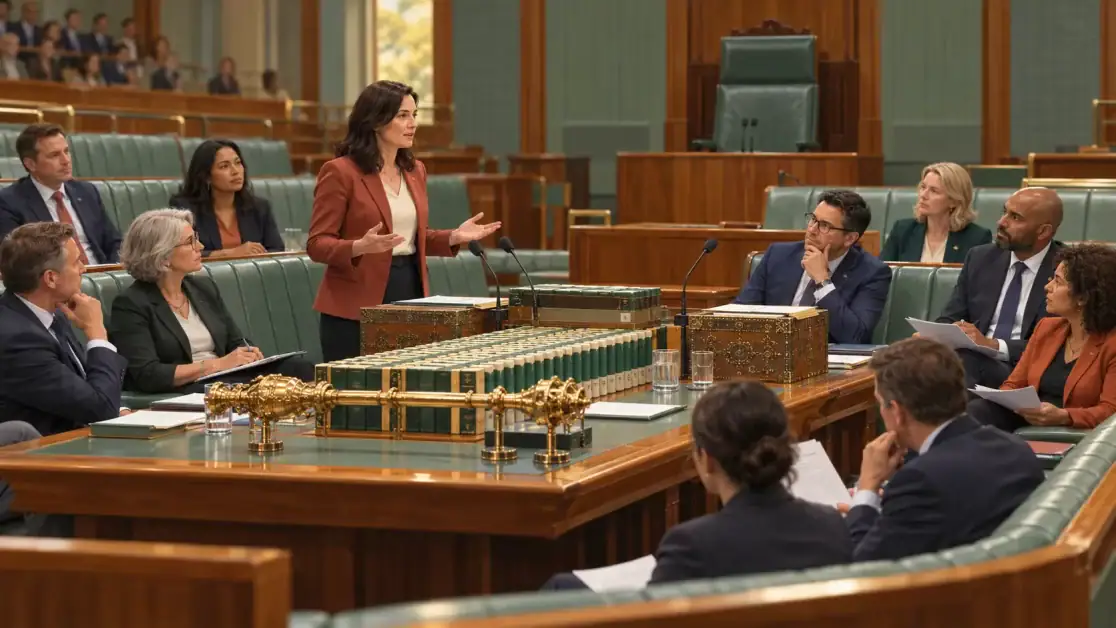
Imagine watching Question Time because you want an answer about a service your community needs. A member asks why it has been delayed. The minister talks about record investment. Someone shouts an insult. The Speaker calls for order.
The exchange ends. You still do not know when the service will open.
This imagined scene captures a reasonable frustration. Australians deserve a Parliament that helps them understand decisions affecting their lives. They should be able to expect respect, truthful claims and evidence that promises are being delivered.
A respectful parliament would make disagreement useful. The challenge is to carry that standard from the campaign advertisement to the parliamentary debate—and through to what governments actually achieve.
Quick Answer
A respectful parliament would allow strong disagreement while expecting politicians to listen, tell the truth and explain their decisions. Question Time should help citizens get answers by focusing on follow-up questions and spending less time on promotion. Honesty should also extend to political advertising, where federal electoral law offers limited protection against misleading policy claims. Governments should clearly distinguish promises, funding announcements, money spent and results achieved. Australia already has parliamentary standards and reporting systems to build on. The practical test is whether people can check a claim, follow a commitment and understand what happened when a promise changed, or a service failed.
1 Respect means taking people and their questions seriously
A good Parliament needs strong disagreement. Members should challenge harmful policies, expose failures and argue about who benefits from government decisions. An uncomfortable question can be exactly the question that needs asking.
Respect means allowing that challenge to be heard. It means answering the argument rather than attacking someone’s appearance, background or personal circumstances. It also means recognising that people affected by a policy may understand problems that its designers have missed.
The Behaviour Code for Australian Parliamentarians already recognises respectful disagreement and rejects bullying, harassment and discrimination. Parliament does not need to invent the principle. It needs to put it into practice.
That responsibility extends beyond relationships between politicians. When members use a disability as an insult or dismiss a struggling constituent, people outside the chamber hear the message too. Public office should require greater care with words.
Courtesy alone, however, is a poor measure of accountability. A minister can speak calmly and still avoid the question. A citizen can speak angrily and raise a legitimate concern. Our earlier article on political civility and accountability explores why respectful politics must protect forceful public criticism.
The standard should be straightforward: hear the concern, examine the evidence and explain the decision. Agreement is not required. Taking the question seriously is.
Why Question Time can feel like a farce
Question Time has a useful purpose. It gives representatives an opportunity to question ministers publicly about government decisions. Citizens can hear the exchange and judge the explanation.
Its value weakens when prepared promotion, evasive replies and interruptions consume that opportunity. Announcing a large spending package does not answer why a particular service remains unavailable.
The rules help explain the frustration. In the House of Representatives, answers must be directly relevant. Yet the House’s official procedural guide also explains that ministers do not have to answer questions. Relevance therefore does not guarantee a complete explanation.
The quality of questions matters too. An accusation packed with disputed assumptions can produce a quarrel over wording. A precise question about a decision, date or result is harder to sidestep and easier for viewers to follow.
Parliament has already examined these problems. Its 2021 report, A Window on the House, investigated Question Time’s practices and procedures. The next task is to judge reforms by what citizens learn from the answers.
What a useful exchange would sound like
Consider this fictional example:
Member: “Minister, the regional service was due to open this month. Why has it been delayed, and when will residents receive an updated opening date?”
Minister: “The premises are ready, but recruitment is incomplete. We will publish a revised timetable within four weeks.”
Follow-up: “What help will residents receive while they wait?”
Minister: “I cannot confirm that today. I will provide the arrangements within five working days.”
The minister has not escaped criticism. The answer identifies a problem and creates commitments that can be checked. Members can pursue the recruitment failure; residents can ask whether the interim help meets their needs.
Useful alternatives already exist. Victoria’s Parliament allows follow-up questions and separates ministers’ statements from questions without notice. Under its current arrangements, government members cannot use those questions for prepared exchanges commonly called Dorothy Dixers.
These arrangements offer practical ideas for federal reform. Measure their success by the information produced, not by how quiet or entertaining proceedings become.
2 Honesty must continue outside the chamber
Respect for voters includes giving them reliable information. A courteous debate achieves little if the same politicians then circulate misleading advertisements about their opponents or exaggerate their own achievements.
Political parties and candidates should back up their factual claims with evidence. When they get something wrong, they should publish a clear correction that people who saw or heard the original claim are likely to notice.
False information can mislead people whether it was spread deliberately or through carelessness. Calling something a lie makes a further claim: that someone knowingly deceived others. Evidence matters when making that accusation, but uncertainty about intent should never excuse leaving an established error uncorrected.
What the advertising rules actually cover
Many voters might reasonably expect election authorities to stop false campaign claims. The Australian Electoral Commission’s guidance explains a narrower federal role.
Section 329 of the Commonwealth Electoral Act concerns misleading people about how to cast their vote. It does not provide a general truth test for policy claims intended to influence which candidate they support. The AEC’s current compliance guidance continues to describe that limited scope.
An authorisation on an advertisement identifies who is responsible for the message. It does not certify that the message is true.
South Australia offers a useful comparison. Its electoral advertising rules prohibit purported statements of fact that are inaccurate and misleading to a material extent. The electoral commissioner may request withdrawal and require a corrective statement.
A national approach could build on that experience. It would need independent decisions, clear reasons, timely corrections and a fair way to challenge a ruling. Penalties should be proportionate, and the process should protect legitimate debate from complaints made simply to burden opponents.
Facts, predictions and opinions are different
If a politician claims an opponent voted for a bill, you can check the parliamentary record or use They Vote For You to explore recorded votes. Read what the vote concerned, including any amendment or procedural motion, before accepting a campaign summary.
A claim that a policy will lower prices is a prediction. Its reliability depends on the evidence and assumptions behind it. Saying one policy is fairer than another expresses a judgement about what matters most.
Laws against misleading advertising should distinguish false factual claims from predictions and opinions. People must remain free to argue about values and uncertain outcomes. Equally, describing something as an opinion should not make an underlying false factual claim immune from scrutiny.
The aim is to give voters a fairer chance to assess competing arguments. A correction published after an election may come too late to help them make that choice.
3 Delivery matters more than the announcement
A government promises a service. Later, it announces funding. A photograph is taken, a media release is issued, and the announcement appears in campaign material.
For the person waiting for help, the central question remains: when can I use it?
An announcement can mark genuine progress. But it is only one stage. Parliament should make the distance between a promise and a result easier to see.
Follow the money and then follow the result
Five questions can turn a broad claim of achievement into something citizens can check:
- What was promised, for whom and by when?
- What funding and legal authority are in place?
- How much money has actually been spent?
- What service, facility or other benefit has been delivered?
- What difference has it made to the people it was meant to help?
These questions describe different things. The Treasury’s budget glossary explains that an appropriation provides parliamentary authority for spending for a particular purpose. That authority does not itself establish that a payment has been made.
Likewise, signing a construction contract is not the same as completing a building. Paying a provider does not prove that people have received the promised care.
Take a hypothetical housing program. Funding allocation, contract signing, home completion, and households housed are separate milestones. Secure, affordable accommodation for the intended households is what ultimately matters.
Parliament should also ask what a headline funding figure contains. Is it additional money or previously announced funding? Over how many years? Does the package include loans or guarantees alongside direct spending? Clear answers would help citizens recognise both genuine progress and exaggerated claims.
Use the reporting systems that already exist
Governments already publish budgets, expenditure information and performance reports. The Department of Finance explains that annual performance statements should compare actual results with planned measures and targets.
The challenge is to connect those records to the promises people remember. Citizens should not have to search through several lengthy documents to find out whether a local service has opened or a national commitment has changed.
Parliamentary committees could regularly bring together the original commitment, spending to date, delivery milestones and evidence of results. A minister claiming success would then need to explain the outcome, not simply repeat the original allocation.
Changed promises need an honest explanation
A broken promise is not automatically a deliberate lie. Circumstances can change, legislation can fail to pass, and implementation can reveal serious flaws. Sometimes changing course is the responsible decision.
What matters is whether the government explains the change openly. It should identify the original promise, what prevented delivery, the money already spent and the consequences for affected people. A revised deadline should come with reasons.
The original record should remain available. Quietly changing the target or presenting partial delivery as completion makes accountability harder.
Our article on why popular policies stall examines barriers to reform. Parliament’s role is to identify the barrier in each case and require an explanation of the next decision.
Honest debate must also explain what Australia can do
When a minister says a service is unaffordable, a useful follow-up is: what is the actual constraint?
The Commonwealth operates within Australia’s currency-issuing monetary system. Households, businesses and state governments do not have that role. Australia has a floating exchange rate, and Commonwealth Treasury Bonds are denominated in Australian dollars.
Australia’s monetary sovereignty means federal finances cannot be understood simply as a household budget. It does not create nurses, builders, equipment or materials. Spending that increases demand beyond available capacity can add to inflation, as the Reserve Bank’s discussion of public-sector balance sheets explains.
Parliament should ask whether the obstacle is a budget priority, a workforce shortage, or another practical limit—and what it can do about it. This would make debate about public investment more honest and more useful.
A practical path to better parliamentary debate
The reforms need not begin with another long list of aspirations. Four changes would provide a clear starting point:
- Make Question Time more useful through focused follow-ups, clearer expectations for answers and a public record of information ministers promise to supply.
- Apply conduct rules fairly so members can be heard and personal abuse does not become a routine political tactic.
- Strengthen safeguards against materially misleading factual electoral advertising, with independent decisions and prominent corrections.
- Review major commitments against spending, delivery and results, keeping earlier promises visible when plans change.
These are recommendations for reform. They should be tested publicly, with attention to whether they improve scrutiny and preserve legitimate disagreement.
Question Time is also only part of Parliament’s work. Senate estimates permit more extensive questioning of ministers and officials about spending and administration. That detailed work deserves attention alongside the exchanges selected for television and social media.
Citizens can begin with one issue. Find the original claim, check the available evidence and ask a representative to pursue what is missing. A precise question can make more progress than a general complaint that all politics is hopeless.
Conclusion
A respectful parliament would take people seriously. It would allow strong disagreement, expect truthful claims and ask whether government action had improved people’s lives.
The standard is practical: answer the question, correct the error and show what happened to the promise. Better manners would help. Honest explanations and evidence of delivery would give those manners substance.
Frequently Asked Questions
Does respectful debate mean politicians must agree?
No. Strong disagreement is essential. Members should challenge decisions and evidence while allowing others to speak and avoiding personal abuse.
Can the Speaker compel a minister to answer?
The House’s practice does not give the Speaker a general power to compel an answer. Relevance rules govern replies, but do not guarantee a complete explanation.
Does the AEC check all political advertising for truth?
No. The federal protection discussed here mainly concerns how people cast their vote. It does not provide a general truth test for campaign policy claims.
Does announced funding mean money has been spent?
No. An announcement, spending authority, a contract and an actual payment are different stages. Even if money is spent, it does not prove the promised result was achieved.
Join the discussion
What would most improve your confidence in Parliament: better answers, more honest campaigning, clearer evidence of delivery—or something else?
Share your experiences, evidence and views in the comments, including respectful disagreement and corrections. Explore related SJA articles, share this article with your community and consider asking your representative one specific question about a commitment that matters to you.
If you believe in what we are trying to achieve, your support can help Social Justice Australia continue producing independent public-interest analysis. Every contribution, large or small, is appreciated. Visit Support Social Justice Australia.
#AustralianPolitics #QuestionTime #DemocraticReform #SocialJustice
Authoritative Sources
Sources checked on 28 October 2026. Historical reports are identified by date; current guidance is linked directly.
- Parliamentary Workplace Support Service — Behaviour Code for Australian Parliamentarians. Undated guidance; code took effect in October 2024. pwss.gov.au.
- Parliament of Australia — House of Representatives Practice, seventh edition, Chapter 15, Answers. 2018 edition, online procedural reference. aph.gov.au.
- House of Representatives Standing Committee on Procedure — A window on the House: practices and procedures relating to Question Time. March 2021. aph.gov.au.
- Parliament of Victoria — How sitting days work. Undated current public guidance. parliament.vic.gov.au.
- Department of the Senate — Senate Brief No. 5 — Consideration of Estimates by the Senate’s Legislation Committees. Undated online guidance. aph.gov.au.
- Reserve Bank of Australia — Exchange Rates and their Measurement. Undated education explainer. rba.gov.au.
- Australian Office of Financial Management — Information Memorandum — Treasury Bonds. 1 March 2024. aofm.gov.au.
- Philip Lowe, Reserve Bank of Australia — COVID-19, the Labour Market and Public Sector Balance Sheets. 21 July 2020. rba.gov.au.
- Australian Electoral Commission — FAQ: Misleading or deceptive electoral advertisement and other communications. Updated 28 April 2023; checked against current compliance guidance. aec.gov.au.
- Australian Electoral Commission — Compliance & Enforcement Activities. Current online guidance, accessed 28 October 2026. aec.gov.au.
- Electoral Commission South Australia — Electoral advertising – state elections. Undated current guidance, including section 113 of the Electoral Act 1985 (SA). ecsa.sa.gov.au.
- Australian Treasury — Portfolio Budget Statements 2023–24 — Glossary. May 2023; used for the meaning of an appropriation. treasury.gov.au.
- Department of Finance — What are annual performance statements?. Resource Management Guide 134, undated current online guidance. finance.gov.au.
- OpenAustralia Foundation — They Vote For You. Undated public parliamentary voting resource; accessed 28 October 2026. theyvoteforyou.org.au.