
Description
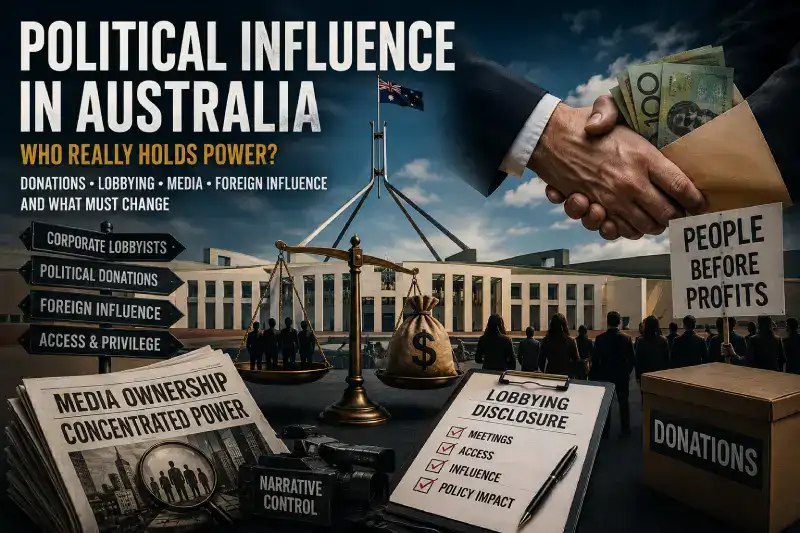
Political influence in Australia shapes government decisions through lobbying, donations, media power, and public policy. Who really holds power?
Introduction
Political influence in Australia has become an increasingly important issue for citizens concerned about housing affordability, climate policy, public services, and the growing gap between community expectations and government decisions.
Recent reforms requiring greater transparency around lobbyists with privileged access to Parliament House have been welcomed by many as a positive step. However, critics argue these changes only address part of a much larger problem involving political donations, lobbying, revolving-door employment, media influence, and corporate access to decision-makers.
Many Australians are asking a simple question: if voters consistently express concern about housing, cost of living, environmental protection, healthcare, and political integrity, why do policies so often favour powerful interests?
Understanding the answer requires following the money, the influence networks, and the structures that shape political decision-making.
This article does not suggest that all politicians, lobbyists, corporations, unions, or public officials act improperly. Rather, it examines how political systems can create incentives and power structures that may influence policy outcomes.
💰 Support Independent Journalism
If you value independent, fact-based analysis like this, consider supporting Social Justice Australia.
Even a small contribution helps keep this work available to everyone.
The Problem – Why Australians Feel Stuck
1. Structural Causes Behind Political Influence
Political systems do not operate in isolation. Governments rely on information, expertise, campaign funding, and stakeholder engagement. In theory, this allows informed decision-making. In practice, however, concerns arise when some voices have significantly greater access than others.
One area receiving increasing attention is political lobbying in Australia.
In June 2026, new parliamentary reforms were introduced requiring lobbyists with sponsored Parliament House access passes, and the MPs who sponsor them, to be publicly identified. Previously, much of this information remained hidden from public scrutiny.
While these reforms improve transparency, several integrity organisations argue that many forms of influence remain untouched, including:
- In-house corporate lobbyists.
- Industry associations.
- Ministerial meetings that are not publicly disclosed.
- Political donations.
- Revolving-door employment between politics and business.
Transparency International Australia welcomed the reforms but described them as only part of the solution, arguing broader weaknesses in federal lobbying rules remain.
Similarly, Australia’s lobbying regulations primarily focus on third-party lobbyists. Large corporations that employ their own government relations teams often work under different arrangements.
This raises an important question:
Does access to decision-makers become a form of political power when it is concentrated among a small number of organisations?
Link: Political Donations and Democracy; Neoliberalism and Corporate Power.
2. The Consequences for Ordinary Australians
For many Australians, political influence is not an abstract concept. It affects daily life.
Housing affordability continues to decline. Cost-of-living pressures are still significant. Energy prices, insurance premiums, healthcare costs, and rents have increased over recent years.
At the same time, public confidence in political institutions has weakened.
The concern is not necessarily that corruption is widespread. Rather, many citizens perceive that powerful interests often receive greater access and attention than ordinary voters.
Political donations provide one example.
The Australian Electoral Commission has implemented major reforms to funding disclosure laws, including lower disclosure thresholds and more frequent reporting requirements. These changes are the largest update to federal electoral funding rules in decades.
However, recent reporting revealed that political parties continued receiving large amounts of funding from sources not immediately visible to the public under earlier disclosure arrangements. Critics argue that improvements in transparency remain incomplete.
Research organisations focused on integrity and accountability have repeatedly warned that opaque funding arrangements, lobbying activity, and privileged access can create the belief that policy outcomes favour those with greater resources and influence.
When trust declines, democratic participation often suffers.
Citizens become less likely to believe their voices matter.
This may be one reason why support for independents and minor parties has grown in recent elections as voters search for alternatives to traditional political structures.
Link: Why Is Housing So Expensive? and The Failure of Neoliberalism
The Impact – What Australians Are Experiencing
3. Following the Money: Political Donations and Access
Most Australians accept that businesses, unions, charities, community organisations, and citizens have a legitimate right to take part in public debate.
The concern arises when some participants have vastly greater financial resources and political access than others.
Political donations sit at the centre of this debate.
Every election cycle, millions of dollars flow into Australian politics from corporations, unions, industry groups, and wealthy individuals.
Supporters argue that donations are a legitimate form of political participation.
Critics argue that large donations risk creating unequal access to political decision-makers and undermining public confidence in democracy.
The issue is not necessarily corruption.
The issue is whether major donors gain greater opportunities to influence policy outcomes than ordinary citizens.
Many integrity experts argue that influence often operates through access, relationships, meetings, and long-term networks rather than direct exchanges of favours.
This raises a fundamental democratic question:
Should access to elected representatives depend on the size of a donation?
Recent reforms have improved transparency by lowering disclosure thresholds and increasing reporting requirements.
However, many Australians are still concerned that wealthy interests continue to enjoy advantages that ordinary voters do not.
Links: Political Donations and Democracy; and Restoring Trust in Australian Politics
Political Lobbying Australia: How Influence Works
Lobbying is not inherently harmful.
In fact, lobbying is an essential part of democracy.
Environmental groups lobby governments.
Community organisations lobby for better services.
Medical professionals lobby for healthcare reform.
Trade unions lobby for workers’ rights.
Business organisations lobby for commercial interests.
Problems arise when access becomes unequal.
Large corporations often have substantial resources that allow them to employ:
- Full-time government relations staff.
- Former politicians.
- Former ministerial advisers.
- Former senior public servants.
- Professional lobbying firms.
These resources can provide levels of access that are simply unavailable to ordinary citizens.
Recent reforms requiring disclosure of Parliament House pass holders improve transparency by identifying some lobbyists and the MPs who sponsor their access.
This is a positive step.
However, many experts point out that significant lobbying activity occurs outside Parliament House through:
- Ministerial meetings.
- Industry forums.
- Advisory committees.
- Corporate briefings.
- Private functions.
As a result, concerns about transparency remain.
Do The New Lobbying Reforms Go Far Enough?
The recent reforms are progress.
However, they do not fully address several long-standing concerns.
In-House Corporate Lobbyists
Many large corporations employ their own government affairs teams.
These individuals often have significant access to decision-makers but may not be covered by the same disclosure requirements as third-party lobbyists.
Ministerial Diaries
Australians often cannot easily determine who ministers are meeting with and how often.
Several integrity advocates have argued for public disclosure of ministerial meetings.
Revolving-Door Employment
Former politicians, advisers, and senior bureaucrats regularly move into corporate, consulting, defence, mining, and lobbying roles.
While legal, these movements can create beliefs of conflict of interest and weaken public trust.
The question is not whether such individuals are acting improperly.
The question is whether democratic systems should rely solely on public confidence when stronger safeguards are available.
Could Australia Ban Political Donations Altogether?
Most proposed reforms focus on increasing transparency around political donations. But some democratic reform advocates argue a more fundamental question should be asked.
Why allow large political donations at all?
Under one model, corporations, industry groups, unions, and wealthy individuals would be prohibited from making significant political donations.
Instead, election campaigns would be publicly funded.
Every candidate who meets clear nomination requirements could receive a fixed allocation of public money to campaign for the election. Spending limits would apply equally to all candidates and parties.
Supporters argue this approach would:
- Reduce the influence of wealth on political outcomes.
- Create a more level playing field for candidates.
- Strengthen public confidence in democracy.
- Allow elections to focus more on policies and ideas rather than fundraising.
Critics argue that publicly funded elections would cost public money and may limit some forms of political participation.
However, from the perspective of democratic accountability, the financial cost would be extremely small compared with the potential benefits.
The question is not whether Australia can afford publicly funded elections.
The question is whether Australia can afford a system where political influence is increasingly linked to fundraising capacity.
If democracy is based on the principle that every citizen should have an equal voice, then perhaps every candidate should have an equal opportunity to be heard.
Australia’s Dollar Sovereignty and Election Funding
Opponents of public funding often ask how Australia could afford such a system.
From the perspective of Australia’s monetary sovereignty, the financial cost would be extremely small compared with overall federal spending.
The real issue is not affordability.
The real issue is whether publicly funded elections would strengthen democracy by reducing the influence of wealth on political outcomes.
A democratic system designed to represent citizens should ensure that political competition is based primarily on ideas, competence, integrity, and public support rather than fundraising capacity.
This proposal does not end influence entirely.
However, it may significantly reduce one of the most visible pathways through which money can shape politics.
4. Who Benefits from The Current System?
This question sits at the heart of debates about political influence in Australia.
Many controversial policies continue regardless of which major party forms government.
Examples often cited include:
- Fossil fuel subsidies.
- Privatisation and outsourcing.
- Resource royalty arrangements.
- Property tax concessions.
- Defence procurement decisions.
Supporters argue these policies encourage investment, jobs, and economic growth.
Critics argue they often provide disproportionate benefits to powerful interests while delivering fewer benefits to ordinary Australians than promised.
These concerns are not merely theoretical. Several recent controversies have highlighted how influence, access, and power continue to shape public policy debates in Australia.
Real-World Examples of Political Influence Debates
The question of political influence is not theoretical. Several recent controversies have raised concerns about how power operates within Australia’s political system.
Fossil Fuel Subsidies
Successive governments have continued providing billions of dollars in support and concessions to fossil fuel industries despite Australia’s climate commitments and growing scientific concern about climate change.
Supporters argue these industries provide jobs, export income, and energy security.
Critics argue that public money is being used to support highly profitable industries, while renewable energy and climate adaptation programs often struggle to secure comparable support.
The PwC Scandal
The PwC tax leaks scandal raised serious questions about the relationship between government, major consulting firms, and private interests.
Confidential government information intended to help prevent multinational tax avoidance was allegedly used to assist corporate clients.
The controversy highlighted broader concerns about outsourcing government functions to private consulting firms and the potential conflicts that can arise.
Resource Royalties
Australia is one of the world’s largest exporters of minerals and natural resources.
Yet critics argue Australians receive a relatively modest return from some resource extraction projects compared with countries such as Norway.
This has led to ongoing debate about whether Australia’s natural wealth is delivering sufficient long-term benefits for the broader community.
Gambling Industry Influence
Australia has some of the highest gambling losses per person in the world.
Attempts to strengthen gambling regulations have often faced strong resistance from powerful industry interests.
Critics argue this demonstrates how well-resourced industries can influence policy debates, while supporters maintain that governments must balance economic activity, personal freedom, and social concerns.
These examples do not prove corruption.
However, they demonstrate why many Australians continue to question whether political influence is distributed fairly across society.
Resource Wealth and Public Benefit
Australia has some of the world’s most valuable natural resources.
Yet unlike Norway, Australia has not established a sovereign wealth fund to capture a substantial share of resource wealth for future generations.
Norway’s Government Pension Fund Global is now worth more than AUD $3 trillion. Built from petroleum revenues, it helps ensure that resource wealth benefits both current and future generations.
Australia possesses vast mineral and energy resources, yet much of the wealth generated from those resources accrues to private interests rather than to long-term public investment.
Even a modest Australian sovereign wealth fund could help finance public housing, healthcare, education, infrastructure, climate adaptation, and future economic challenges.
This raises important questions.
Could greater public returns from Australia’s natural resources help fund:
- Public housing.
- Healthcare.
- Education.
- Climate transition projects.
- Infrastructure.
If Australia’s natural wealth belongs collectively to its citizens, should the public receive a greater share of the benefits?
💰 Mid-Article Donation CTA
This kind of analysis is rarely covered in mainstream media.
If you want more content like this, reader support makes it possible.
👉 A small donation helps keep this work going
A Question for Readers
Would Australian democracy be stronger if large political donations were banned and every candidate received equal public funding to contest elections?
The Solution – What Must Be Done
5. Foreign Influence, National Sovereignty and Democratic Accountability
Political influence does not come only from donations and lobbying.
Many Australians are increasingly asking whether Australia’s major strategic decisions are always being made primarily in Australia’s long-term national interest.
This question has become particularly important in discussions surrounding AUKUS, defence procurement, intelligence sharing arrangements, and Australia’s broader foreign policy direction.
AUKUS and Strategic Dependence
The AUKUS agreement is one of the most significant defence commitments in Australian history.
Supporters argue that AUKUS will:
- Strengthen national security.
- Improve military capability.
- Enhance deterrence.
- Strengthen alliances with traditional partners.
Critics raise different concerns.
They question:
- The long-term financial costs.
- Strategic dependence on foreign powers.
- Reduced foreign policy independence.
- Whether alternative investments may deliver greater public benefit.
The debate itself is legitimate.
The important democratic question is whether Australians have been given sufficient information and opportunity to participate meaningfully in decisions involving hundreds of billions of dollars of public money.
Pine Gap and Intelligence Sharing
Australia’s participation in intelligence-sharing arrangements and the operation of facilities such as Pine Gap continue to generate debate.
Supporters view these arrangements as essential to national security.
Critics argue they may increase Australia’s involvement in conflicts over which Australians have limited democratic oversight.
Regardless of individual views, these issues highlight a broader concern.
Major strategic decisions should be subject to robust public scrutiny and democratic accountability.
Media Concentration and Narrative Control
Political influence is not exercised solely through governments.
Media organisations also shape public understanding of issues.
Australia has one of the most concentrated media ownership structures in the democratic world.
A small number of organisations dominate newspapers, television, radio, and online news distribution.
This does not mean journalists act improperly.
However, concentrated ownership can influence:
- Which issues receive attention?
- Which perspectives dominate the debate?
- Which voices are amplified?
- Which policies are presented as realistic?
A healthy democracy benefits from a diversity of viewpoints.
Independent media, community media, public broadcasting, and alternative news sources all contribute to a more informed public discussion.
When citizens receive information from a wider range of sources, they are better equipped to evaluate competing claims and hold power to account.
Is The Problem Corruption or System Design?
Many political discussions quickly turn into accusations of corruption.
However, the evidence often points toward a more complex reality.
Much of the influence discussed throughout this article is legal.
Political donations are legal.
Lobbying is legal.
Former politicians accepting private sector employment is legal.
Corporate advocacy is legal.
The problem may therefore be less about individual misconduct and more about how the system itself operates.
Structural Incentives
Political systems create incentives.
Those incentives often reward:
- Fundraising.
- Party loyalty.
- Media management.
- Short-term electoral thinking.
- Relationships with influential stakeholders.
At the same time, they may discourage:
- Long-term planning.
- Structural reform.
- Challenging powerful interests.
- Policies whose benefits may not appear until years later.
If these incentives consistently produce outcomes that favour concentrated power, the issue may not lie with individual politicians.
The issue may be the system’s design.
💰 Mid-Article Donation CTA
This kind of analysis is rarely covered in mainstream media.
If you want more content like this, reader support makes it possible.
👉 A small donation helps keep this work going
6. Policy Solutions: Building a Democracy That Works for Citizens
If Australians want different outcomes, reforms must address the sources of influence rather than merely the symptoms.
Reform Political Donations
Reforms include:
- Banning corporate political donations.
- Banning foreign political donations.
- Strict limits on individual donations.
- Real-time disclosure of donations.
- Greater transparency in campaign funding.
Introduce Publicly Funded Elections
As discussed earlier, election campaigns could be funded through transparent public allocations rather than large private donations.
Potential benefits include:
- Greater electoral fairness.
- Reduced donor influence.
- Stronger public confidence.
- Improved opportunities for independents and smaller parties.
Strengthen Lobbying Transparency
Reforms include:
- Comprehensive lobbyist registers.
- Public disclosure of ministerial meetings.
- Disclosure of advisory committee memberships.
- Stronger reporting requirements for in-house corporate lobbyists.
Extend Cooling-Off Periods
Former politicians, advisers, and senior bureaucrats could face longer waiting periods before accepting lobbying or industry positions related to their earlier responsibilities.
Media Diversity Reforms
Australia could encourage:
- Greater media competition.
- Independent journalism.
- Community media initiatives.
- Strong public broadcasting services.
Citizens Assemblies
Randomly selected citizens could help examine major policy issues and provide recommendations to Parliament.
This approach has been used successfully in several democratic countries.
Monetary Sovereignty and Democratic Renewal
Australia has a unique advantage that is often misunderstood.
As the issuer of its own currency, the Australian Government is not financially constrained in the same way households, businesses, or state governments are.
The real limits on public spending are:
- Available labour.
- Skills.
- Technology.
- Natural resources.
- Inflationary pressures.
This understanding creates opportunities to address many of Australia’s challenges.
A Federal Job Guarantee
A Job Guarantee could:
- End involuntary unemployment.
- Provide meaningful local work.
- Stabilise communities.
- Improve economic security.
Public Housing Construction
Large-scale public housing programs could:
- Reduce homelessness.
- Improve affordability.
- Support employment.
- Strengthen communities.
Healthcare and Education
Monetary sovereignty allows Australia to focus on real resources and public needs rather than arbitrary budget targets.
The question should not be:
“Can we afford it?”
The question should be:
“Do we have the people, skills, materials, and capacity to do it?”
If the answer is yes, then the challenge becomes political will rather than financial affordability.
What Would a Democracy Designed for Citizens Look Like?
Imagine a system where:
- Political influence is transparent.
- Elections are publicly funded.
- Lobbying activities are visible.
- Public resources serve public needs.
- Citizens take part more directly in decision-making.
- Government focuses on long-term national interests.
Such a system would not end disagreement.
Nor would it end competing interests.
However, it could help ensure that public policy is shaped primarily by democratic participation rather than concentrated economic power.
💰 Pre-Conclusion Donation Trigger
This article is part of a broader effort to inform and empower Australians.
Right now, the site is only partially funded.
👉 If just a small number of readers contribute, this work continues.
Final Thoughts
Political influence in Australia is about more than donations, lobbying, media ownership, or individual politicians.
It is about who has access to power, who shapes public policy, and whether Australia’s democratic institutions primarily serve citizens or powerful interests.
The recent lobbying reforms are a welcome step towards greater transparency. However, they also highlight a larger question.
If Australians want genuine democratic accountability, reforms may need to go beyond disclosure and address the structures that allow concentrated economic and political power to shape public outcomes.
The evidence examined throughout this article suggests that many of the challenges Australians face today, including housing affordability, rising inequality, environmental degradation, declining trust in institutions, and concerns about national sovereignty, are connected by a common theme.
Power is rarely distributed equally.
A healthy democracy should continually look to ensure that every citizen has a meaningful voice regardless of wealth, political connections, or organisational influence.
Political influence in Australia will remain a central issue for future generations.
The question is whether Australians are willing to reform the system before public trust declines even further.
The future of Australian democracy may depend on the answer.
💰 Support Independent Journalism That Puts Australians First
This site operates on a modest budget of about $2,000 per year and is currently only partially funded.
So far, readers have contributed $807 towards that goal.
If this article helped you see things differently, this is your chance to support more work like it.
🤝 Join the Conversation
Share This Article
If you found this article valuable, please share it with your family, friends, community groups, and social media networks.
Public awareness is the first step towards meaningful reform.
Leave A Comment
Do you believe powerful interests have too much influence over Australian politics?
What reforms would you support?
Reader Feedback
Click on our Reader Feedback menu and tell us how Social Justice Australia has helped inform your understanding of important public issues.
Testimonials
Your feedback helps strengthen independent journalism and encourages others to engage with the issues that matter.
Follow Social Justice Australia
Stay connected through:
Together, we can help build a more informed and democratic Australia.
Frequently Asked Questions
What is political influence in Australia?
Political influence in Australia refers to the ability of individuals, organisations, corporations, lobbyists, media groups, unions, and other stakeholders to affect government decisions, legislation, public policy, and political outcomes.
Is lobbying legal in Australia?
Yes. Lobbying is a legitimate part of democracy and allows organisations and citizens to advocate for their interests. Concerns arise when lobbying lacks transparency or when some groups have greater access to decision-makers than others.
What are the recent lobbying reforms?
Recent reforms require greater disclosure of lobbyists with sponsored access to Parliament House and name the parliamentarians who sponsor those access passes. These reforms aim to improve transparency and public accountability.
Should political donations be banned?
Opinions differ. Some experts argue that banning large political donations and replacing them with publicly funded election campaigns would reduce the influence of wealth in politics. Others argue that donations are a legitimate form of political participation.
How does Australia’s monetary sovereignty relate to political reform?
Australia issues its own currency and is not financially constrained like a household or business. This means the federal government can fund public programs when sufficient real resources are available. The primary constraints are labour, skills, productive capacity, and inflation, rather than revenue collection alone.
What reforms could improve democratic accountability?
Common proposals include:
- Greater lobbying transparency.
- Public disclosure of ministerial meetings.
- Stronger anti-corruption measures.
- Publicly funded elections.
- Restrictions on political donations.
- Longer cooling-off periods for politicians and senior officials.
- Citizens assemblies.
- Greater media diversity.
References
Government And Parliamentary Sources
- Australian Electoral Commission (AEC)
- Australian Parliament House
- Parliamentary Library Research Briefs
- National Anti-Corruption Commission (NACC)
Transparency And Governance
Research And Analysis
- Australian Institute
- Grattan Institute
- Productivity Commission
- Universities Australia research publications
News Sources
- The Guardian Australia
- ABC News
- Independent Australia
- Michael West Media
- The Australian Independent Media Network
Questions For Readers
Do you believe Australia’s political system primarily serves citizens, political parties, corporations, or a combination of all three?
What single reform would most improve Australian democracy?