
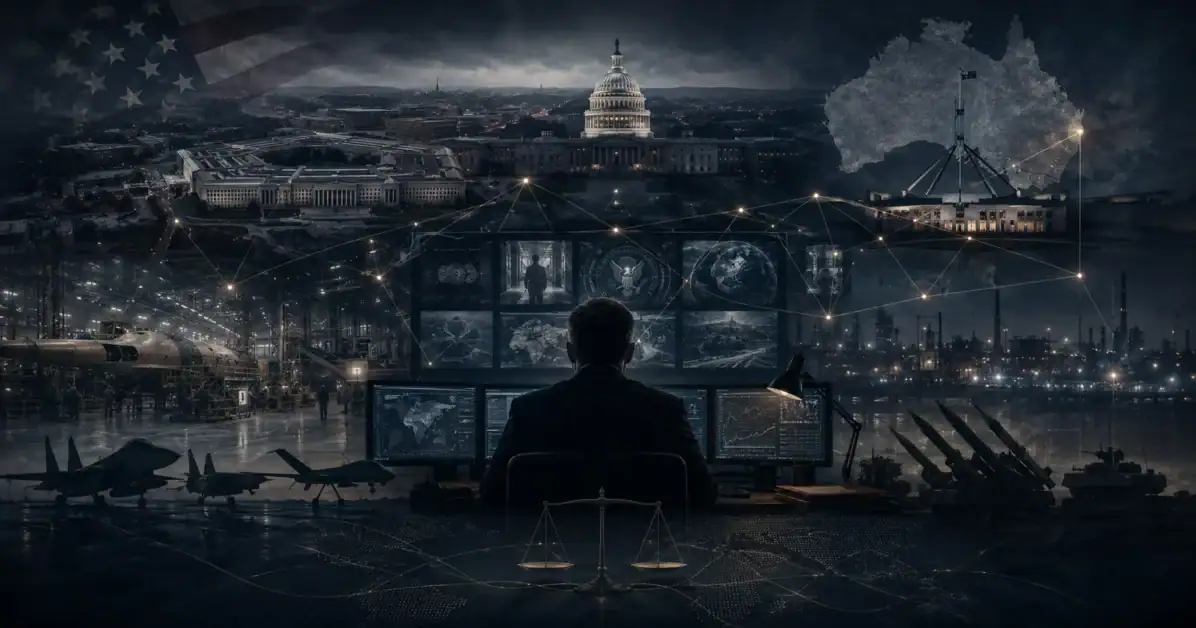
How the US military-industrial complex, CIA secrecy and defence profits weaken international law—and why Australia should care.
Quick Answer
No court or universally recognised authority has designated the United States Government a terrorist organisation or formally declared it a rogue state. Those labels should therefore not be presented as established fact. However, official records prove that US administrations have authorised covert regime-change operations, supported armed groups, used torture and violated international law. The military-industrial complex does not secretly control every decision, but it creates powerful incentives for threat inflation, high military expenditure and reliance on force. The strongest conclusion is not that every American action is criminal; it is that immense power, secrecy and profit have repeatedly weakened democratic and legal restraint.
A Serious Charge Requires Careful Language
Calling a government a terrorist organisation may express moral outrage, but it is not a settled legal finding. The United Nations Office on Drugs and Crime notes that international agreement on a universal legal definition of terrorism remains absent. States can nevertheless commit unlawful aggression, war crimes, crimes against humanity, torture and other grave violations under established bodies of law.
“Rogue state” is also a political description rather than a formal status. If the term is used, it should be tied to transparent criteria: repeated disregard for international law, coercive interference in other countries, refusal of independent accountability and a double standard between rules applied to adversaries and rules accepted for oneself. The same test must apply to the United States, China, Russia, Israel, Iran and every other state.
The legal starting point is the United Nations Charter. Article 2(4) generally prohibits the threat or use of force against another state. The principal exceptions are Security Council authorisation and individual or collective self-defence following an armed attack. Disagreement over facts and legal justification is common, but military power does not itself create legality.
Who Authorises, Who Operates and Who Profits?
The system is more complex than a hidden group issuing orders from a single room. Responsibility is distributed across institutions with different roles and interests:
- Presidents and the National Security Council set strategy and authorise major covert or military actions.
- The CIA collects intelligence and conducts covert operations intended to conceal or obscure US responsibility.
- The Pentagon plans and carries out overt military operations.
- Congress approves funding, writes relevant laws and is supposed to provide oversight.
- Defence and technology companies supply weapons, surveillance systems, logistics and specialised personnel.
- Think tanks, lobbyists and media commentators influence which threats and responses appear politically respectable.
This is not proof of a perfectly coordinated conspiracy. Institutions disagree, governments change, officials sometimes resist unlawful proposals, and investigative journalists and whistleblowers expose abuse. The danger lies in aligned incentives: secrecy protects officials, contracts reward companies, military commands seek capability, and elected representatives value jobs and investment in their constituencies.
The CIA’s Documented Record
The CIA is often treated as the central aggressor because covert action allows a government to interfere abroad while denying or obscuring responsibility. The historical record supports serious criticism, but it also shows that presidents and senior policymakers frequently directed the operations.
Iran, 1953
Declassified material in the CIA Reading Room records that the agency organised and directed the 1953 coup that removed Prime Minister Mohammad Mossadegh and strengthened the Shah. The operation helped entrench authoritarian rule and left a legacy of distrust that still shapes relations between Iran and the United States.
Guatemala, 1954
Official US State Department historical documents describe a covert plan to remove the government of Jacobo Árbenz and install and sustain a pro-US government. The overthrow was followed by decades of repression and civil conflict. The CIA executed the operation under government authority and in cooperation with other agencies.
Chile, 1970–73
US diplomatic records show that President Richard Nixon directed the CIA to try to prevent Salvador Allende from taking office. The United States funded propaganda and opposition activity and explored ways to encourage a coup. The documents establish improper interference. They do not justify the oversimplified claim that the CIA single-handedly planned and executed every aspect of the 1973 military coup.
Secret detention and torture
The US Senate Intelligence Committee’s investigation documented the CIA detention and interrogation program after the September 11 attacks. Its findings described brutal treatment, serious management failures and inaccurate claims to policymakers about effectiveness. This was not speculation supplied by an adversary; it was an investigation by the United States Senate.
These cases demonstrate that covert power can cause enormous harm. They do not establish that every CIA employee or operation is criminal. Intelligence agencies also warn of attacks, monitor weapons proliferation and provide information needed for legitimate defence. The democratic problem is the combination of secrecy, weak scrutiny and the capacity to inflict harm without timely public accountability.
How the US Military-Industrial Complex Shapes Foreign Policy
President Dwight Eisenhower’s 1961 farewell address warned of “unwarranted influence” arising from the conjunction of a permanent military establishment and a large arms industry. The US National Archives records that warning. Eisenhower was not arguing that defence was unnecessary. He was warning that a necessary institution could acquire misplaced power.
That concern has grown with the scale and concentration of modern defence procurement. SIPRI estimated US military expenditure at approximately US$954 billion in 2025, close to one-third of the global total. A US Department of Defence report found that consolidation reduced the number of major aerospace and defence prime contractors from 51 in the 1990s to five.
The revolving door adds another concern. The US Government Accountability Office found that 14 major defence contractors employed about 1,700 former senior or acquisition officials in 2019 who had left the Department of Defence during the previous five years. Employment is not proof of corruption, and restrictions apply. It nevertheless creates real or perceived conflicts of interest and can weaken public confidence.
The defensible argument is therefore about incentives, not a universal claim about motives. Contractors profit from procurement, elected representatives defend local jobs, military organisations seek budgets and capability, and security institutions tend to emphasise threats. Together, these pressures can make diplomacy appear weak and military expansion appear prudent even when the evidence is uncertain.
It would still be wrong to claim that every war is manufactured solely for profit. Governments respond to genuine aggression, allies sometimes need protection, and industrial capacity is necessary for credible defence. Profit may influence policy without being its only cause. A factual analysis must distinguish documented financial interests from claims about secret intentions that cannot be proved.
When Power Resists International Accountability
The strongest evidence for “rogue” behaviour comes from specific legal findings. In the Nicaragua case, the International Court of Justice found that US support for the Contras and actions including the mining of Nicaraguan ports breached obligations under international law. The judgment remains an important example of a powerful state being found to have violated rules governing the use of force and non-intervention.
A more recent dispute concerns the International Criminal Court. In February 2025, the White House imposed sanctions on people associated with ICC investigations involving US personnel and Israeli leaders. The administration argues that the court lacks legitimate jurisdiction over nationals of states that have not joined the Rome Statute.
United Nations human-rights experts reject that position and say the sanctions undermine judicial independence and accountability for grave crimes. The disagreement should be reported fairly: the United States disputes the court’s authority, while critics argue that territorial jurisdiction can apply when alleged crimes occur in a state party’s territory.
The deeper issue is consistency. A rules-based international order loses credibility when powerful countries demand accountability for rivals but resist independent scrutiny of themselves or close allies. This does not mean every allegation is true. It means allegations should be tested by evidence and law, rather than defeated through economic coercion against judges and prosecutors.
The Strongest Counterarguments
A fair article must recognise the case made by supporters of US power:
US military capability has deterred some aggression and provided security guarantees valued by allies.
Intelligence cooperation can prevent terrorism, cyberattacks and weapons proliferation.
A viable defence industry is necessary because military equipment cannot be improvised after a crisis begins.
American courts, congressional committees, journalists and civil society have exposed wrongdoing that more closed states would conceal.
Focusing only on US abuses can minimise serious violations committed by rival powers.
These arguments have weight. The United States is neither uniquely evil nor incapable of serving constructive purposes. However, beneficial actions do not cancel unlawful ones. Democracies should be judged more rigorously, not less, because they claim to act with public consent and under law. Criticism of US policy is strongest when it is universal, evidence-based and equally willing to condemn abuses by other governments.
Why Australia Is Implicated
Australia is not merely an observer. Its alliance, intelligence facilities and procurement choices connect it to the American security system.
Australian governments say activities at Pine Gap occur with Australia’s “full knowledge and concurrence”. That assurance means Australia cannot simultaneously claim complete ignorance if joint capabilities contribute to controversial operations. Necessary operational secrecy should not remove ministerial responsibility or independent legal oversight.
AUKUS deepens military and industrial integration. The Australian Government has estimated the submarine pathway at roughly A$268–368 billion over three decades and argues it will strengthen deterrence, skills and manufacturing. The official AUKUS announcement projects substantial investment and around 20,000 direct jobs over 30 years. Those claimed benefits must be weighed against technological dependence, delivery risk, strategic entrapment and the real resources committed.
This article does not repeat the detailed examination of US military facilities in Australia, the evidence-based discussion of hidden institutional power or the analysis of war expenditure and opportunity cost. The distinct question here is accountability: can Australia verify that the system it supports remains within international law?
Australia’s Dollar Sovereignty Does Not Remove Real Choices
Australia issues its own floating currency. The Commonwealth therefore does not face the same financial constraint as a household, business or state government when purchasing goods and services available in Australian dollars. It can fund defence and essential public services. The binding limits are productive capacity, available workers and materials, inflation, technology and foreign-currency requirements.
That makes the defence debate more concrete. Engineers, shipyard capacity, specialist trades, research capability, steel and imported technology committed to AUKUS cannot automatically be used elsewhere at the same time. The question is not whether Canberra can “find the money”. It is whether the security gained justifies the real resources, dependencies and risks involved.
The neoliberal preference for outsourcing and private contracting did not create the military-industrial complex, but it widened the role of profit-seeking companies in functions once performed inside government. Rebuilding public expertise would help Australia assess procurement claims independently rather than relying heavily on the firms seeking contracts.
What Democratic Reform Would Look Like
The answer is not isolationism or the abolition of intelligence and defence. It is democratic control strong enough to match the power being exercised.
Require parliamentary approval before Australia enters major overseas conflicts, with a tightly defined emergency exception and rapid retrospective review.
Publish the legal basis, objectives, expected duration and civilian-risk assessment for military operations whenever genuine operational security permits.
Strengthen independent oversight of Pine Gap and other joint facilities, including confidential review of whether Australian-derived intelligence supports operations consistent with international law.
Tighten revolving-door, lobbying and conflict-of-interest rules for senior defence officials, ministers, advisers and contractors.
Publish AUKUS milestones, risks, contingent liabilities, foreign payments and major beneficiaries in a form Parliament and the public can scrutinise.
Protect whistleblowers and accelerate declassification of historical operations once security risks have passed.
Invest more seriously in diplomacy, regional institutions, arms control, climate security and conflict prevention.
Australia’s Parliament has acknowledged that the decision to send forces into armed conflict is among the most serious powers exercised by government. The Joint Standing Committee inquiry into armed conflict decision-making provides a foundation for continuing reform, even though governments have resisted transferring the final decision to Parliament.
Conclusion: Accountability, Not Anti-Americanism
The available evidence does not justify presenting the United States as a legally designated terrorist organisation. Nor does it prove that the CIA or arms companies secretly control every administration. It does justify a grave democratic concern.
Across several administrations, the United States has interfered in other countries, used unlawful or abusive methods and resisted external accountability. The CIA has often been the covert instrument. The military has supplied overt force. Defence contractors benefit from sustained expenditure. Political leaders and Congress remain responsible for authorising, funding or failing to restrain the system.
Many of the people who exposed these abuses were Americans: senators, judges, journalists, veterans, whistleblowers and human-rights advocates. Questioning concentrated US power is therefore not hostility towards the American people. It is support for the democratic and legal principles that Americans themselves have repeatedly fought to defend.
For Australia, loyalty to an ally must never mean surrendering independent judgment. A responsible alliance should allow Canberra to refuse to take unlawful action, demand credible evidence, and place international law above political convenience. If it cannot, the problem is not simply American power. It is Australia’s failure to govern its own involvement.
Frequently Asked Questions
Is the United States officially a rogue state?
No. “Rogue state” is a political description, not a formal legal category. The responsible approach is to assess particular actions against international law and transparent standards.
Does the CIA act independently of the US Government?
Not in the broad sense. Major covert actions are authorised within the executive system, although secrecy, compartmentalisation and weak oversight can give agencies considerable operational freedom. Presidents and senior officials cannot escape responsibility by blaming the CIA alone.
Does the military-industrial complex cause wars?
It creates incentives for high expenditure, threat-focused policy and military solutions. That influence is well documented, but it does not prove that profit is the sole cause of every conflict.
Can Australia afford defence and strong public services?
Financially, the currency-issuing Commonwealth can fund both. The real constraints are workers, materials, industrial capacity, imports, technology and inflation. Those resources must therefore be allocated according to transparent public priorities.
Does AUKUS automatically make Australia responsible for US actions?
No. Responsibility depends on Australia’s knowledge, approval and material contribution to a particular action. Greater integration nevertheless increases the need for independent oversight and a demonstrated capacity to refuse participation.
Have Your Say
Can Australia remain a responsible US ally while refusing unlawful or unaccountable operations—and what safeguards would convince you that it can?
If you found this article insightful, explore more about political reform and Australia’s monetary sovereignty on Social Justice Australia.
Share this article with your community to help drive the conversation towards a more just and equal society.
Click on our Reader Feedback menu. Let us know how our content has inspired you. Submit your testimonial and help shape the conversation today.
Additionally, leave a comment about this article below.
Independent public-interest analysis depends on readers. If you are able, please support Social Justice Australia with a donation.
Authoritative Sources
US National Archives — President Eisenhower’s Farewell Address (1961)
SIPRI — Trends in World Military Expenditure, 2025
US Department of Defense — State of Competition Within the Defense Industrial Base
US Government Accountability Office — Post-Government Employment Restrictions
CIA Reading Room — The Battle for Iran and the 1953 coup
US State Department, Office of the Historian — Guatemala covert-action plan
US State Department, Office of the Historian — CIA Chilean Task Force activities
US Senate — Church Committee investigation of intelligence abuses
US Senate Intelligence Committee — CIA Detention and Interrogation Program
International Court of Justice — Nicaragua v United States
United Nations — Purposes and Principles of the UN Charter
UN Office on Drugs and Crime — Defining Terrorism
White House — Executive Order imposing sanctions on the ICC
UN Human Rights Office — Demand to withdraw US sanctions against ICC officials
Australian Parliament — Pine Gap and “full knowledge and concurrence”
Australian Government — AUKUS nuclear-powered submarine pathway
Australian Parliament — Inquiry into international armed conflict decision-making