
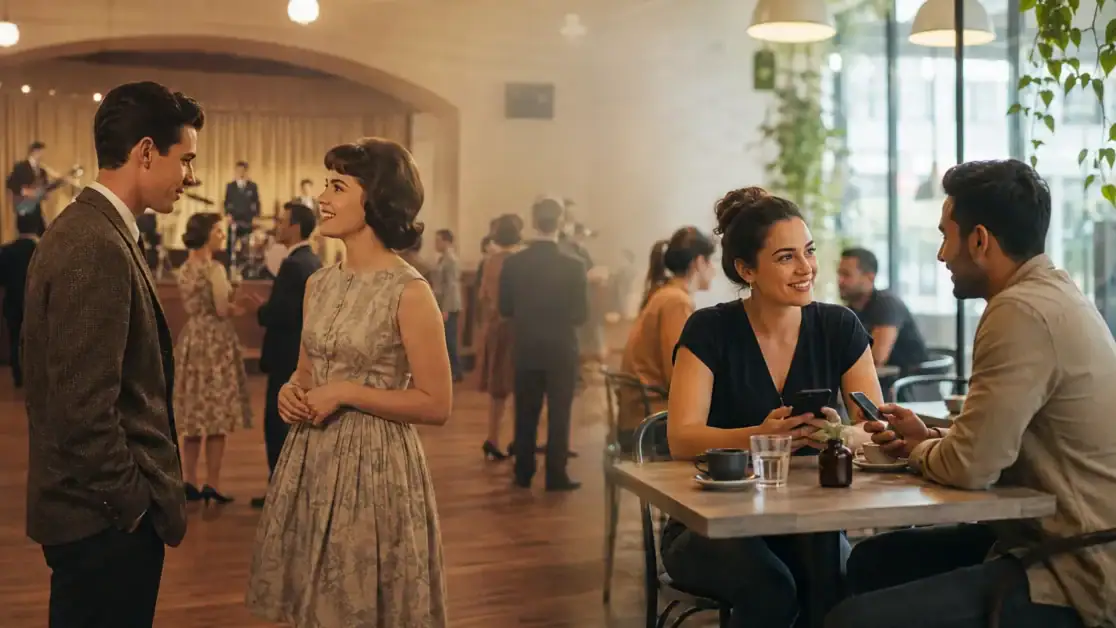
How dating has changed in Australia, from courtship and marriage to apps, consent, equality and modern expectations of intimacy.
How Dating Has Changed in Australia
When I first entered adulthood, dating usually began in the physical world. People met through friends, dances, churches, workplaces, sporting clubs or neighbourhood gatherings. There were no profiles to swipe, no instant messages and no silent disappearance known as “ghosting”.
That does not mean dating was necessarily easier or fairer. Courtship occurred within stricter social rules. Marriage was widely treated as the expected destination; women had less economic independence, sexual acts between men remained criminal offences, and many intimate matters were hidden behind silence or shame.
Today, Australians have much greater freedom to choose whom they love, how they meet and what kind of relationship they want. Yet choice has brought new complications. Dating can now feel faster, less certain and more commercial. People may have access to thousands of possible partners while still struggling to form one secure connection.
This article follows Healthy Intimacy in Relationships: What Makes Love Last?. That article examined the qualities that sustain closeness. This one asks a broader question: how has the society surrounding dating, relationships and intimacy changed?
Quick Answer
Dating in Australia has changed from a relatively narrow, marriage-centred system to a more diverse and digitally mediated one. People now tend to marry later, cohabitation is common, women have greater financial independence, same-sex couples can marry, and consent and equality receive far greater attention.
Men and women generally have more freedom, but they also navigate less settled rules. Many women expect safety, equality, emotional maturity and a fair division of work. Many men are expected to communicate more openly and participate as equal partners, while still encountering traditional pressure to initiate, provide and appear confident.
These are broad patterns, not rules about every individual. Expectations vary greatly with age, culture, sexuality, religion, disability and personal values.
Dating in the Post-War Years
For many Australians who began dating in the 1950s or 1960s, courtship was closely connected to marriage. Social circles were smaller, introductions often came through people already known, and a person’s family or community could exercise considerable influence.
Marriage also happened much earlier. According to the Australian Bureau of Statistics, the median age at first marriage in 1971 was 23.4 for men and 21.1 for women. By 2025, the median age at marriage, including marriages beyond the first, was 32.7 for men and 31.2 for women. These measures are not exactly identical, but the long-term movement towards later marriage is unmistakable.
The earlier system offered some advantages. Meeting through shared communities could provide social accountability. Intentions were often clearer because dating was expected to lead towards commitment. Face-to-face conversation came before prolonged private messaging.
However, nostalgia can hide the system’s costs. Women could be judged more harshly than men for sexual activity. Pregnancy outside marriage carried severe stigma. Divorce was difficult, and an unhappy or unsafe marriage could be hard to leave. Gay, lesbian and bisexual Australians were denied recognition and often forced to conceal their relationships.
The old rules created certainty for some people by restricting the freedom of others.
The Social Changes That Transformed Relationships
Modern dating did not emerge from a single sexual revolution. It developed through several connected legal, economic and cultural changes.
Contraception gave couples greater control
Reliable contraception helped separate sexual intimacy from an unavoidable risk of pregnancy. This expanded women’s ability to plan education, employment and parenthood, although access, social acceptance and individual experiences were never uniform.
Women gained greater economic independence
Women accounted for about 30% of Australia’s paid workforce in 1966 and almost half by 2020. Paid employment did not eliminate inequality, but it reduced the extent to which marriage had to function as a woman’s main source of economic security.
This changed the basis on which relationships could be formed. A partner increasingly had to offer companionship, respect and emotional value, not merely financial provision or social status.
Divorce became more accessible
The Family Law Act 1975 introduced no-fault divorce. A spouse no longer had to prove adultery, cruelty or another marital offence to end a marriage. This did not make separation painless, but it recognised that the law should not compel people to remain in a relationship that had irretrievably broken down.
Relationships became more diverse
De facto relationships became common and more legally recognised. Marriage equality arrived in December 2017. Australians became more able to live openly in relationships that did not conform to the heterosexual, lifelong-marriage model.
In the 2021 Census, the ABS counted about 8.75 million married people and 2.17 million people living in de facto relationships. The change is not the disappearance of commitment. It is the decline of marriage as the only socially acceptable form of adult intimacy.
How Technology Changed the Way People Meet
Perhaps the most visible change is the movement from local courtship to digital search.
The eSafety Commissioner estimates that more than three million Australians use dating apps and websites to seek love, intimacy or sexual connection. Online dating can be especially valuable for people in regional areas, people with disability, those with caring responsibilities and members of smaller sexual or cultural communities.
It expands opportunity. A person is no longer restricted to whoever happens to attend the same dance, church, workplace or club.
But the same technology changes how people are perceived. A complex human being can be reduced to a photograph, a short description and a few filters. The next possible match is always visible. This can encourage hasty judgements and the feeling that nobody needs to be accepted as imperfect, since another option may be just one swipe away.
Dating platforms are also businesses. Their commercial success depends on continued use, not necessarily on every user quickly finding a lasting partner. That does not prove that apps deliberately prevent relationships, but it raises a legitimate question about whether the platform’s and the user’s interests always coincide.
Modern dating, therefore, contains a paradox: people can reach more potential partners than ever before while feeling disposable, overwhelmed, or lonely.
Have Women’s Expectations Changed?
Women are not a single group, and no list can describe them all. Nevertheless, greater legal and economic independence has made several expectations more visible.
Equality is increasingly treated as essential
Many women now expect to participate equally in decisions about money, work, children, sex and the future. A relationship based on male authority and female obedience is less likely to be accepted simply because it was once considered normal.
Safety and consent are more openly discussed
Consent is not merely the absence of a spoken “no”. Healthy intimacy requires voluntary and continuing agreement, without pressure, fear or manipulation. Past generations also valued respect, but today there is a stronger public language for identifying coercion, sexual harassment and controlling behaviour.
The 2021 National Community Attitudes towards Violence against Women Survey found gradual improvement in Australians’ rejection of harmful beliefs about gender inequality and violence. It also found that troubling attitudes persist. Social change is real, but incomplete.
Emotional and sexual satisfaction matter
Women have greater freedom to say that companionship alone is not enough. Many expect affection, emotional availability, communication and concern for mutual pleasure. These are not excessive modern demands. They reflect the idea that both partners are full human beings whose needs matter.
Domestic equality remains unfinished
Expectations have changed faster than behaviour in some households. Australian Institute of Family Studies research continues to find gendered patterns in housework and caring, particularly when a man works full-time and a woman works part-time or is outside paid employment.
The modern ideal may be equal partnership, but many couples are still negotiating what equality means in daily life.
Have Men’s Expectations Changed?
Men have gained freedoms too. They are less confined to the role of distant provider and disciplinarian. A man can seek emotional closeness, share care, admit uncertainty and define masculinity more broadly than earlier generations often permitted.
At the same time, modern expectations can feel contradictory.
A man may be expected to respect equality while still making the first approach. He may be encouraged to show vulnerability, even as he fears that uncertainty will be read as weakness. He may no longer be assumed to be the sole provider, yet housing costs and social expectations can still make income and status feel central to his desirability.
Some men adapt comfortably to equal partnership. Others feel that familiar rules have disappeared without clear new ones replacing them. That confusion should be taken seriously, but it does not justify resentment towards women or a return to male authority.
The constructive response is better communication and a healthier model of masculinity. Respect, emotional honesty and shared responsibility do not diminish men. They allow men to participate in relationships as complete people rather than performers of an inflexible role.
What Do Men and Women Expect From Each Other Now?
Despite frequent claims that the sexes want entirely different things, the overlap is substantial. Most people seeking a healthy relationship want some combination of:
- attraction and affection
- honesty about intentions
- emotional and physical safety
- loyalty to the agreement the couple has made
- satisfying intimacy
- respect for independence
- dependable companionship
- fair treatment during disagreement
- shared responsibility for practical life
- the freedom to leave without intimidation
The difficulty is not always incompatible values. It is that modern relationships have fewer assumed rules. One person may be seeking marriage while another wants companionship without cohabitation. One may assume exclusivity after several dates while the other believes exclusivity requires an explicit conversation.
Freedom works best when expectations are discussed rather than guessed.
Intimacy Has Become More Open, but Not Necessarily Easier
People today can speak more openly about sexual orientation, pleasure, contraception, boundaries and different relationship structures. That openness can foster healthier intimacy because partners have better language to express what they do and do not want.
Yet public openness can create its own pressure. Advertising, pornography and social media may suggest that everyone else is more attractive, adventurous or sexually fulfilled. Private relationships can then be measured against carefully staged images or unrealistic performances.
True intimacy is not achieved by following a fashionable script. It depends on whether the people involved can be honest, considerate and safe with one another.
Consent is indispensable, but consent alone does not guarantee emotional care. Conduct can be consensual and still leave someone feeling misled if intentions were deliberately concealed. Ethical intimacy requires clarity, empathy and responsibility as well as permission.
The New Risks of Online Dating
Online dating creates real relationships, but its dangers should not be minimised.
An Australian Institute of Criminology survey of nearly 10,000 Australian dating-platform users found that 72.3% of its sample had experienced some form of online sexual harassment, aggression or violence from a person they met through a platform during the previous five years. The findings describe the survey sample, not every Australian dating-app user, and the broad measure covered experiences ranging from unwanted sexual messages and persistent contact to threats. It should not be misread as meaning that nearly three-quarters experienced physical assault.
Romance scams add another danger. Scamwatch recorded more than $28.6 million in reported losses from romance scams during 2025. Actual harm may be higher because embarrassment and emotional distress can discourage reporting.
Basic safeguards include:
- remaining on the platform until trust has developed
- using video calls to help verify identity
- meeting first in a public place
- telling someone where you are going
- keeping financial and identifying information private
- never sending money to a person known only online
- treating sudden declarations of love, repeated emergencies or investment proposals as warning signs
Responsibility must not rest only on users. Platforms should be required to design safer systems, respond effectively to reports and remove repeat offenders.
Dating and Intimacy in Later Life
Public discussion often treats romance as the property of the young. That is both inaccurate and ageist.
Older people may seek love, sex, companionship or affection after divorce, separation or bereavement. Some want to remarry. Others prefer a committed relationship while maintaining separate homes, finances or family arrangements.
Later-life dating can bring distinctive considerations, including health, mobility, adult children, caring responsibilities, pensions, inheritance and fear of losing independence. It can also bring strengths: greater self-knowledge, less concern with social approval and a clearer understanding of what makes companionship worthwhile.
Older Australians should not be treated as asexual, foolish or incapable of choosing. They deserve the same respect for consent, privacy and intimate self-determination as anyone else, together with practical protection from exploitation.
How Economic Insecurity Enters the Bedroom
Relationships do not exist outside the economy. Housing costs, insecure work, long commutes and insufficient time place pressure on courtship and intimacy.
Relationships Australia’s national Relationship Indicators study found that 71.9% of Australians had experienced at least one pressure affecting their most important relationship during the previous six months. Common pressures included work or study commitments, mental health, money problems and the division of household tasks.
This matters for social justice. Governments often treat relationship distress as a private failure requiring individuals to communicate better. Communication is important, but no conversation can manufacture an affordable home, stable roster, accessible childcare or adequately funded mental-health service.
Australia’s dollar sovereignty gives the federal government the financial capacity to invest in public housing, secure employment, healthcare, education and community services. The real limits are available workers, skills, materials, productive capacity and inflation, not whether the Commonwealth can “find” Australian dollars.
Good public policy cannot create love. It can remove avoidable pressures that make loving relationships harder to form and sustain.
Was Dating Better Then or Now?
There is no honest one-word answer.
Earlier dating often offered clearer rituals, stronger community connections and more face-to-face interaction. It could also enforce gender inequality, silence sexual minorities and pressure people into marriage.
Modern dating offers greater freedom, broader choice and more equal expectations. It can also encourage superficial judgement, ambiguous commitment, harassment and emotional exhaustion.
The past provided more rules. The present provides more choices. Neither guarantees intimacy.
What matters is whether freedom is supported by honesty, equality and care. Without those qualities, traditional courtship can become control and modern choice can become disposability.
Relationships Are a Social Justice Issue
Love is personal, but the conditions in which people seek it are political.
A fair society should support:
- comprehensive education about consent and respectful relationships
- economic security and affordable housing
- accessible sexual and mental healthcare
- serious action against domestic and sexual violence
- effective regulation of dating-platform safety and privacy
- equal recognition of diverse relationships
- protection from discrimination based on sex, sexuality, gender identity, disability or age
- community spaces where people can meet without having to purchase access through an app
Healthy intimacy cannot be legislated into existence. However, governments can help create a society in which nobody must trade dignity, safety or economic survival for companionship.
What Has Not Changed
Technology has transformed how people meet, but human needs are remarkably persistent.
People still want to be seen rather than assessed, desired rather than used, and accepted without having to pretend. They want someone who listens, keeps faith with agreed boundaries and remains emotionally present when novelty gives way to ordinary life.
The methods of dating have changed profoundly. The foundations of worthwhile intimacy have not.
What do you think: has greater choice improved relationships, or made genuine connection harder to find?
Frequently Asked Questions
How has dating changed in Australia?
Dating has shifted from locally organised, face-to-face courtship towards greater use of apps and social media. Australians generally marry later, cohabitation is common, relationships are more diverse, and expectations around equality, consent and communication are stronger.
Was dating easier in the 1950s and 1960s?
It sometimes offered clearer expectations and stronger community connections. However, it also involved stricter gender roles, limited recognition of diverse sexuality, less economic independence for women and greater pressure to marry. Whether it felt easier depended heavily on who you were.
What do women expect from relationships today?
There is no universal female preference. Common expectations include respect, safety, emotional communication, sexual consideration, economic independence and a fair division of domestic and caring work.
What do men expect from relationships today?
Men’s preferences also vary. Many seek affection, loyalty, intimacy, acceptance and equal companionship. Men may also face conflicting expectations to be emotionally open while remaining confident, successful and willing to initiate.
Are dating apps making relationships worse?
The evidence does not support such a simple conclusion. Apps expand access and help many people form relationships, especially where local opportunities are limited. They can also expose users to superficial selection, unwanted contact, harassment and scams. Outcomes depend partly on platform design and how people use the technology.
Help Build a Fairer Conversation
If you found this article insightful, explore more about political reform and Australia’s monetary sovereignty on Social Justice Australia.
Share this article with your community to help drive the conversation towards a more just and equal society.
Support Social Justice Australia to help keep independent, evidence-based articles freely available.
Visit our Reader Feedback page. Let us know how our content has inspired you, submit your testimonial and help shape the conversation today.
Additionally, leave a comment about this article below.
Sources
- Australian Bureau of Statistics, Marriages and Divorces, Australia, 2025
- Australian Bureau of Statistics, Year Book Australia 2003: median age at first marriage
- Australian Bureau of Statistics, Household and families: Census 2021
- Australian Bureau of Statistics, Changing female employment over time
- Parliament of Australia, Marriage and family in Australia
- Australian Institute of Family Studies, Couple relationships in Australia today
- Relationships Australia, Relationship Indicators: Full Report
- eSafety Commissioner, Online dating
- Australian Institute of Criminology, Sexual harassment, aggression and violence victimisation among mobile dating app and website users
- ANROWS, Quick Guide to the 2021 National Community Attitudes towards Violence against Women Survey
- Scamwatch, National Anti-Scam Centre romance scam taskforce report
- Australian Institute of Health and Welfare, Social isolation and loneliness