
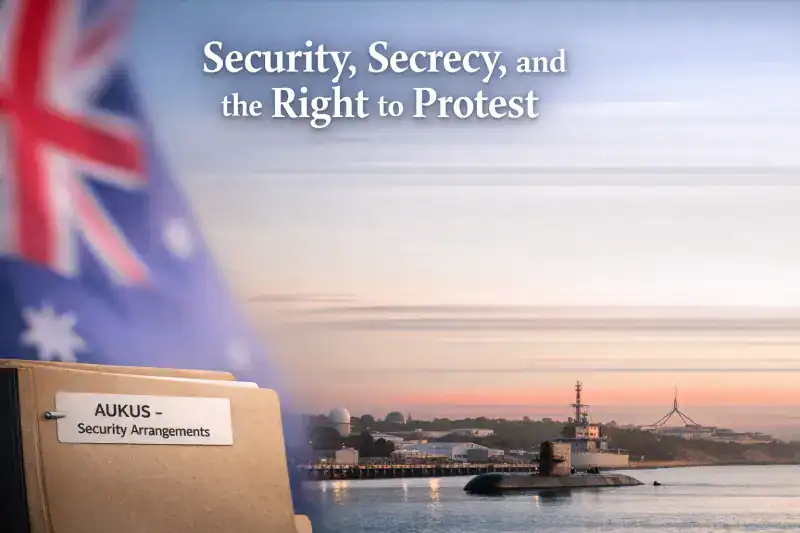
Description
AUKUS protest police: FOI documents reveal the AFP’s Orcus Command and how protest is being treated as a national security issue in Australia.
Introduction
Public discussion of AUKUS has focused on submarine delivery dates, strategic alignment, and cost blowouts. Far less attention has been given to how the Australian government is preparing for domestic opposition to the agreement.
Freedom of Information documents obtained by transparency advocate Rex Patrick and reported by Michael West Media reveal that the Australian Federal Police has quietly established a new unit, Orcus Command, dedicated to protecting AUKUS-related defence facilities. The documents show this unit is also planning for public order management, including protest and political dissent connected to Australia’s growing role in US and UK military operations.
This matters because protest is a cornerstone of democratic accountability. When dissent is framed primarily as a security risk, the balance between public order and civil liberties shifts in ways that deserve close public scrutiny.
What has received far less attention is how the government is preparing to manage Australians who oppose it.
Internal link: “Australia’s AUKUS agreement”.
Editor’s note:
This analysis is based on Freedom of Information documents obtained by transparency advocate Rex Patrick and reporting by Michael West Media. All claims in this article are drawn from released documents, budget papers, and publicly available statements. Care has been taken to distinguish between documented facts, lawful policing powers, and broader democratic implications.
What Is Orcus Command
Orcus Command is a specialised AFP unit created to provide protective security for the AUKUS nuclear-powered submarine program, particularly at strategically significant defence bases such as HMAS Stirling in Western Australia.
FOI documents show that:
- The unit was created with minimal public disclosure.
- It has a mandate extending beyond physical asset protection.
- It is embedded within the Department of Defence, not a civilian oversight body.
- Its planning includes public order and protest activity.
This institutional placement is significant. By situating Orcus Command within Defence rather than a civilian agency, protest management around AUKUS is treated as a national security issue rather than a matter of routine democratic policing.
Internal link: “Defence influence in Australia”.
Protest and Dissent as a Security Issue
Internal AFP documents explicitly reference the monitoring and response to political opposition and protest activity linked to AUKUS and the expanding US military presence in Australia.
This reflects a broader shift in Australian governance. Over recent years, most states have introduced or strengthened laws restricting protest, increasing police powers, and imposing harsher penalties for disruption.
Rather than being framed as a democratic expression to be facilitated and protected, protest is increasingly framed as a risk to continuity and order.
The Orcus Command documents indicate:
- Planning for escalation scenarios
- Proactive monitoring of protest groups
- Coordination with state police
- Anticipation of increased protest intensity
Internal link: “right to protest in Australia”
Why Is Protest Being Framed as a National Security Issue Under AUKUS?
The documents state that Orcus Command has Commonwealth responsibility for protecting the nuclear submarine program under existing legislative powers.
This places protest activity in the same conceptual space as counterterrorism and critical infrastructure protection. While such powers are lawful, their application to political dissent raises difficult questions.
When a protest is absorbed into a national security framework:
- Thresholds for intervention are lowered.
- Decision-making becomes less transparent.
- Oversight mechanisms are weakened.
- Civil liberties are more easily subordinated to strategic objectives.
This does not mean that protest is automatically criminalised. It does mean that the lens through which protest is viewed has changed.
Internal link: “national security frameworks”.
Lethal Force Provisions and What They Signal
One of the most sensitive revelations in the AFP briefing material is the inclusion of lethal force within Orcus Command’s armed protection planning.
Lethal force authorisations are standard in many armed federal policing and counter-terrorism contexts. Their inclusion alone is not unlawful or unusual. However, the context matters.
These provisions appear within documents that also discuss protest and public order management. This signals that scenarios involving political dissent are being contemplated within a framework that allows for the highest level of force available to federal police.
This does not suggest protesters will routinely face lethal force. It does show that dissent around AUKUS is being planned for within a security paradigm where extreme outcomes are legally contemplated.
That distinction is important, but it should not be dismissed.
Reassuring Allies, Managing Citizens
FOI emails reveal that Australian authorities are keen to show to the United States and the United Kingdom that protest activity will not disrupt or delay AUKUS operations.
This highlights a core tension: Australian policing resources are being used not only to keep domestic order, but also to reassure foreign military partners.
The documents emphasise:
- Proactive responses to identified protest risks.
- The importance of continuity for allied operations
- Minimising disruption to US and UK interests
Internal link: “Foreign policy dependence“.
Budget Allocations Signal Long-Term Expansion
Funding figures reinforce the seriousness of the operation.
- $73.8 million allocated to Orcus Command in late 2025.
- Funding rising to $125.2 million in 2026.
This near doubling suggests the government expects expanded responsibilities and sustained operations, rather than a short-term security task.
Budgets reflect priorities. In this case, substantial public funds are being committed to a policing unit designed to manage both infrastructure security and anticipated dissent.
Internal link: “public money priorities”.
Secrecy, FOI, and Democratic Oversight
AUKUS is one of the most secretive projects in Australia’s modern history. While some confidentiality around defence capabilities is legitimate, secrecy has expanded far beyond technical details.
The government has:
- Refused a comprehensive public inquiry.
- Limited parliamentary scrutiny
- Relied heavily on national security exemptions
- Restricted public access to key information
Without FOI requests and investigative journalism, the existence and scope of Orcus Command would remain unknown.
The Broader Democratic Context
The creation of Orcus Command does not occur in isolation. It sits alongside:
- Tightened protest laws across states
- Expanded police powers.
- Increasing surveillance of activists
- Reduced tolerance for disruption
Taken together, these trends suggest a gradual rebalancing of the state’s relationship with citizens, particularly where dissent intersects with powerful economic or strategic interests.
Why This Matters for Democracy
A functioning democracy requires more than elections. It requires:
- The right to dissent.
- Transparency in decision-making
- Civilian oversight of coercive power
- Proportional policing
When protest is framed as a threat rather than a democratic expression, public trust erodes and accountability weakens.
Orcus Command is not, by itself, proof of authoritarian intent. But it is a clear indicator of how the Australian state is preparing to manage disagreement over one of its most controversial policy decisions.
Frequently Asked Questions
What is Orcus Command?
Orcus Command is a specialist unit within the Australian Federal Police created to provide protective security for AUKUS-related defence facilities. FOI documents show its remit includes public order planning linked to protest activity around these sites.
Why is the AFP involved in managing AUKUS protests?
Because AUKUS infrastructure is classified as critical national security infrastructure, the federal government has assigned responsibility to the AFP. This places protest management within a national security framework rather than routine civilian policing.
Can Australian police use lethal force against protesters?
Lethal force is authorised in limited circumstances under federal policing laws. FOI documents show lethal force provisions are included in Orcus Command’s armed protection planning, though this does not mean peaceful protest is automatically subject to such force.
Is protesting against AUKUS illegal in Australia?
No. Protest is still lawful in Australia. However, laws and policing approaches increasingly restrict where, when, and how protests can occur, particularly near critical infrastructure and defence sites.
Why is there so much secrecy around AUKUS?
The government argues that secrecy is necessary for national security. Critics say the scope of secrecy extends beyond technical details and limits democratic oversight of costs, risks, and policing arrangements.
Who uncovered the existence of Orcus Command?
The unit’s existence and scope were revealed through Freedom of Information requests by transparency advocate Rex Patrick and reported by Michael West Media.
Conclusion
The establishment of the AFP’s Orcus Command marks a significant shift in how Australia approaches dissent related to defence and foreign policy.
By embedding protest management within a national security framework tied to allied military interests, the government has quietly redefined the boundaries between democratic expression and security enforcement.
This shift toward AUKUS protest police reflects a broader redefinition of dissent in Australia and deserves careful public examination, not silence.
Call to Action
We want to hear from you
- Please share your thoughts through our Reader Feedback
- Visit our Testimonials page to see how others are engaging.
- Leave a comment below; every voice helps shape future content.
Explore more
Find more writing on political reform and Australia’s dollar sovereignty at Social Justice Australia.
Share this article
Articles like this only create change when they are shared. If it stays with one reader, the message stops.
Support independent journalism
Running this site costs around $2000 a year, and reader donations have helped cover $807 so far.
Every contribution helps keep this work online, accessible, and independent.
Donate now, one time or monthly.
Already donated? A quick Google review helps others discover the site.
What Do You Think?
Do you believe protests related to major defence projects like AUKUS should be managed within a national security framework, or treated primarily as a democratic right?
Have your say in the comments below.
I find this deeply disappointing.
For decades, the Labor Party presented itself as the party of the people, the defender of democratic rights and civil liberties. Yet in recent years, we have seen a federal government that appears increasingly comfortable with secrecy, expanded security powers, and the quiet sidelining of public debate.
Whatever one’s view on AUKUS, Australians should not have to rely on Freedom of Information requests and independent journalism to learn how protest and dissent are being treated by the state. That alone should concern anyone who values a healthy democracy.
This article is not about fear or exaggeration. It is about transparency, accountability, and the steady erosion of principles that once defined Labor’s purpose. At the very least, Australians deserve honesty, scrutiny, and open discussion about the direction our country is taking.