
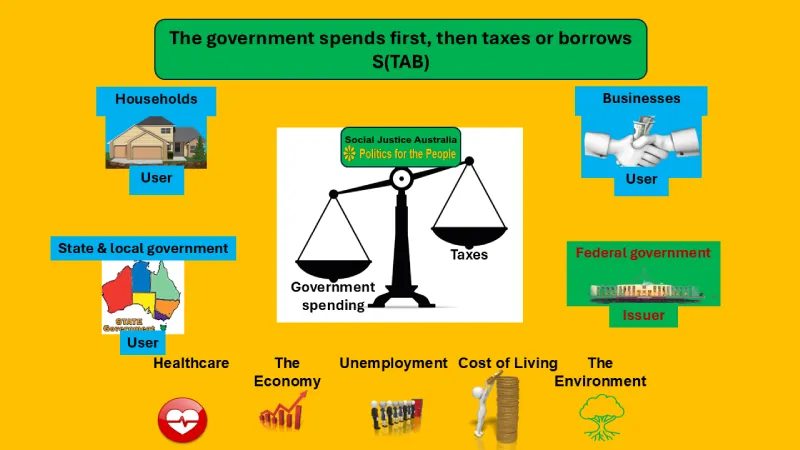
Do taxes fund government spending? Explore taxpayers’ money, Australia’s dollar sovereignty, accountability and the real limits on spending.
“There is no such thing as taxpayers’ money” challenges a familiar political story: that Canberra must first collect enough dollars from households before it can provide public services. That story overlooks Australia’s position as the issuer of its national currency.
Yet, the counterclaim also needs care. People really do pay taxes. Tax receipts are government revenue. Australia has laws, bank accounts and borrowing arrangements that govern public expenditure. Recognising monetary sovereignty does not make these arrangements disappear.
So, do taxes fund government spending? The answer depends on whether we mean today’s budget and payment arrangements or the Commonwealth’s wider monetary capacity. Understanding both helps Australians judge decisions about housing, healthcare, education and other shared needs.
Quick Answer
Taxes help finance Commonwealth spending under Australia’s existing budget and cash-management arrangements. But the Commonwealth is part of the system that issues the Australian dollar, so its financial position differs fundamentally from a household’s. “Taxpayers’ money” becomes misleading when it suggests every federal payment requires an equivalent amount of tax collected beforehand. The opposite claim, that taxes have no financing role, also overlooks current arrangements. Spending requires lawful authority and managed cash balances. Its wider limits include inflation, workers, skills, materials and environmental capacity. Calling it public money keeps attention on those limits and on accountability to the whole community.
What people mean by taxpayers’ money
The phrase has at least two meanings. One is a demand for care: people surrender income through taxation and expect governments to act responsibly. That is a legitimate concern. Nobody needs to accept a particular economic theory to oppose waste or favouritism.
The other meaning is a claim about where spending capacity comes from. It suggests government resembles a household with a jar of savings, and that the jar must contain enough tax dollars before anything useful can happen.
For the Commonwealth, that picture leaves out central banking, government borrowing and the national currency system. The Australian Office of Financial Management’s explanation of its operations describes an active process of forecasting cash flows and arranging borrowing. Federal expenditure is not capped at the tax collected on a particular day. [1]
“Public money” is often the more helpful expression. It preserves the demand for responsible government without making a claim that a particular person’s tax payment bought a particular hospital bed.
Our editorial view is that public accountability belongs to the whole community. A child, an unpaid carer or someone unable to work has a stake in public decisions whether or not they pay income tax. Their needs should not require a receipt proving their financial contribution.
Do taxes fund government spending under current rules
Yes, taxation is a source of financing within the arrangements Australia currently uses. A government can also borrow, receive non-tax revenue and draw on cash it already holds. Taxation therefore matters, even without a dollar-for-dollar ceiling on spending.
The Reserve Bank of Australia’s banking services page explains that the Official Public Account group records the Commonwealth’s daily cash position. The Australian Office of Financial Management, or AOFM, must ensure enough cash is available for payment commitments. These arrangements include a strictly limited overdraft facility, not an unrestricted spending account. [2]
This raises two different questions. Can an agency disregard its authority or available funding because Australia issues dollars? No. Does the national government face the same financial constraint as a family that cannot issue the currency? Also, no.
The distinction matters when assessing political claims. A statement that a proposal exceeds an existing appropriation may be accurate. A statement that the Commonwealth has the same money-earning capacity as a household is a much broader claim, and a misleading one.
Australia’s monetary sovereignty changes the comparison
Australia has its own currency and a floating exchange rate. The dollar has floated since 1983, rather than being maintained at a fixed price against another currency. The RBA’s account of the exchange-rate system explains how this supports domestic monetary policy and helps absorb external shocks. [3]
The Commonwealth’s standard Treasury Bonds are Australian-dollar obligations. A household borrowing dollars must acquire a currency it cannot issue. The Commonwealth operates at the centre of the institutions that issue and manage that currency. [4]
That gives Australia substantial policy capacity. It does not mean a minister personally controls an unlimited bank balance. Parliament, government agencies and the RBA have distinct responsibilities. Existing legal and institutional requirements continue to apply.
It also does not mean Australia can create whatever the dollars are meant to purchase. Currency capacity cannot guarantee a supply of trained nurses, suitable land, imported machinery or affordable energy.
Social Justice Australia’s broader explanation of monetary sovereignty explores the currency-issuer distinction. Here, the central issue is how that distinction fits alongside actual financing arrangements and democratic responsibility.
Public spending needs legal authority
An appropriation is legal authority to draw money for specified purposes. Sections 81 and 83 of the Constitution establish the Consolidated Revenue Fund and require an appropriation before money is drawn from it. The Department of Finance’s guidance explains these requirements. [5]
Finance describes the Consolidated Revenue Fund as a notional concept representing Commonwealth money. It is not simply one ordinary bank account. Actual banking and cash management occur through separate operational arrangements.
Legal authority and cash availability answer different questions. An appropriation permits expenditure within its terms; it does not itself manufacture staff, deliver a service or guarantee a successful outcome. A funded announcement is still only a step towards delivery.
These distinctions protect democratic control. Arguing for a larger public housing program means making a case for lawful expenditure, practical delivery and public benefit. Monetary sovereignty strengthens the possibilities available for consideration; it does not replace the need to justify them.
What happens when government pays and collects tax
A simplified payment example helps. Suppose the Commonwealth pays an approved invoice to an Australian supplier. Government banking arrangements move the payment through the financial system, and the supplier receives a credit in its bank account.
Tax payment moves purchasing power in the other direction. The payer’s available balance falls, and funds flow to government accounts. In a 2020 explanation of the RBA’s balance sheet, then Deputy Governor Guy Debelle described how spending, taxation and bond issuance affect government deposits and banking-system liquidity. Liquidity here means funds available for settling payments. [6]
These are accounting entries, but their consequences are real. The supplier can pay wages; the taxpayer has less money available for other uses.
Calling taxes “destroyed money” can describe their effect when analysts combine the government and central bank into one accounting unit. It is incomplete as a description of Australia’s actual institutional accounts, where tax receipts also increase government deposits. The accounting perspective must be stated, not assumed. [6, 16]
Nor should every dollar in a private bank account be described as the result of earlier government spending. The RBA explains that commercial-bank lending creates deposits. A bank loan creates a deposit alongside a debt owed by the borrower. That is different from a government payment and from central-bank money used between banks. [7]
Why Modern Monetary Theory and official accounts sound different
Modern Monetary Theory, or MMT, emphasises the capacity of a government that issues its own currency. Its researchers examine the relationship between treasury operations, central banking and the rest of the economy.
In research published by the Levy Economics Institute, the argument is that currency issuers have policy options obscured by comparisons with currency users. Analysing treasury and central-bank operations together helps show that capacity. The paper’s detailed case study concerns the United States, so it should not be mistaken for a manual of Australian law. [8]
Official Australian descriptions, by contrast, explain the responsibilities of institutions operating separately under current arrangements. AOFM describes borrowing as financing the Budget. The RBA describes maintaining government cash balances. These describe actual operations, not evidence that the country is financially identical to a household. [1, 2]
There is also substantive disagreement about policy. In a July 2020 question-and-answer session, then RBA Governor Philip Lowe opposed direct central-bank financing, arguing that it could weaken confidence in institutional arrangements. That was a policy judgement about how monetary capacity should be used, rather than a denial that central banks can create money. [9]
Readers deserve both distinctions: what today’s system requires, and what alternative arrangements might permit. Assess a reform proposal on its merits, not as something already happening.
Why taxation remains essential
Taxation affects who can spend, what they can buy and how economic power is distributed. Recognising Australia’s dollar sovereignty does not make those questions less important.
Taxes influence demand and distribution
Collecting tax reduces the income available to the payer. Alongside government transfers, the tax system changes how disposable income is distributed. Its design also influences incentives to work, save, invest or consume. These roles are explained in Treasury’s account of Australia’s tax and transfer system. [10]
The consequences depend on which tax changes and whose spending changes. A tax that mainly reduces saving is not economically identical to one that cuts a struggling household’s grocery budget. The distributional question should therefore sit beside the revenue estimate.
That is a reason to scrutinise tax concessions and avoidance carefully. A currency-issuing government still needs a fair and workable tax system. The capacity to issue dollars does not settle who should retain purchasing power or how much inequality a society should accept.
Taxes help stabilise the economy
Tax receipts and income-support payments can change automatically as economic conditions change. When earnings weaken, some tax liabilities decline and support payments may rise. These effects can cushion a downturn without a fresh policy announcement. Treasury describes these mechanisms as automatic stabilisers. [10, 17]
A deficit can consequently widen because economic activity has weakened. It is not, by itself, proof of irresponsible spending. Equally, a smaller deficit does not demonstrate that services improved or hardship declined.
Taxes support demand for the currency
MMT also highlights the role of obligations payable in the national currency. L. Randall Wray’s account of the state theory of money links taxation to demand for that currency. [11]
This is an explanation within a particular monetary tradition, not a claim that taxes alone determine the dollar’s exchange rate or purchasing power. Productive capacity, financial conditions and international trade also matter.
Why the Commonwealth borrows
Under current arrangements, borrowing helps the Commonwealth meet payments and manage cash flows. AOFM forecasts receipts and outlays, maintains a liquidity buffer and issues government securities. Its stated objective includes financing the Budget cost-effectively while managing risk. [1]
A Treasury Bond is a genuine obligation. Investors hold an asset, while the Commonwealth owes the promised payments. The AOFM’s Treasury Bonds page explains the fixed-interest instrument. Interest and repayment commitments cannot simply be dismissed because Australia issues dollars. [4]
Changing these financing arrangements could be a subject for democratic debate. It should be described as a proposed change, with its consequences examined openly. Saying government borrowing is fictitious does not help readers understand the obligations that exist.
Central-bank bond purchases are also a separate operation. During the pandemic, the RBA bought bonds in the secondary market, meaning from existing holders through market counterparties. That was different from a government agency directly spending central-bank money without normal authorisation or financing arrangements. The RBA’s monetary-policy explainer makes this distinction explicit. [18]
Inflation depends on what spending meets
Fiscal policy concerns government spending and taxation. Monetary policy concerns the RBA’s influence on interest rates and financial conditions. The RBA’s monetary-policy explainer describes its cash-rate tool and other operations. Both policies influence the economy, but funding a public service differs from a central-bank decision about interest rates. [17, 18]
The inflation question is about demand relative to supply, costs and expectations. It cannot be answered solely by asking whether expenditure was tax-funded, borrowed, or money-financed.
The RBA’s explanation of inflation distinguishes pressure from strong demand, higher production costs and expectations about future prices. Spare productive capacity matters, but it cannot be measured perfectly. [12]
Recent evidence reinforces the need for care. In research published on 27 August 2026, RBA economist Isobel McKay examined household consumption prices. Labour costs, business-owner returns, dwelling rents and import prices all contributed to the elevated inflation examined, with their relative importance changing over time. [13]
The study is an accounting breakdown, not proof of one single cause. Business-owner returns are also broader than excess profits. The findings do not justify blaming all inflation on public spending, wages or corporate behaviour alone.
For policy, the implication is practical: identify the pressure before choosing the response. Reducing demand may help when spending exceeds capacity. It cannot, on its own, repair a damaged supply chain or train a specialist workforce.
A public housing example makes the trade-offs clear
Consider a hypothetical Commonwealth program to expand public housing. Its public value could be substantial, but the announcement needs more than a funding figure.
If appropriate workers and materials are available, additional orders may bring unused capacity into production. If suitable tradespeople are already fully occupied, the program may compete with other construction and raise costs. Both possibilities should be investigated locally, rather than assumed from a national unemployment figure.
A credible proposal would identify serviced land, workforce requirements, construction timing and ongoing maintenance. It would also explain which households benefit and how delivery will be measured.
Our policy recommendation is to match funding with a staged delivery plan. Apprenticeships, predictable procurement and investment in infrastructure should be considered where they address demonstrated constraints. Their benefits would need evaluation; they should not be promised automatically.
Tax reform could form part of that plan if it changes competing demand or improves fairness. But raising a particular amount of revenue would not prove that the required electricians or building materials had become available. Conversely, the absence of an equal-sized tax increase would not, by itself, prove that the program was impossible.
Australia cannot issue foreign resources into existence
Some goods needed for public programs come from overseas. Australia can issue Australian dollars, but cannot require foreign suppliers to provide unlimited equipment at unchanged prices.
The RBA’s exchange-rate explainer describes how a weaker dollar can increase import prices and contribute to inflation. The size and timing of the effect vary. [14]
Monetary sovereignty therefore provides room for policy but does not insulate Australia from the world. A program dependent on imported medical equipment, for example, needs realistic procurement costs and delivery assumptions. A dollar-denominated budget does not guarantee protection against overseas shortages or currency movements.
Environmental limits deserve equal attention. A payment authorisation cannot establish that a project’s water use, emissions or land impacts are acceptable. Those consequences require their own evidence and public judgement.
State and local governments face different constraints
Queensland, other states and territories, and local councils do not issue the Australian dollar. They depend on their own receipts, transfers, borrowing and available financial assets. Treasury’s description of the federation explains the relationship between national revenue and state financing. [10]
This is why claims about Commonwealth monetary sovereignty cannot simply be applied to a council budget. The level of government matters.
We argue that national monetary capacity strengthens the case for examining Commonwealth support when essential local services face funding pressure. That still leaves questions about responsibilities, conditions, implementation and fairness between communities. Moving costs between governments does not settle those questions.
Public money requires stronger accountability
The case for accountability does not depend on treating Canberra as a household. Poor decisions can waste scarce skills, transfer income unfairly and leave communities without useful services.
The Department of Finance’s guidance on committing public money explains obligations under the Public Governance, Performance and Accountability Act. Proper use means efficient, effective, economical and ethical use. [15]
That is a useful starting point for assessing a proposal. A program can follow payment procedures and still require scrutiny of whether it delivers its intended benefits.
We recommend asking five practical questions:
- What need will this expenditure meet, and what evidence establishes that need?
- Who receives the benefits and bears the costs, including people who pay little or no income tax?
- Are the necessary workers, materials and delivery systems available?
- What alternatives were considered, and why was this option chosen?
- What outcomes will be reported, and what happens if delivery falls short?
These questions apply equally to social programs, defence procurement, infrastructure and business assistance. A preference for one kind of spending should not exempt it from scrutiny.
A more accurate way to discuss public money
The phrase “there is no such thing as taxpayers’ money” makes a useful challenge when it rejects the idea that the Commonwealth is merely a household spending its earnings. Taken literally, however, it obscures genuine tax payments and the financing arrangements Australia actually uses.
The evidence supports a more precise conclusion. Taxes matter in the existing fiscal system. Australia’s currency-issuing capacity makes the Commonwealth fundamentally different from currency users. Neither statement removes legal obligations, inflation risks or real-resource limits.
Social Justice Australia’s position is that public debate should recognise this capacity and demand evidence about how it is used. A proposal deserves assessment of its public purpose, practical feasibility and consequences. Calling the money public reminds us that those decisions concern everyone.
Frequently Asked Questions
Is it wrong to say taxpayers’ money?
It is understandable shorthand for demanding responsible government. It becomes misleading when it implies that federal spending is limited to tax already collected, or that people who pay more income tax have a greater democratic claim on public decisions.
Can the Commonwealth spend before collecting an equivalent amount of tax
Yes. Spending does not have to match tax receipts day by day or across a budget year. Under current arrangements, however, payments still require appropriate legal authority and cash management, including borrowing where needed. [1, 2, 5]
Would abolishing taxes make everyone better off
That conclusion does not follow from monetary sovereignty. Taxes influence demand, distribution and incentives, and are central to existing public financing. Removing them without considering those effects could create serious economic and distributional problems. [10, 11]
Does every government payment permanently increase the money supply
No. The overall effect depends on other transactions, including taxation, borrowing and banking activity. Commercial-bank lending also creates deposits. One payment cannot establish the lasting change in the total money supply. [6, 7]
Does the RBA’s ability to create money mean ministers can spend without limit
No. Central-bank capacity does not remove parliamentary authorisation, government cash-management arrangements or institutional responsibilities. Nor does it produce unlimited goods and services. [2, 5, 12]
Should a public program be judged by its price alone
No. Cost matters, but so do benefits, alternatives, delivery capacity, and who is affected. A cheaper program can be poor value if it fails; a more expensive program requires evidence that its benefits justify its resource use. [15]
Join the discussion
What information would help you judge whether a proposed use of public money is worthwhile for your community?
Share your experiences, evidence and views in the comments. Respectful disagreement is welcome, including alternative interpretations and corrections supported by reliable sources.
Support independent public-interest analysis
If you believe in what we are trying to achieve, your support can help Social Justice Australia continue producing independent public-interest analysis. We appreciate every contribution, large or small. You can support Social Justice Australia here.
Explore our Monetary Sovereignty articles, share this article with people who may find it useful, and bring evidence-based questions about public spending to community discussions and your elected representatives.
Authoritative Sources
All links checked on 28 September 2026. Undated guidance is identified below; historical sources are used for explanations or explicitly dated positions, not to describe current economic conditions.
- Australian Office of Financial Management. Operations. Undated current guidance. aofm.gov.au.
- Reserve Bank of Australia. Banking Services. Undated current guidance. rba.gov.au.
- Reserve Bank of Australia. The Exchange Rate and the Reserve Bank’s Role in the Foreign Exchange Market. Undated explanatory page. rba.gov.au.
- Australian Office of Financial Management. Treasury Bonds. Undated current instrument information. aofm.gov.au.
- Department of Finance. Appropriations, cash and Other CRF money. Undated current guidance, RMG 413. finance.gov.au.
- Guy Debelle, Reserve Bank of Australia. The Reserve Bank’s Policy Actions and Balance Sheet. Speech, 30 June 2020. rba.gov.au.
- Reserve Bank of Australia. Box D: Recent Growth in the Money Supply and Deposits. Statement on Monetary Policy, August 2020. rba.gov.au.
- Levy Economics Institute of Bard College. Modern Money Theory and Interrelations between the Treasury and the Central Bank: The Case of the United States. Working Paper 788, 3 March 2014. levyinstitute.org.
- Philip Lowe, Reserve Bank of Australia. Transcript of Question & Answer Session on 21 July 2020. 21 July 2020. rba.gov.au.
- Australian Treasury. Architecture of Australia’s Tax and Transfer System. Revised August 2008; especially section 1.1 and the overview of the federation. treasury.gov.au.
- Randall Wray, Levy Economics Institute of Bard College. From the State Theory of Money to Modern Money Theory: An Alternative to Economic Orthodoxy. Working Paper 792, 5 March 2014. levyinstitute.org.
- Reserve Bank of Australia. Causes of Inflation. Undated education explainer. rba.gov.au.
- Isobel McKay, Reserve Bank of Australia. An Input-cost Decomposition of the Household Consumption Deflator. Bulletin, 27 August 2026. rba.gov.au.
- Reserve Bank of Australia. Exchange Rates and the Australian Economy. Undated education explainer. rba.gov.au.
- Department of Finance. Commitment of Relevant Money (RMG 400). Undated current guidance. finance.gov.au.
- Levy Economics Institute of Bard College. Modern Money Theory 101: A Reply to Critics. Working Paper 778, November 2013; especially the discussion of consolidated accounts, pages 11–14. levyinstitute.org.
- Ken Henry, Australian Treasury. Fiscal policy and the current environment. Speech, 18 May 2010; fiscal policy section. treasury.gov.au.
- Reserve Bank of Australia. How the Reserve Bank Implements Monetary Policy. Undated education explainer. rba.gov.au.