
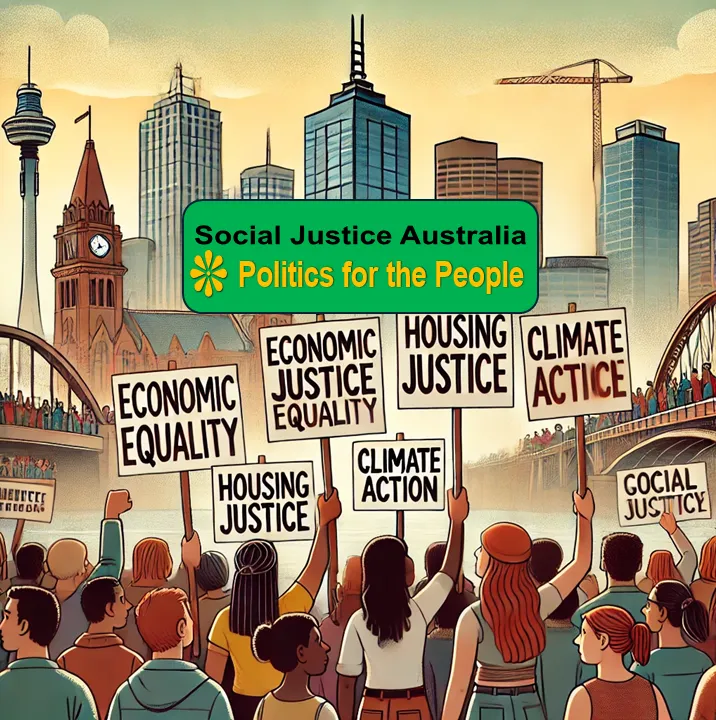
Explore social justice issues in Australia and how protecting dignity, rights, essential services and participation can build a fairer nation.
Australia has democratic institutions, considerable national wealth and highly developed public services. Yet where someone is born, their income, gender, disability, cultural background or postcode can still shape their access to housing, healthcare, education, employment and political influence.
A socially just Australia does not promise identical outcomes for everyone. It removes unfair barriers, guarantees essential rights and gives people the support required to participate on genuinely equal terms.
What Does Social Justice in Australia Mean?
Social justice is often reduced to helping disadvantaged people after hardship occurs. Its meaning is broader.
It asks whether society’s laws, institutions and resources are organised fairly. It examines who has power, who benefits from public policy, who bears the risks and whose voice is missing from important decisions.
The Australian Human Rights Commission identifies equality, non-discrimination, participation and inclusion as central elements of a human-rights-based approach.
Social justice can be understood through four closely connected principles.
Equity
Equity recognises that people begin life with different circumstances and encounter different barriers.
Treating everyone identically may preserve existing disadvantage. A person living with disability, a remote community and a wealthy metropolitan household may require different support to enjoy equal opportunities.
Equity therefore means directing resources according to need while removing structural barriers.
Access
Essential services must be practically accessible, not merely available in theory.
Healthcare is not genuinely universal if patients cannot afford gap fees or must travel hundreds of kilometres for treatment. Education is not equally accessible when poverty, disability, location or debt restricts participation.
Access includes affordability, physical availability, cultural safety and understandable information.
Participation
People should have a meaningful voice in decisions affecting their lives.
Participation requires more than voting every few years. It involves consultation, community decision-making, union representation, diverse media and genuine opportunities to influence policy.
The Australian Human Rights Commission states that participation should be active, free, meaningful and accessible. Australian Human Rights Commission
Rights
Human dignity should not depend entirely on market income.
A just society protects civil and political freedoms while also recognising the importance of housing, healthcare, education, employment security and a safe environment.
Rights require institutions, resources and accountability. Declaring a right without ensuring practical access leaves it unfulfilled.
Where Australia Falls Short
Australia has achieved major social advances, including Medicare, public education, anti-discrimination protections, compulsory superannuation and a regulated minimum wage.
Acknowledging these achievements does not require ignoring serious shortcomings. Social justice examines both progress and the people who remain excluded from it.
Economic Inequality and Material Security
Economic growth does not automatically produce social justice.
The Australian Bureau of Statistics reported that the highest wealth quintile owned 63 per cent of household wealth in 2019–20, while the lowest quintile owned less than one per cent. More recent measures confirm that household wealth remains distributed far more unequally than income.
This matters because wealth provides security and opportunity. It can generate investment income, fund education, support home ownership and protect families during illness or unemployment.
People without assets depend more heavily on wages and public services. When rents, energy and food costs rise faster than household income, they have little financial protection.
A just economic system should therefore:
- Maintain adequate wages and income support.
- Ensure taxation reduces excessive inequality.
- Provide universal essential services.
- Prevent monopolies and market concentration.
- Make housing less dependent on inherited wealth.
- Give workers a fair share of productivity gains.
The purpose is not to make everyone financially identical. It is to prevent extreme inequality from determining people’s rights, opportunities and political power.
First Nations Justice and Self-Determination
No account of social justice in Australia is complete without recognising colonisation, dispossession and the continuing disadvantage experienced by Aboriginal and Torres Strait Islander peoples.
Justice requires more than programs designed in Canberra and delivered to communities. It requires First Nations people to exercise genuine authority over policies affecting their lives.
The National Agreement on Closing the Gap recognises that Aboriginal and Torres Strait Islander people should determine, drive and own desired outcomes in partnership with governments. It contains 19 national targets across 17 outcome areas. Closing the Gap
Deaths in custody remain a profound concern. The Australian Institute of Criminology recorded 33 Indigenous deaths in custody during 2024–25—the highest annual number recorded since 1979–80. This does not mean every death had the same cause, but it reinforces the urgency of reducing over-representation and implementing effective prevention. Australian Institute of Criminology
Meaningful reform should include:
- Indigenous-led policy design and service delivery.
- Truth-telling and recognition of historical injustice.
- Stronger land, cultural and language rights.
- Community-controlled health, housing and legal services.
- Full implementation of relevant Royal Commission recommendations.
- Justice reinvestment and alternatives to unnecessary imprisonment.
- Accountability based on measurable outcomes.
Self-determination is not an optional addition to social justice. It is fundamental to it.
Housing as a Foundation of Justice
Secure housing affects health, education, employment, family stability and community participation.
At June 2025, approximately 206,000 households were on consolidated Australian social-housing waiting lists. Around 190,000 were waiting for public housing, including 77,400 households classified as being in greatest need. Australian Institute of Health and Welfare
Australia’s housing system heavily rewards ownership and investment while exposing renters to insecurity. Private development is necessary, but it cannot be expected to meet every social need because developers understandably build where returns are attractive.
Housing justice requires:
- Large-scale direct construction of public housing.
- Secure and adequately maintained public tenancies.
- Stronger protections for private renters.
- More crisis accommodation and supportive housing.
- Accessible housing for older people and people with disability.
- Tax reform that reduces speculative demand.
- Planning and infrastructure coordinated around community needs.
Housing should first be treated as a home and a basis for human dignity—not merely a financial asset.
Healthcare and Education
Medicare and public education demonstrate what collective provision can achieve. However, universal systems become less universal when access depends on location, waiting time or the ability to pay.
Healthcare inequality appears through:
- Rural and regional workforce shortages.
- Specialist and elective-treatment delays.
- Mental-health service gaps.
- Dental care remaining largely outside Medicare.
- Out-of-pocket charges.
- Unequal access to disability and aged-care services.
Education inequality develops when disadvantaged schools lack sufficient staff and resources, vocational education is weakened, or university participation creates substantial personal debt.
Social justice requires high-quality public services available according to need. Governments may use private providers, but outsourcing should never weaken accessibility, accountability or service quality.
Essential reforms include:
- Expanding the public healthcare workforce.
- Adding dental care to Medicare.
- Strengthening public hospitals and community health.
- Fully funding public schools.
- Rebuilding public TAFE.
- Providing fee-free university education.
- Ensuring disability and aged-care services prioritise dignity over profit.
Public services are not charity. They are shared institutions that allow people to participate fully in society.
Workers’ Rights and Secure Employment
Employment can provide income, identity, social connection and purpose. However, having a job does not guarantee economic security.
In August 2025, Australia had 2.4 million casual employees—approximately 19 per cent of all employees. Casual employment suits some workers, and its proportion has declined over recent years. Nevertheless, many casual workers lack guaranteed hours and paid leave. Australian Bureau of Statistics
Workplace justice requires:
- Enforceable minimum wages and conditions.
- Effective action against wage theft.
- Genuine collective-bargaining rights.
- Predictable hours where workers want them.
- Safe workplaces.
- Equal treatment of migrant workers.
- Strong apprenticeships and paid training pathways.
- A voluntary federal Job Guarantee.
A Job Guarantee could offer meaningful public employment at a socially inclusive wage to anyone ready and willing to work. It would strengthen communities while establishing an effective minimum standard for wages and conditions.
Gender Equality and Safety
Australia has made important progress towards gender equality, but substantial gaps remain.
According to ABS data reported by the Workplace Gender Equality Agency, the national full-time gender pay gap was 11.5 per cent in November 2025. This measure does not compare men and women performing the same job; it shows the broader difference in average full-time earnings across the workforce. Workplace Gender Equality Agency
Women are also more likely to perform unpaid care, work in lower-paid industries and experience interrupted employment. These patterns affect lifetime earnings, housing security and retirement income.
Gender justice requires:
- Pay transparency and enforceable equality measures.
- Proper valuation of care work.
- Accessible early-childhood education and care.
- Adequately funded domestic-violence services.
- Secure emergency and long-term housing.
- Workplace protections against harassment.
- Prevention programs addressing the causes of violence.
Safety and economic independence are closely connected. People cannot easily escape violence without income, housing and accessible support.
Refugees, Migrants and Equal Treatment
A fair society protects human dignity regardless of birthplace or visa status.
Refugees and migrants make major social, cultural and economic contributions to Australia. Yet some encounter workplace exploitation, racism, insecure residency, language barriers or difficulty accessing services.
Australia also continues to maintain regional processing arrangements. Policies intended to manage borders should still comply with human rights, procedural fairness and humane treatment.
Reform should include:
- Timely and fair assessment of protection claims.
- Community-based alternatives to prolonged detention.
- Effective safeguards against migrant-worker exploitation.
- English-language and settlement support.
- Recognition of overseas qualifications.
- Strong action against racism and discrimination.
Border policy and social justice need not be opposites. Australia can administer migration law while respecting human dignity.
Climate and Environmental Justice
Climate change is also a justice issue because its causes and consequences are distributed unevenly.
People with lower incomes generally have fewer resources to insulate homes, relocate, obtain insurance or recover from floods, fires and extreme heat. First Nations and regional communities may also experience damage to land, culture, employment and essential infrastructure.
A just transition should:
- Expand publicly owned renewable energy.
- Reduce household energy costs.
- Guarantee support and retraining for affected workers.
- Fund climate-resilient public housing.
- Strengthen disaster preparation and recovery.
- Support First Nations land management.
- Ensure communities influence major environmental decisions.
Climate action should improve daily life rather than ask households with the least capacity to carry the greatest burden.
Democracy, Representation and Accountability
Economic inequality can become political inequality.
Corporations, industry groups and wealthy individuals possess greater access to lobbyists, advertising, political donations and decision-makers than ordinary citizens. This does not prove that every policy is purchased, but it creates unequal influence and weakens public confidence.
Social justice requires democratic institutions that are transparent and responsive.
Reforms should include:
- Tighter limits on political donations and election expenditure.
- Real-time disclosure of significant donations.
- A public register of lobbyists and ministerial meetings.
- Strong freedom-of-information laws.
- Effective whistleblower protections.
- Transparent government procurement.
- Greater media diversity.
- Citizens’ assemblies on major long-term questions.
- Stronger opportunities for community participation between elections.
Democracy should give every citizen political standing—not allocate influence according to wealth.
Australia’s Dollar Sovereignty and Social Justice
Australia’s federal government issues the Australian dollar. It is not financially constrained in the same way as a household, business, local council or state government.
This gives the Commonwealth considerable capacity to fund national priorities authorised by Parliament.
However, monetary sovereignty does not mean the government can purchase unlimited goods and services without consequences. The real limits are:
- Available workers and skills.
- Materials, equipment and technology.
- Productive capacity.
- Imports and the exchange rate.
- Ecological constraints.
- Inflation.
If Australia has unemployed or underused workers and available productive resources, federal spending can bring those resources into use. If the economy lacks nurses, builders, teachers or construction materials, additional money alone will not solve the shortage and may raise prices.
Responsible public investment must therefore include workforce planning, training, infrastructure development and careful management of inflation.
Taxes remain important. They help control inflation, reduce inequality, discourage harmful activities and create economic space for public programs. But the federal government should not be compared simplistically with a household that must first earn or borrow dollars before spending.
The proper question is:
Does Australia possess—or can it develop—the workers, skills, infrastructure and natural resources required to achieve the public purpose?
Understanding Australia’s monetary sovereignty expands what is politically possible while keeping attention on the economy’s real limits.
A Practical Social Justice Program
A serious national program should:
- Guarantee secure housing through direct public construction and stronger rental protections.
- Strengthen universal public services, including Medicare, dental care, public hospitals, schools, TAFE and universities.
- Pursue full employment through public investment, training and a voluntary federal Job Guarantee.
- Support First Nations self-determination through Indigenous-led decision-making and accountable implementation.
- Reduce economic inequality through fair taxation, stronger wages and limits on monopoly power.
- Advance gender equality and safety through pay reform, care services, prevention and secure housing.
- Deliver a just climate transition led by public investment and community participation.
- Restore democratic accountability through donation, lobbying, transparency and media reforms.
These policies are not isolated expenses. Housing improves health. Education increases productive capacity. Secure work reduces poverty. Renewable energy strengthens national resilience.
Social investment can improve both justice and economic capability.
Frequently Asked Questions
What is social justice in Australia?
Social justice in Australia means protecting rights, removing unfair barriers and ensuring equitable access to housing, healthcare, education, employment and democratic participation.
What are the four main principles of social justice?
The four commonly used principles are equity, access, participation and rights. They provide a practical framework for assessing whether institutions and policies treat people fairly.
Does social justice require equal outcomes?
No. It requires fair rights, opportunities and access while recognising that different people may require different support. It also seeks to prevent extreme disadvantage and concentrated power from becoming permanent.
Is capitalism incompatible with social justice?
Markets and private enterprise can operate within strong social, democratic and environmental limits. Problems arise when profit determines access to essential services or when concentrated wealth gains excessive influence over government.
Can Australia afford social-justice reform?
The Commonwealth can authorise Australian-dollar spending, subject to its institutional and parliamentary processes. The decisive constraints are available workers, skills, materials, productive capacity and inflation.
Why is public participation important?
Policies are more legitimate and effective when affected communities help design, implement and evaluate them. Participation also prevents governments and powerful organisations from defining people’s needs without listening to them.
Social Justice in Australia Is a Democratic Choice
Australia already possesses many of the foundations of a fair society: democratic government, public institutions, skilled workers, natural resources and monetary sovereignty.
Its persistent injustices are not evidence that solutions are impossible. They show that political priorities, institutional structures and distributions of power matter.
A fair society cannot guarantee that every person will experience the same life. It can guarantee that no one is denied dignity, essential services, meaningful opportunity or a political voice because they are poor, disadvantaged or excluded from power.
Social justice in Australia is therefore not a distant ideal. It is a continuing democratic responsibility—and a practical choice about what kind of country Australians want to build.
What Do You Think?
Which principle of social justice—equity, access, participation or rights—does Australia most urgently need to strengthen?
Leave a comment below or share your experience through our Reader Feedback page.
Explore and Share
If you found this article insightful, explore more about political reform and Australia’s monetary sovereignty.
Share this article with your friends, family and community to help drive the conversation towards a more just and equal Australia.
Visit our Testimonials page to see how other readers are engaging with this work.
Support Independent Journalism
Social Justice Australia is reader-supported, advertising-free and independent.
Running the website costs approximately $2,000 annually. Reader donations have so far contributed $807 towards those expenses.
Even a small contribution helps keep this analysis freely available.
Already donated? A brief Google review can help more readers discover the site.
Sources
- Australian Human Rights Commission—Access, Equity and Human Rights
- Australian Human Rights Commission—Human Rights-Based Approaches
- National Agreement on Closing the Gap
- Australian Institute of Criminology—Deaths in Custody 2024–25
- Australian Institute of Health and Welfare—Housing Waitlists
- Australian Bureau of Statistics—Characteristics of Employment
- Workplace Gender Equality Agency—Gender Pay Gap Data