
Description
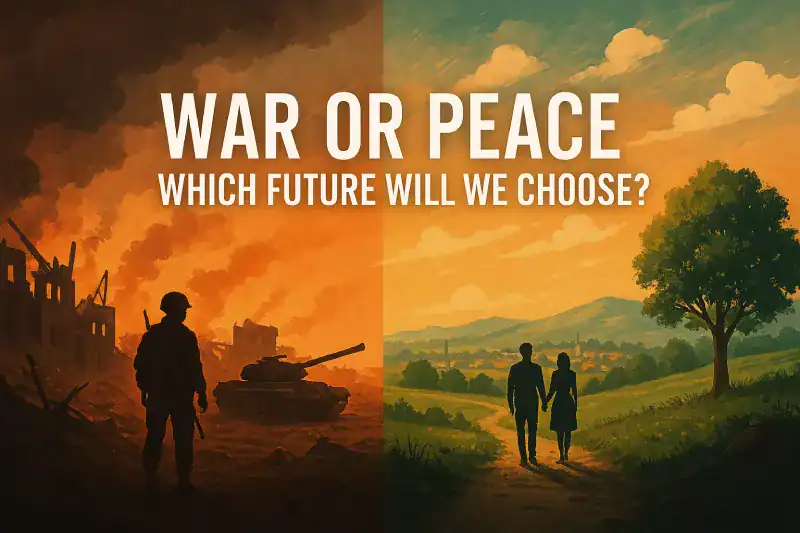
Is the world heading to war or justice? Explore the dangers ahead and discover how people power can shape a peaceful, just future.
Introduction: A Glimpse of the Future We Could Face
Location: Northern New South Wales, 2025.
A farmer, Mark, surveys his parched land. The river his family depended on for three generations has run dry.
Across the world in Ukraine, families flee bombed-out villages. In Gaza, hospitals run on backup generators, their doctors working with dwindling supplies. Meanwhile, Australia spends billions on nuclear submarines.
“Is this really the best we can do?” Mark wonders.
These are not isolated events. They are signs of a world drifting toward chaos. But amid the darkness, voices rise—from schoolyards in Sweden to protests in Sydney. This article asks the crucial question: Is the world heading to war—or can we change course?
The Problem: Is the World Heading to War or Just Falling Apart?
Military Spending Is Soaring
According to the Stockholm International Peace Research Institute (SIPRI), global military spending reached an all-time high of $2.4 trillion in 2024. Countries are arming for war, not peace.
Australia alone has committed over $368 billion to the AUKUS submarine deal, money that could have been used to fund housing, healthcare, and climate adaptation.
“They always have money for war, never for the people.” — protestor at the Sydney anti-AUKUS rally.
Climate Breakdown Accelerates Conflict
Rising temperatures are fuelling resource wars. Water scarcity, crop failures, and forced migration are intensifying tensions worldwide.
In Sudan, prolonged drought has escalated tribal violence—yet few ask, is the world heading to war over water and resources? In the Pacific, climate refugees face geopolitical battles over resettlement.
Neoliberalism and the Rise of Authoritarianism
As inequality widens, neoliberal governments shift blame, scapegoating migrants and stoking nationalism. From India to Hungary, and increasingly in Australia, we see civil liberties eroding and public discourse becoming increasingly hostile. These are fertile grounds for militarisation.
The Human Cost of a Broken System
Personal Debt, Public Apathy
Emma, a nurse in Melbourne, checks her bank balance: $52 left until payday. Her HECS debt looms large, and her rent just went up.
“Why is my government buying submarines while I can’t afford groceries?” “She wonders, is the world heading to war while ordinary people struggle just to survive?”
Thousands echo her story. Meanwhile, fossil fuel giants receive billions in subsidies and defence contracts, which enrich foreign corporations.
Indigenous Peoples Pay the Highest Price
On Wangan and Jagalingou land in Queensland, sacred sites are destroyed to make way for coal mines. The same communities face police raids and surveillance for opposing projects that harm both land and culture.
“We protect the country, they send bulldozers.” — Adrian Burragubba, Wangan and Jagalingou elder.
Youth Bear the Future’s Burden
In schoolyards and universities, hope is eroding. A generation raised amid climate chaos and political corruption is losing faith in democracy itself. But they are also fighting back through climate strikes, mutual aid, and protests.
The Groundswell of People Power
Global Movements for Peace and Justice

In response to the growing fear that the world is heading to war, movements like Extinction Rebellion, Black Lives Matter, and First Nations-led campaigns in Australia are reshaping the conversation.
They’re not just resisting war and injustice, they’re building alternatives: regenerative economies, cooperative housing, and community-led food systems.
Modern Monetary Theory: A Path Forward for Australia
Modern Monetary Theory (MMT) shows that, as a sovereign currency issuer, Australia can fund any project it chooses, without needing to raise taxes or borrow from markets. A government with dollar sovereignty is constrained not by money, but by real resources and political will.
“We can afford peace. We can afford justice. What we can’t afford is more war.” — Dr. Steven Hail, economist and MMT advocate.
Redirecting funds from militarism to social infrastructure could fund:
• A universal job guarantee
• Free public education and healthcare
• Large-scale renewable energy
• A national public housing program
Australia’s Role in Building a Peaceful Region
Instead of being a pawn in US military strategy, Australia could lead peacebuilding in the Asia-Pacific. By investing in diplomacy, cultural exchange, and climate cooperation, we strengthen national security through regional stability, rather than relying on bombs.
What Future Will We Choose?
We stand at a global crossroads. The forces of destruction—militarism, climate collapse, and corporate greed—are real. But so is the resistance. Communities worldwide are waking up, demanding a future that honours life.
Australia has the tools: our dollar sovereignty, our democratic voice, our rich lands and diverse people. The question is whether we will use them to build peace or continue down the path of war.
Is the world heading to war? Not if we decide otherwise.
Q&A: What People Are Asking
Q1: Isn’t military spending necessary for national security?
Only if we define security as weapons. Proper security means housing, food, education, health, and diplomacy. War makes us less safe.
Q2: How can Australia afford peace-building investments?
Thanks to Modern Monetary Theory, we understand that Australia, as a currency issuer, doesn’t need to “find” money; it requires political will. We can afford to fund what matters.
Q3: What can individuals do?
Support peace organisations, vote for independent or minor candidates committed to justice, learn about MMT, and speak out. Share articles. Start conversations. Every voice counts.
Q4: Why does it feel like the world is spiralling into chaos?
Because people are rightly asking, is the world heading to war, and seeing too few leaders choose diplomacy over destruction?
Call to Action: Join the Movement for a Just Future
Curious what others think? Please read what our readers are saying on our Reader Testimonials page.
If you found this article insightful, you can explore more on political reform and Australia’s monetary sovereignty at Social Justice Australia:
👉 https://socialjusticeaustralia.com.au/
Share this article with your community to help drive the conversation toward a more just and equal society.
Click on our Reader Feedback page: https://socialjusticeaustralia.com.au/reader-feedback/. Please let us know how our content has inspired you.
Submit your testimonial and help shape the conversation today!
If you value our work, please leave a quick Google Review here and help others discover us: https://g.page/r/Cf72h_5fXcalEBM/review
Support Social Justice Australia – Help Keep This Platform Running
Social Justice Australia is committed to delivering independent, in-depth analysis of critical issues affecting Australians. Unlike corporate-backed media, we rely on our readers to sustain this platform.
If you find value in our content, consider making a small donation to help cover the costs of hosting, maintenance, and continued research. No matter how small, every contribution makes a real difference in keeping this site accessible and ad-free.
💡 Your support helps:
• ✅ Keep this website running without corporate influence
• ✅ Fund research and publishing of articles that challenge the status quo
• ✅ Expand awareness of policies that affect everyday Australians
💰 A one-time or monthly donation ensures Social Justice Australia stays a strong, independent voice.
🔗 Donate Now: https://socialjusticeaustralia.com.au/donation/
Thank you for being part of this movement for truth and justice.