
Description
Why Australia manufacturing decline happened and how policy choices reshaped jobs, costs, and national resilience.
Introduction – A Nation That Once Made Things
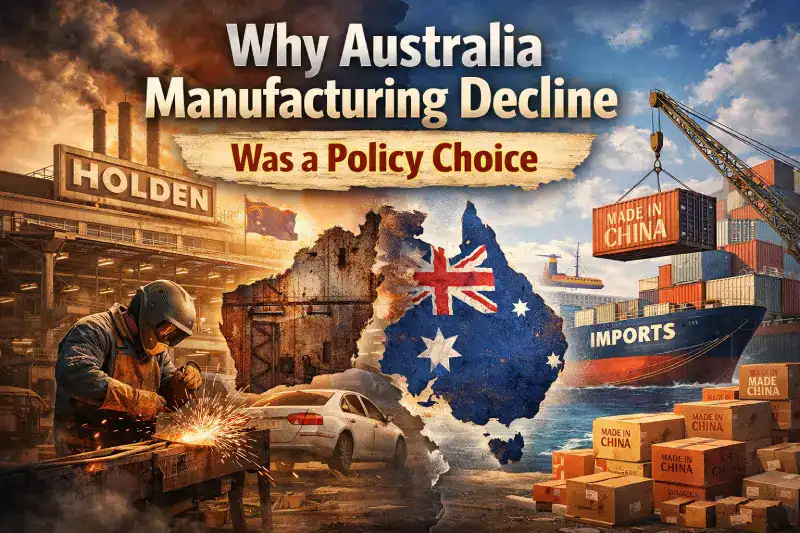
Australia manufacturing decline did not happen overnight. It unfolded over decades, reshaping the country from a nation that built cars, textiles, and machinery into one that imports much of what it uses.
For many Australians, this shift is not abstract. It is seen in lost industries, fewer stable jobs, and growing reliance on overseas supply chains.
The Problem – Policy Choices, Not Inevitable Change
1. Tariff Cuts and Industry Abandonment
From the 1980s, successive governments reduced tariffs and opened Australia to global competition. Advice from bodies like the Productivity Commission promoted efficiency and free trade.
While this lowered prices for some imports, it also exposed local industries to competition they were not supported to withstand.
2. Governments Choosing Imports Over Local Jobs
Public procurement increasingly favoured cheaper overseas goods. Instead of strengthening local manufacturing, policy settings often prioritised short-term cost savings over long-term capability.
The Impact – What Australians Are Experiencing
3. Job Loss, Wage Pressure, Regional Decline
The closure of Holden and Ford Australia symbolised a broader trend.
Manufacturing jobs, once a backbone of middle-income security, declined sharply. Regions that depended on these industries experienced long-term economic stress. When major factories closed, entire local economies were affected. Workers who lost stable, well-paid manufacturing jobs often struggled to find equivalent employment, especially in regional areas where alternative industries were limited.
Small businesses such as cafés, retail stores, and local service providers also suffered as household incomes fell and spending declined. Over time, this led to rising unemployment, reduced property values, and fewer opportunities for younger people, many of whom were forced to leave their communities to find work elsewhere.
The loss of manufacturing did not just remove jobs. It weakened the economic foundation of these regions. Skills built over generations were lost, local supply chains disappeared, and communities that once had a clear economic purpose were left trying to rebuild without the same level of support or investment.
4. Corporate Gains vs Public Losses
Global corporations received help from lower production costs offshore. Meanwhile, Australia lost industrial depth, increasing reliance on imports funded by public money circulating through the economy.
The Cause – The Ideology Behind the Shift
5. Rise of Economic Rationalism
Economic reforms focused on deregulation, privatisation, and reducing the role of government in industry development. The assumption was that markets would allocate resources efficiently.
6. The Myth of Efficiency
While imports appeared cheaper, hidden costs appeared:
- Loss of skills and innovation.
- Supply chain vulnerability.
- Reduced economic resilience.
The Solution – What Must Be Done
7. Strategic Industry Policy
Countries like the US and Germany now actively support domestic manufacturing. Australia can do the same by treating industry as a strategic asset.
8. Policy Solutions and Demands
- Prioritise local manufacturing in government procurement.
- Invest in advanced manufacturing sectors.
- Rebuild vocational training pathways.
- Support regional industry hubs.
Frequently Asked Questions
Why did manufacturing leave Australia?
Policy decisions, including tariff reductions and lack of industry support, made local production less competitive.
Can manufacturing return to Australia?
Yes, with targeted investment and strategic policy, industries can be rebuilt.
Is Australia too expensive to manufacture goods?
Not necessarily. Productivity, technology, and policy support can offset higher labour costs.
Final Thoughts – Rebuilding What Was Lost
Australia manufacturing decline was not inevitable. It was shaped by decisions that prioritised short-term efficiency over long-term national capability.
The opportunity now is to recognise those choices and chart a different path—one that rebuilds resilience, supports jobs, and strengthens the economy.
What’s Your Experience?
Have you seen the effects of Australia manufacturing decline in your local area or work life?
Call to Action
If this article helped you better understand how Australia really works, do not leave it here. Please share it with others who are asking the same questions.
Your voice matters. Your experience matters. And your participation matters.
➡ Share this article with family, friends, and your community
➡ Leave a comment below and join the discussion
➡ Visit the Reader Feedback page and share your view
➡ Share a testimonial if our content has helped you think differently
➡ Connect with us on TikTok, LinkedIn and X
Discuss this article in our Facebook group, where Australians share perspectives and ask questions in a calm, respectful space.
A more informed Australia begins with people willing to discuss the issues that shape our future. You can help lead that change.
Support independent journalism
Operating this site costs approximately $2,000 per year, and reader donations have covered $807 so far. Every contribution helps keep this work online, accessible, and independent.
If you find value in these articles, please consider supporting the site. Even a few dollars help keep this work going.
Donate now, one time or monthly.
Already donated? A quick Google review helps others discover the site.
References
Australian Bureau of Statistics: Manufacturing statistics
Reserve Bank of Australia: Structural change
Department of Foreign Affairs and Trade: Trade policy